Review
. 2015 Nov;90(4):1279-97.
doi: 10.1111/brv.12157. Epub 2014 Nov 25.

The role of skeletal-muscle-based thermogenic mechanisms in vertebrate endothermy

Affiliations
Review

The role of skeletal-muscle-based thermogenic mechanisms in vertebrate endothermy

Leslie A Rowland et al. Biol Rev Camb Philos Soc. 2015 Nov.

Abstract

Thermogenesis is one of the most important homeostatic mechanisms that evolved during vertebrate evolution. Despite its importance for the survival of the organism, the mechanistic details behind various thermogenic processes remain incompletely understood. Although heat production from muscle has long been recognized as a thermogenic mechanism, whether muscle can produce heat independently of contraction remains controversial. Studies in birds and mammals suggest that skeletal muscle can be an important site of non-shivering thermogenesis (NST) and can be recruited during cold adaptation, although unequivocal evidence is lacking. Much research on thermogenesis during the last two decades has been focused on brown adipose tissue (BAT). These studies clearly implicate BAT as an important site of NST in mammals, in particular in newborns and rodents. However, BAT is either absent, as in birds and pigs, or is only a minor component, as in adult large mammals including humans, bringing into question the BAT-centric view of thermogenesis. This review focuses on the evolution and emergence of various thermogenic mechanisms in vertebrates from fish to man. A careful analysis of the existing data reveals that muscle was the earliest facultative thermogenic organ to emerge in vertebrates, long before the appearance of BAT in eutherian mammals. Additionally, these studies suggest that muscle-based thermogenesis is the dominant mechanism of heat production in many species including birds, marsupials, and certain mammals where BAT-mediated thermogenesis is absent or limited. We discuss the relevance of our recent findings showing that uncoupling of sarco(endo)plasmic reticulum Ca(2+)-ATPase (SERCA) by sarcolipin (SLN), resulting in futile cycling and increased heat production, could be the basis for NST in skeletal muscle. The overall goal of this review is to highlight the role of skeletal muscle as a thermogenic organ and provide a balanced view of thermogenesis in vertebrates.

Keywords: SR calcium transport; brown adipose tissue; endothermy; skeletal muscle; thermogenesis.


Figures

Fig. 1
Fig. 1
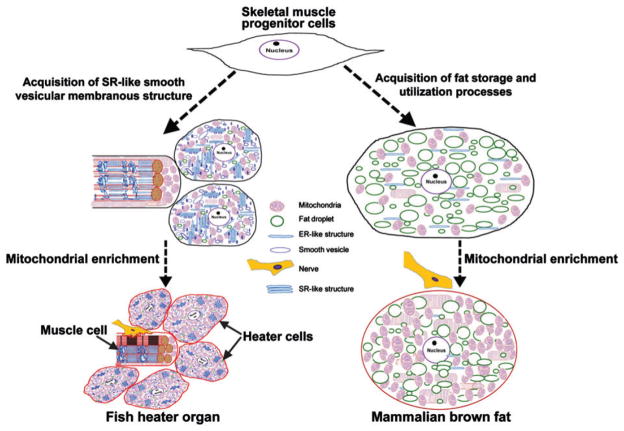
Modification of the skeletal muscle lineage during evolution to acquire a non-shivering thermogenic function. Electron microscopy of the heater organ from various fishes has shown that the sarcoplasmic reticulum (SR) network [with SR Ca2+-ATPase (SERCA), Ca2+ release channel (CRC) and Ca2+-buffering proteins] and mitochondria act in partnership to produce heat (Block & Franzini-Armstrong, 1988; O’Brien & Block, 1996; Londraville et al., 2000; Morrissette et al., 2003). This suggests that during evolution, skeletal muscle progenitor cells must have adapted by decreasing the expression of myofibrillar proteins to give rise to a new cell type that ultimately became heater cells of the fish heater organ. It can be speculated that among mammals, brown adipose tissue (BAT), which is functionally analogous to the fish heater organ, followed a similar evolutionary path. By acquiring more prominent fatty acid uptake, storage, and utilization processes and mitochondrial enrichment, a skeletal-muscle-like progenitor cell could have evolved into a BAT-progenitor cell type that would ultimately become modern (eutherian) BAT cells. Recent findings that skeletal muscle and BAT share a common cellular origin (see Fig. 4) provide support for this scenario. ER, endoplasmic reticulum.
Fig. 2
Fig. 2
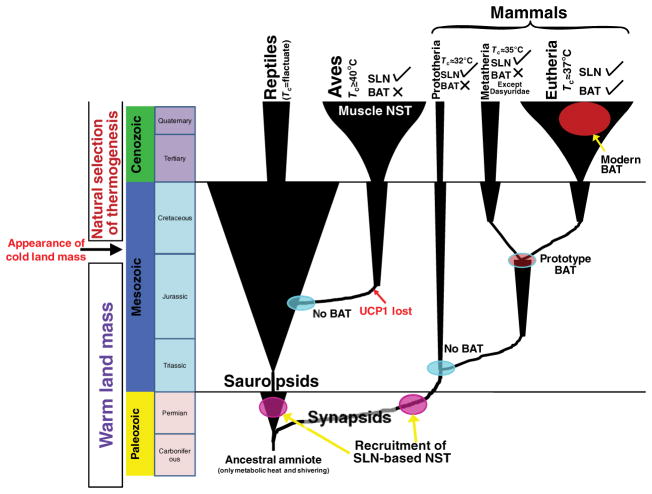
Proposed scheme illustrating the evolution of brown adipose tissue (BAT) and muscle-based thermogenesis that contributed to vertebrate endothermic homeothermy. The common ancestor of amniotes must have been bradymetabolic with metabolic heat (with or without the ability to shiver) as the only source of endothermic heat production. With the appearance of an erect posture (which appeared independently in many sauropsid and synapsid lineages in the mid-to-late Permian) among early amniotes, continuously recruited postural muscles would have provided a feasible molecular environment for sarcolipin (SLN)-based muscle non-shivering thermogenesis (NST) to be recruited. Many of the sauropsid lineages relied on muscle hyperplasia (birds and some dinosaurs) (Newman, 2011), which would have had a twofold benefit: bigger muscles that equated to faster locomotion and better chase/escape ability as well as greater cumulative heat production. An aerial mode of locomotion (i.e. flying) is accompanied by muscle hyperplasia, eliminating the need for additional thermogenic mechanisms. The synapsids took a different route to homeothermy that did not rely primarily on muscle hyperplasia. BAT-based NST has largely been attributed to a eutherian innovation that enabled utilization of uncoupling protein 1 (UCP1) for heat production. However, recent findings have identified the presence of a primitive BAT in a single metatherian species. According to palaeontological evidence, the divergence between Metatheria and Eutheria took place in the Late Jurassic, suggesting that UCP1 presumably was not recruited for thermogenesis until just before metatherian/eutherian divergence. Hence, SLN and UCP1 must have been recruited for thermogenesis at very different time frames in the evolutionary history of vertebrates. The evolution of BAT among mammals also overlaps the evolution of viviparity, which occurred between the prototherian–therian and metatherian–eutherian divergence events. It is interesting to note that birds and monotremes (that lack BAT) are completely oviparous, while only therian mammals (that have BAT) are viviparous. Therefore, BAT may have aided the survival of viviparous newborns, where skeletal muscle is often not fully developed at birth. However, the role of BAT (which can influence the energy trade-off between the neonate and parent) in the evolution of viviparity has not been studied.
Fig. 3
Fig. 3
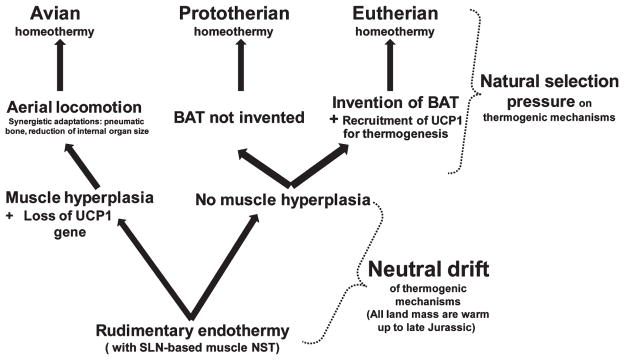
The evolution of two routes of vertebrate homeothermy in mammals. The common ancestor of synapsids and sauropsids must have recruited sarcolipin (SLN)-based muscle non-shivering thermogenesis (NST) achieving a rudimentary level of endothermy. However, for muscle-based NST to be used to achieve homeothermy, the muscle mass to body mass ratio would have to be increased, which only birds achieved. Evolution of thermogenic mechanisms might not have had a selective evolutionary advantage until the appearance of colder climatic niches in the Cretaceous; under this scenario most endothermic mechanisms would have been evolving more or less under neutral drift (because a minimal thermogenic need can be achieved by sustaining an elevated metabolic rate). Ancestral mammals (the common ancestor of Metatheria and Eutheria) evolved brown adipose tissue (BAT) possibly in the Jurassic; the Prototheria do not have this tissue. Thereafter, mammals possessing two adaptive thermogenic processes will have utilized and fine-tuned them according to the demands of their particular environmental/ecological niche.
Fig. 4
Fig. 4
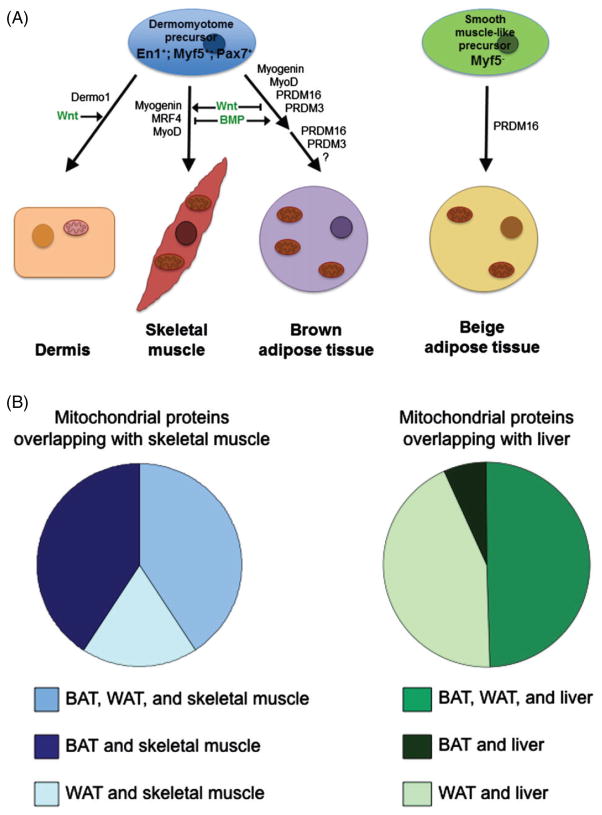
Skeletal muscle and brown adipose tissue share a common cellular lineage. (A) Lineage tracing analyses show that En1, Pax7, and Myf5-expressing cells of the dermomyotome of the paraxial mesoderm are tripotent, giving rise to dermis, skeletal muscle, and brown adipose tissue. Dermis develops from the dermomyotome near the surface ectoderm, and its differentiation is dependent on the expression of Dermo1 and Wnt signalling from the ectoderm (Atit et al., 2006; Gensch et al., 2008; Lepper & Fan, 2010). Skeletal muscle and brown adipose tissue develop from the medial dermomyotome. Skeletal muscle differentiation is initiated by the sequential expression of myogenin, myogenic regulatory factor (MRF4), and myogenic determination factor (MyoD) and by spatiotemporal Wnt signalling from the ectoderm and neural tube (Francetic & Li, 2011; von Maltzahn et al., 2012). Early brown adipose tissue precursors express the myogenic transcription factors myogenin and MyoD but downregulate them upon terminal differentiation (Timmons et al., 2007). Brown fat specification is regulated by expression of PR domain-containing 16 (PRDM16), or the functionally redundant PRDM3 (Harms et al., 2014), and BMP (4 and 7) signalling further directs brown fat differentiation by inhibiting MyoD and Myf5 expression and promoting adipogenesis (Kajimura, Seale & Spiegelman, 2010; Francetic & Li, 2011). Furthermore, Wnt signalling inhibits adipogenesis, promoting skeletal muscle specification (von Maltzahn et al., 2012). Due to common transcription factors (myogenin and MyoD) found in early brown fat and skeletal muscle precursors, it seems possible that the dermomyotome initially gives rise to two cell types rather than three: dermal precursors and a common skeletal muscle/brown fat precursor, which further differentiates into skeletal muscle and brown fat. Details of this process have not been elucidated. The development of beige adipose and white adipose tissue is much less clear. Beige adipose tissue develops from a separate lineage to skeletal muscle and classical brown adipose tissue. Beige fat arises from Myf5-negative precursors of the smooth muscle lineage, and its differentiation is directed by PRDM16 (Cohen et al., 2014; Long et al., 2014). Because smooth muscle develops from heterogeneous cellular lineages (i.e. neural crest, proepicardium, mesothelium, etc.), beige fat may have multiple developmental origins that are depot-specific (Majesky, 2007; Long et al., 2014). White adipose tissue also has diverse cellular origins, developing from ectoderm and mesoderm, including neural crest (ectoderm), mesenchyme (lateral mesoderm), dermis, etc. (Billon & Dani, 2012; Wojciechowicz et al., 2013). (B) Mitochondria are the energetic workhorses of cells; therefore, their properties match the metabolic requirements and/or demand of the cell type. The mitochondrial proteomes of brown adipose tissue (BAT) and white adipose tissue (WAT) were compared to the mitochondrial proteomes of skeletal muscle and liver. A large portion of the proteomes of WAT and BAT overlapped, which mostly included proteins integral to basic mitochondrial structure and function. The mitochondrial proteome of BAT closely resembles that of skeletal muscle. Both are enriched in proteins involved in catabolic processes such as lipolysis, fatty acid metabolism, citric acid cycle, etc. On the other hand, WAT mitochondria share a similar mitochondrial protein profile with liver. WAT mitochondria, in contrast to BAT mitochondria, are specialized for anabolic functions including lipogenesis and detoxification processes. Adapted from Forner et al. (2009)
Fig. 5
Fig. 5
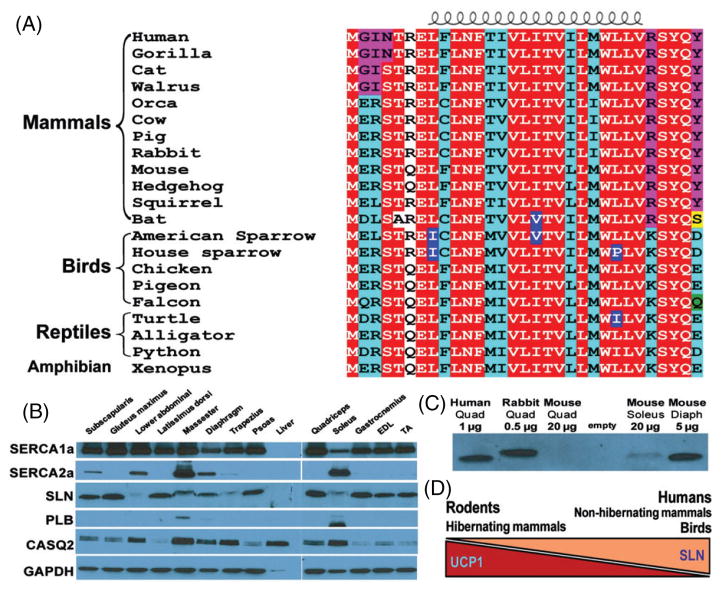
Sarcolipin (SLN) is evolutionarily conserved and is abundant in large mammals. (A) Alignment of SLN protein sequences from various vertebrates. SLN is highly conserved among vertebrate species. Importantly, the transmembrane and C-terminal domains, responsible for inhibition of sarco(endo)plasmic reticulum Ca2+ ATPase (SERCA), are remarkably conserved from amphibians to humans. The N-terminal region has unique conservation among different vertebrate groups; however, the physiological relevance of these unique residues has yet to be studied. All sequences were obtained from GenBank. The house sparrow (Passer domesticus) sequence was obtained, by our laboratory (L.A. Rowland and N.C. Bal), by DNA cloning from the pectoralis muscle and is highly homologous to the published SLN sequence of the American sparrow (Zonotrichia albicollis). The function of SLN in avian species is yet to be investigated. (B) Analyses of SLN and SERCA expression in rabbit skeletal muscle. SLN is abundantly expressed in most skeletal muscle tissues, whereas the homologous protein, phospholamban (PLB), is only found in slow muscles. CASQ2, calsequestrin; EDL, extensor digitorum longus; TA, tibialis anterior. (C) Expression of SLN in large mammals, including humans and dogs (Vangheluwe et al., 2005; Babu et al., 2007), is significantly greater than in rodents. SLN protein is detectable in 0.5 and 1.0 μg of rabbit and human quadriceps muscles, respectively, but is not detectable in 20 μg mouse quadriceps. In mouse muscles where SLN protein is detectable (soleus and diaphragm), total SLN content is still significantly lower than in rabbit and human muscle. Quad, quadriceps; Diaph, diaphragm. (D) Proposed model showing relative contributions of uncoupling protein 1 (UCP1) and SLN to thermogenesis in birds and mammals. We propose that in adult humans, birds, and other non-hibernating mammals, SLN-based muscle thermogenesis constitutes the largest component of thermogenesis, whereas in rodents and hibernating mammals, UCP1 (BAT) is the dominant heat producer. Tissues used to generate (B) and (C) were approved by the institutional animal care committee and institutional review board.

References

    1. Alexander G, Bennett JW, Gemmell RT. Brown adipose tissue in the new-born calf (Bos taurus) Journal of Physiology. 1975;244:223–234. - PMC - PubMed
    1. Anunciado-Koza RP, Zhang J, Ukropec J, Bajpeyi S, Koza RA, Rogers RC, Cefalu WT, Mynatt RL, Kozak LP. Inactivation of the mitochondrial carrier SLC25A25 (ATP-Mg2+/Pi transporter) reduces physical endurance and metabolic efficiency in mice. Journal of Biological Chemistry. 2011;286:11659–11671. - PMC - PubMed
    1. Arruda AP, Da-Silva WS, Carvalho DP, De Meis L. Hyperthyroidism increases the uncoupled ATPase activity and heat production by the sarcoplasmic reticulum Ca2+ —ATPase. Biochemical Journal. 2003;375:753–760. - PMC - PubMed
    1. Arruda AP, Ketzer LA, Nigro M, Galina A, Carvalho DP, de Meis L. Cold tolerance in hypothyroid rabbits: role of skeletal muscle mitochondria and sarcoplasmic reticulum Ca2+ ATPase isoform 1 heat production. Endocrinology. 2008;149:6262–6271. - PubMed
    1. Arruda AP, Nigro M, Oliveira GM, de Meis L. Thermogenic activity of Ca2+ —ATPase from skeletal muscle heavy sarcoplasmic reticulum: the role of ryanodine Ca2+ channel. Biochimica et Biophysica Acta. 2007;1768:1498–1505. - PubMed