AKI in low-risk versus high-risk patients in intensive care
- PMID: 25424992
- PMCID: PMC4317734
- DOI: 10.2215/CJN.03200314
AKI in low-risk versus high-risk patients in intensive care
Abstract
Background and objectives: AKI in critically ill patients is usually part of multiorgan failure. However, nonrenal organ failure may not always precede AKI and patients without evidence of these organ failures may not be at low risk for AKI. This study examined the risk and outcomes associated with AKI in critically ill patients with and without cardiovascular or respiratory organ failures at presentation to the intensive care unit (ICU).
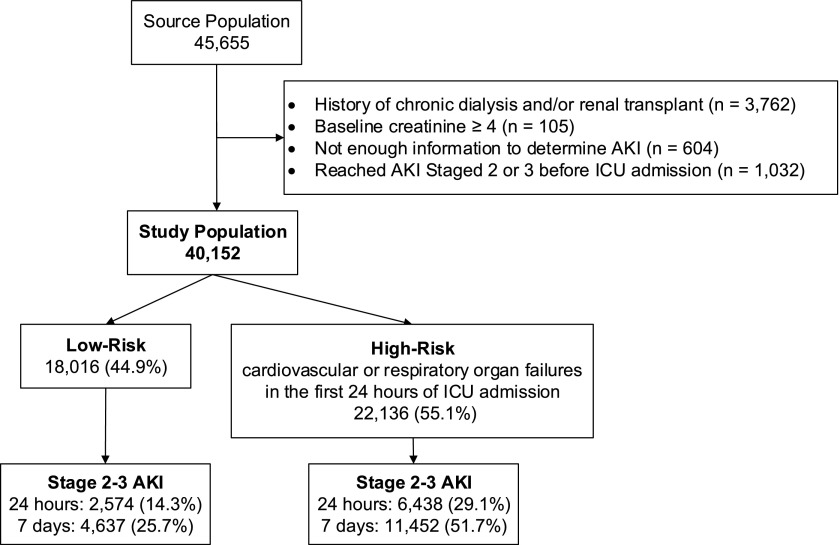
Design, setting, participants, & measurements: A large, academic medical center database, with records from July 2000 through October 2008, was used and the authors identified a low-risk cohort as patients without cardiovascular and respiratory organ failures defined as not receiving vasopressor support or mechanical ventilation within the first 24 hours of ICU admission. AKI was defined using Kidney Disease Improving Global Outcomes criteria. The primary end points were moderate to severe AKI (stages 2-3) and risk-adjusted hospital mortality.
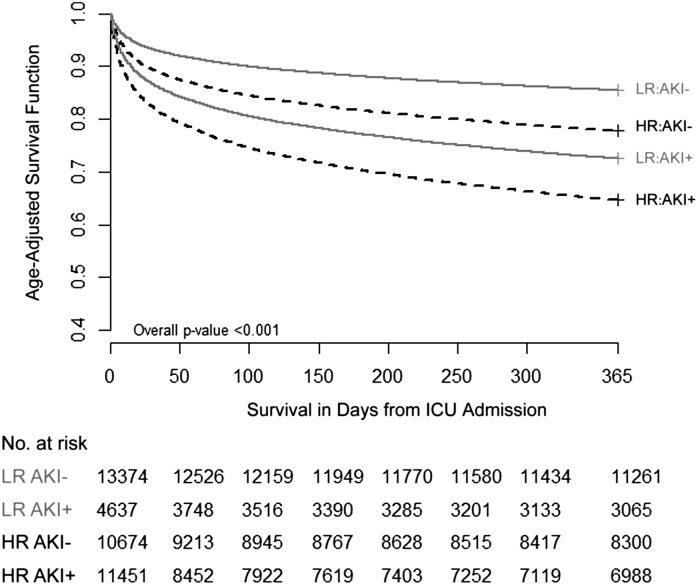
Results: Of 40,152 critically ill patients, 44.9% received neither vasopressors nor mechanical ventilation on ICU day 1. Stages 2-3 AKI occurred less frequently in the low-risk patients versus high-risk patients within 24 hours (14.3% versus 29.1%) and within 1 week (25.7% versus 51.7%) of ICU admission. Patients developing AKI in both risk groups had higher risk of death before hospital discharge. However, the adjusted odds of hospital mortality were greater (odds ratio, 2.99; 95% confidence interval, 2.62 to 3.41) when AKI occurred in low-risk patients compared with those with respiratory or cardiovascular failures (odds ratio, 1.19; 95% confidence interval, 1.09 to 1.3); interaction P<0.001.
Conclusions: Patients admitted to ICU without respiratory or cardiovascular failure have a substantial likelihood of developing AKI. Although survival for low-risk patients is better than for high-risk patients, the relative increase in mortality associated with AKI is actually greater for low-risk patients. Strategies aimed at preventing AKI should not exclude ICU patients without cardiovascular or respiratory organ failures.
Keywords: kidney disease; mortality; outcomes.
Copyright © 2015 by the American Society of Nephrology.
Figures
References
-
- Murugan R, Karajala-Subramanyam V, Lee M, Yende S, Kong L, Carter M, Angus DC, Kellum JA, Genetic and Inflammatory Markers of Sepsis (GenIMS) Investigators : Acute kidney injury in non-severe pneumonia is associated with an increased immune response and lower survival. Kidney Int 77: 527–535, 2010 - PMC - PubMed
-
- Kidney Disease Improving Global Outcomes Acute Kidney Injury Work Group : KDIGO clinical practice guideline for acute kidney injury. Kidney Int Suppl 2: 1–138, 2012
-
- MacLeod A: NCEPOD report on acute kidney injury-must do better. Lancet 374: 1405–1406, 2009 - PubMed
-
- Vincent JL, Moreno R, Takala J, Willatts S, De Mendonça A, Bruining H, Reinhart CK, Suter PM, Thijs LG, Working Group on Sepsis-Related Problems of the European Society of Intensive Care Medicine : The SOFA (Sepsis-related Organ Failure Assessment) score to describe organ dysfunction/failure. Intensive Care Med 22: 707–710, 1996 - PubMed
-
- Yount R, Vries J, Councill C: The Medical Archival System: An information retrieval system based on distributed parallel. Inf Process Manage 27: 379–389, 1991
Publication types
MeSH terms
Grants and funding
LinkOut - more resources
Full Text Sources
Other Literature Sources
Medical