Review
. 2014 Nov 26;21(1):103.
doi: 10.1186/s12929-014-0103-1.

Improving clinical efficacy of adeno associated vectors by rational capsid bioengineering

Affiliations
Review

Improving clinical efficacy of adeno associated vectors by rational capsid bioengineering

Dwaipayan Sen. J Biomed Sci. .

Abstract

Adeno associated vectors (AAV) have shown considerable promise to treat various genetic disorders in both preclinical and clinical settings mainly because of its safety profile. However, efficient use of AAV to deliver genes in immune-competent sites like muscles and liver requires very high doses which are associated with concomitant cellular immune response against the viral capsids leading to destruction of the transduced cells. Coupled with that, there are enough evidences that at high doses, AAV particles are subjected to increased cellular phosphorylation/uniquitination leading to proteasome mediated degradation and loss of the viral particles. The presence of preexisting immunity against AAV further adds on to the problem which is acting as a major roadblock to efficiently use it as a gene therapy vector in the clinics. To overcome this, rational bioengineering of AAV capsid becomes a prime tool by which specific amino acid residue(s) can be suitably modified/replaced by compatible residue(s) to create vectors having lower host immune response and higher intracellular trafficking rate. This article reviews the various aspects of rationally designing AAV capsids like by site-directed mutagenesis, directed evolution and combinatorial libraries which can create vectors having not only immune evasive property but also enhanced gene expression and transduction capability. One or more combinations of these strategies have strong potential to create novel vectors which will have suitable clinical efficiency even at a low dose.


Figures
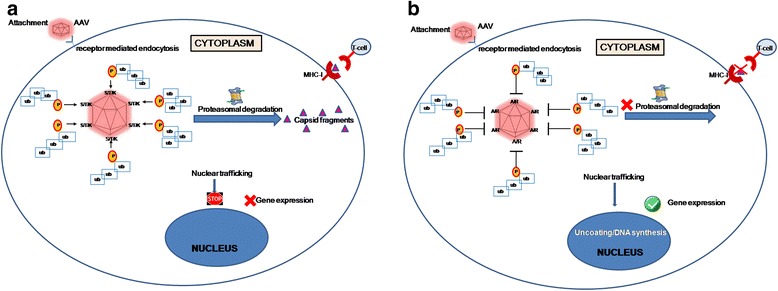
Figure 1
Figure 1
Targeted mutation of S/T/K residues on AAV capsid. Following cellular internalization of AAV by receptor-mediated endocytosis, it travels through the cytosol, undergoes acidification in the endosomes before getting released. Post endosomal escape, AAV undergoes nuclear trafficking, where uncoating of the viral capsid takes place resulting in release of its genome and induction of gene expression (a) S/T/K residues are potential sites for phosphorylation and subsequent poly-ubiquitination which serves as a cue for proteasomal degradation of capsid proteins. This prevents trafficking of the vectors into the nucleus to express its transgene leading to low gene expression. Also, the proteasomally degraded capsid fragments can be presented by the MHC-Class I molecules on the cell surface for CD8 + T-cell recognition. This leads to immune response thus destroying the transduced cells and further reducing persistent transgene expression. (b) Point mutations, S/T to A and K to R, prevents/reduces phosphorylation sites on the capsid. This leads to reduced ubiquitination and proteosomal degradation allowing more number of intact vectors to enter nucleus and express the transgene. Preventing/lowering the overall capsid degradation also reduces antigen presentation to T cells resulting in lower host immune response against the vectors. ub- ubiquitination, p- phophorylation.

References

    1. Gao G, Vandenberghe LH, Alvira MR, Lu Y, Calcedo R, Zhou X, Wilson JM. Clades of Adeno-associated viruses are widely disseminated in human tissues. J Virol. 2004;78:6381–6388. doi: 10.1128/JVI.78.12.6381-6388.2004. - DOI - PMC - PubMed
    1. Bell P, Moscioni AD, McCarter RJ, Wu D, Gao G, Hoang A, Sanmiguel JC, Sun X, Wivel NA, Raper SE, Furth EE, Batshaw ML, Wilson JM. Analysis of tumors arising in male B6C3F1 mice with and without AAV vector delivery to liver. Mol Ther. 2006;14:34–44. doi: 10.1016/j.ymthe.2006.03.008. - DOI - PubMed
    1. Schlehofer JR. The tumor suppressive properties of adeno-associated viruses. Mutat Res. 1994;305:303–313. doi: 10.1016/0027-5107(94)90250-X. - DOI - PubMed
    1. Srivastava A, Lusby EW, Berns KI. Nucleotide sequence and organization of the adeno-associated virus 2 genome. J Virol. 1983;45:555–564. - PMC - PubMed
    1. Pereira DJ, McCarty DM, Muzyczka N. The adeno-associated virus (AAV) Rep protein acts as both a repressor and an activator to regulate AAV transcription during a productive infection. J Virol. 1997;71:1079–1088. - PMC - PubMed
