


Optic nerve sheath diameter as a marker for evaluation and prognostication of intracranial pressure in Indian patients: An observational study
- PMID: 25425840
- PMCID: PMC4238090
- DOI: 10.4103/0972-5229.144015
Optic nerve sheath diameter as a marker for evaluation and prognostication of intracranial pressure in Indian patients: An observational study
Abstract
Background and aims: The aim was to evaluate efficacy of optic nerve sheath diameter (ONSD) by ultrasound as a noninvasive method for detecting raised intracranial pressure (ICP) in intensive care unit, to compare with computed tomography/magnetic resonance imaging (MRI) findings of raised ICP and to prognosticate ONSD value with treatment.
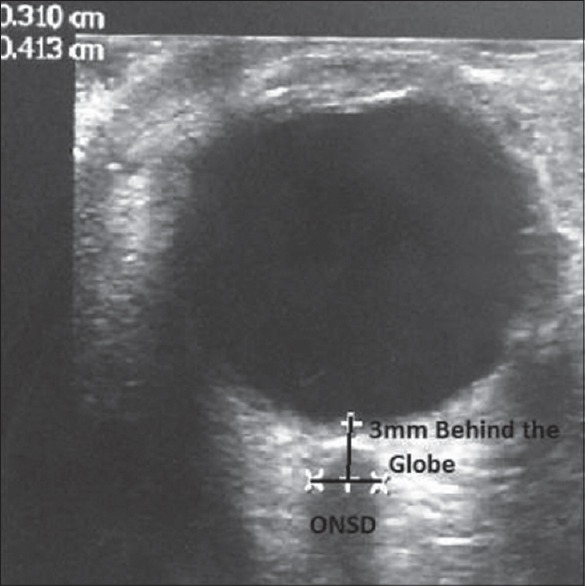
Materials and methods: We conducted a prospective, observational study on 101 adults by including 41 healthy individuals in group A as control and 60 patients in group B admitted with fever, headache, vomiting, and altered sensorium. We examined them in supine position using 10 MHz linear array probe on closed eyelid. ONSD was measured 3 mm behind the globe in each eye. A mean binocular ONSD > 4.6 mm in female and 4.8 mm in male was considered abnormal. Midline shift, edema, effacement or ONSD > 5.0 mm on T2 MRI suggestive of elevated ICP was used to evaluate ONSD accuracy.
Results: Group A mean ONSD was 4.6 mm in females and 4.8 mm in males. Group B mean ONSD for 17 females was 5.103 ± 0.6221 mm (P = 0.002) and for 43 males 5.081 ± 0.5799 mm (P = 0.032). Radiological sign of raised ICP was confirmed in 35 patients (females = 11 and males = 24) with high ONSD value. Sensitivity of detecting raised ICP by ONSD was 84.6% in females and 75% in males while specificity was 100% in both genders. Out of 25 patients without radiological signs of raised ICP 10 patients showed high ONSD (females = 4.735 mm and males = 4.907 mm). ONSD was well prognosticated with treatment modalities.
Conclusion: Bedside ocular ultrasonography for measuring ONSD can be used an early test for diagnosing raised ICP as it is a noninvasive, cost effective bedside test, which can be repeated for re-evaluation.
Keywords: Computed tomography; intensive care unit; magnetic resonance imaging; mannitol; optic nerve sheath diameter; raised intracranial pressure; ultrasonography.
Conflict of interest statement
Figures



References
-
- Vahedi K, Hofmeijer J, Juettler E, Vicaut E, George B, Algra A, et al. Early decompressive surgery in malignant infarction of the middle cerebral artery: A pooled analysis of three randomised controlled trials. Lancet Neurol. 2007;6:215–22. - PubMed
-
- Ware AJ, D'Agostino AN, Combes B. Cerebral edema: A major complication of massive hepatic necrosis. Gastroenterology. 1971;61:877–84. - PubMed
-
- Quagliarello V, Scheld WM. Bacterial meningitis: Pathogenesis, pathophysiology, and progress. N Engl J Med. 1992;327:864–72. - PubMed
-
- Pedersen M, Brandt CT, Knudsen GM, Ostergaard C, Skinhøj P, Frimodt-Møller N, et al. Cerebral blood flow autoregulation in early experimental S. pneumoniae meningitis. J Appl Physiol (1985) 2007;102:72–8. - PubMed
LinkOut - more resources
Full Text Sources
Other Literature Sources
Medical