


Producing gestures facilitates route learning
- PMID: 25426624
- PMCID: PMC4245190
- DOI: 10.1371/journal.pone.0112543
Producing gestures facilitates route learning
Abstract
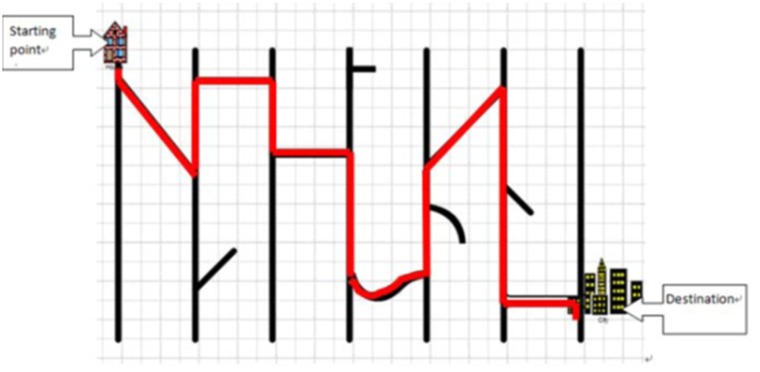
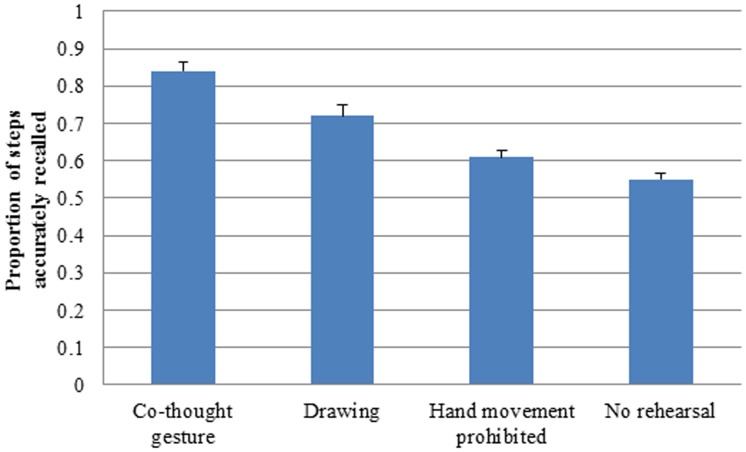
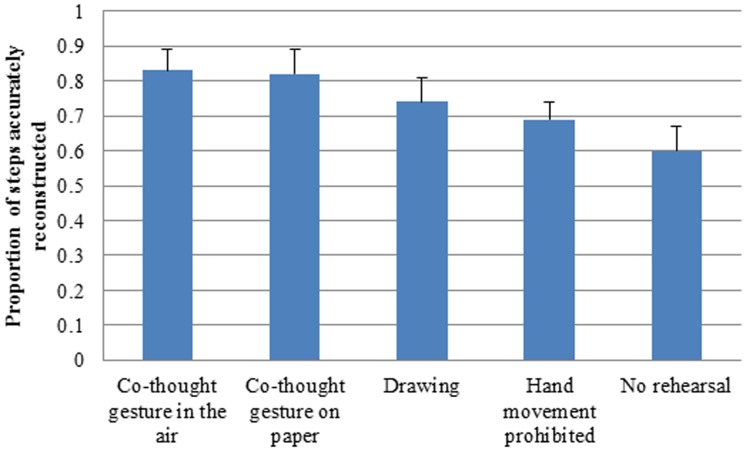
The present study investigates whether producing gestures would facilitate route learning in a navigation task and whether its facilitation effect is comparable to that of hand movements that leave physical visible traces. In two experiments, we focused on gestures produced without accompanying speech, i.e., co-thought gestures (e.g., an index finger traces the spatial sequence of a route in the air). Adult participants were asked to study routes shown in four diagrams, one at a time. Participants reproduced the routes (verbally in Experiment 1 and non-verbally in Experiment 2) without rehearsal or after rehearsal by mentally simulating the route, by drawing it, or by gesturing (either in the air or on paper). Participants who moved their hands (either in the form of gestures or drawing) recalled better than those who mentally simulated the routes and those who did not rehearse, suggesting that hand movements produced during rehearsal facilitate route learning. Interestingly, participants who gestured the routes in the air or on paper recalled better than those who drew them on paper in both experiments, suggesting that the facilitation effect of co-thought gesture holds for both verbal and nonverbal recall modalities. It is possibly because, co-thought gesture, as a kind of representational action, consolidates spatial sequence better than drawing and thus exerting more powerful influence on spatial representation.
Conflict of interest statement
Figures
References
-
- Nunez R, Lakoff G (1998) What did Weierstrass really define? The cognitive structure of natural and continuity. Math Cogn 4:85–101.
-
- Barsalou LW (1999) Perceptual symbol systems. Behav Brain Sci 22:577–660. - PubMed
-
- Glenberg AM (1997) What memory is for. Behav Brain Sci 20:1–55. - PubMed
-
- Humphreys LG, Lubinski D, Yao G (1993) Utility of predicting group membership: Exemplified by the role of spatial visualization for becoming an engineer, physical scientist, or artist. J Appl Psychol 78:250–261. - PubMed
-
- Brunyé TT, Rapp DN, Taylor HA (2008) Representational flexibility and specificity following spatial descriptions of real world environments. Cognition 108:418–443. - PubMed
Publication types
MeSH terms
LinkOut - more resources
Full Text Sources
Other Literature Sources
