


Smoking and life expectancy among HIV-infected individuals on antiretroviral therapy in Europe and North America
- PMID: 25426809
- PMCID: PMC4284008
- DOI: 10.1097/QAD.0000000000000540
Smoking and life expectancy among HIV-infected individuals on antiretroviral therapy in Europe and North America
Erratum in
- AIDS. 2015 Sep 10;29(14):1909
Abstract
Background: Cardiovascular disease and non-AIDS malignancies have become major causes of death among HIV-infected individuals. The relative impact of lifestyle and HIV-related factors are debated.
Methods: We estimated associations of smoking with mortality more than 1 year after antiretroviral therapy (ART) initiation among HIV-infected individuals enrolled in European and North American cohorts. IDUs were excluded. Causes of death were assigned using standardized procedures. We used abridged life tables to estimate life expectancies. Life-years lost to HIV were estimated by comparison with the French background population.
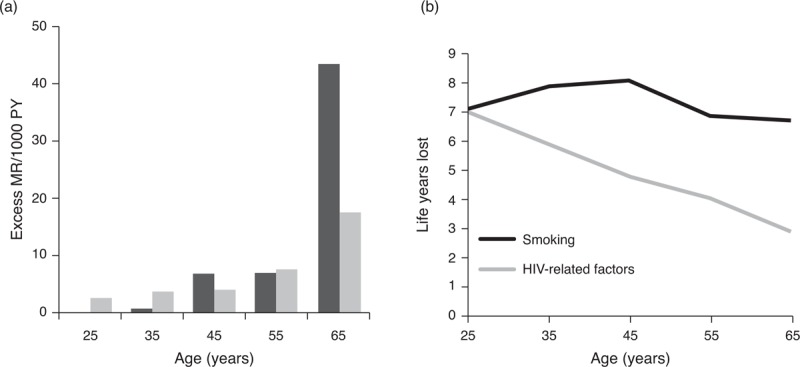
Results: Among 17,995 HIV-infected individuals followed for 79,760 person-years, the proportion of smokers was 60%. The mortality rate ratio (MRR) comparing smokers with nonsmokers was 1.94 [95% confidence interval (95% CI) 1.56-2.41]. The MRRs comparing current and previous smokers with never smokers were 1.70 (95% CI 1.23-2.34) and 0.92 (95% CI 0.64-1.34), respectively. Smokers had substantially higher mortality from cardiovascular disease, non-AIDS malignancies than nonsmokers [MRR 6.28 (95% CI 2.19-18.0) and 3.31 (95% CI 1.80-5.45), respectively]. [corrected]. Among 35-year-old HIV-infected men, the loss of life-years associated with smoking and HIV was 7.9 (95% CI 7.1-8.7) and 5.9 (95% CI 4.9-6.9), respectively. The life expectancy of virally suppressed, never-smokers was 43.5 years (95% CI 41.7-45.3), compared with 44.4 years among 35-year-old men in the background population. Excess MRRs/1000 person-years associated with smoking increased from 0.6 (95% CI -1.3 to 2.6) at age 35 to 43.6 (95% CI 37.9-49.3) at age at least 65 years.
Conclusion: Well treated HIV-infected individuals may lose more life years through smoking than through HIV. Excess mortality associated with smoking increases markedly with age. Therefore, increases in smoking-related mortality can be expected as the treated HIV-infected population ages. Interventions for smoking cessation should be prioritized.
Figures
References
-
- Lim SS, Vos T, Flaxman AD, Danaei G, Shibuya K, Adair-Rohani H, et al. A comparative risk assessment of burden of disease and injury attributable to 67 risk factors and risk factor clusters in 21 regions, 1990–2010: a systematic analysis for the Global Burden of Disease Study 2010. Lancet 2012; 380:2224–2260. - PMC - PubMed
-
- Palella FJ, Jr, Delaney KM, Moorman AC, Loveless MO, Fuhrer J, Satten GA, et al. Declining morbidity and mortality among patients with advanced human immunodeficiency virus infection. HIV Outpatient Study Investigators. N Engl J Med 1998; 338:853–860. - PubMed
-
- Vittinghoff E, Scheer S, O’Malley P, Colfax G, Holmberg SD, Buchbinder SP. Combination antiretroviral therapy and recent declines in AIDS incidence and mortality. J Infect Dis 1999; 179:717–720. - PubMed
-
- Sackoff JE, Hanna DB, Pfeiffer MR, Torian LV. Causes of death among persons with AIDS in the era of highly active antiretroviral therapy: New York City. Ann Intern Med 2006; 145:397–406. - PubMed
-
- Hasse B, Ledergerber B, Furrer H, Battegay M, Hirschel B, Cavassini M, et al. Morbidity and aging in HIV-infected persons: the Swiss HIV cohort study. Clin Infect Dis 2011; 53:1130–1139. - PubMed
Publication types
MeSH terms
Grants and funding
LinkOut - more resources
Full Text Sources
Other Literature Sources
Medical
Molecular Biology Databases
