


PET-PCR method for the molecular detection of malaria parasites in a national malaria surveillance study in Haiti, 2011
- PMID: 25428550
- PMCID: PMC4289323
- DOI: 10.1186/1475-2875-13-462
PET-PCR method for the molecular detection of malaria parasites in a national malaria surveillance study in Haiti, 2011
Abstract
Background: Recently, a real-time PCR assay known as photo-induced electron transfer (PET)-PCR which relies on self-quenching primers for the detection of Plasmodium spp. and Plasmodium falciparum was described. PET-PCR assay was found to be robust, and easier to use when compared to currently available real-time PCR methods. The potential of PET-PCR for molecular detection of malaria parasites in a nationwide malaria community survey in Haiti was investigated.
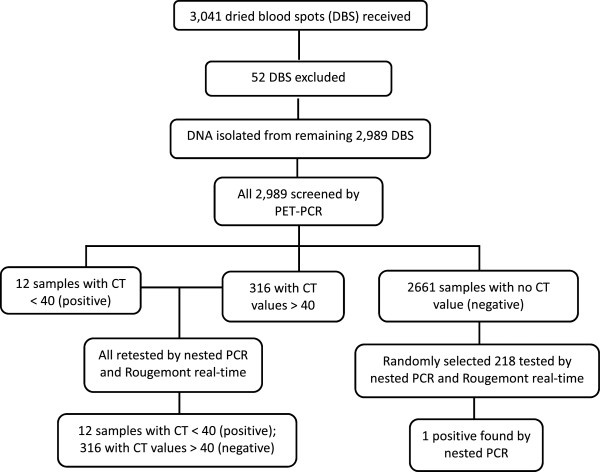
Methods: DNA from the dried blood spots was extracted using QIAGEN methodology. All 2,989 samples were screened using the PET-PCR assay in duplicate. Samples with a cycle threshold (CT) of 40 or less were scored as positive. A subset of the total samples (534) was retested using a nested PCR assay for confirmation. In addition, these same samples were also tested using a TaqMan-based real-time PCR assay.
Results: A total of 12 out of the 2,989 samples screened (0.4%) were found to be positive by PET-PCR (mean CT value of 35.7). These same samples were also found to be positive by the nested and TaqMan-based methods. The nested PCR detected an additional positive sample in a subset of 534 samples that was not detected by either PET-PCR or TaqMan-based PCR method.
Conclusion: While the nested PCR was found to be slightly more sensitive than the PET-PCR, it is not ideal for high throughput screening of samples. Given the ease of use and lower cost than the nested PCR, the PET-PCR provides an alternative assay for the rapid screening of a large number of samples in laboratory settings.
References
-
- WHO . Guidelines for the Treatment of Malaria. Guidelines for the Treatment of Malaria. 2. Geneva: World Health Organization; 2010.
-
- WHO . Towards Quality Testing of Malaria Rapid Diagnostic Tests: Evidence and Methods. Geneva: World Health Organization; 2006. Proceedings of the WHO Informal Consultation on Development and Methods for Testing Malaria Rapid Diagnostic Tests.
-
- Mens P, Spieker N, Omar S, Heijnen M, Schallig H, Kager PA. Is molecular biology the best alternative for diagnosis of malaria to microscopy? A comparison between microscopy, antigen detection and molecular tests in rural Kenya and urban Tanzania. Trop Med Int Health. 2007;12:238–244. - PubMed
-
- Waitumbi JN, Gerlach J, Afonina I, Anyona SB, Koros JN, Siangla J, Ankoudinova I, Singhal M, Watts K, Polhemus ME, Vermeulen NM, Mahoney W, Steele M, Domingo GJ. Malaria prevalence defined by microscopy, antigen detection, DNA amplification and total nucleic acid amplification in a malaria-endemic region during the peak malaria transmission season. Trop Med Int Health. 2011;16:786–793. doi: 10.1111/j.1365-3156.2011.02773.x. - DOI - PubMed
Publication types
MeSH terms
Substances
LinkOut - more resources
Full Text Sources
Other Literature Sources
Medical
Miscellaneous
