Review
. 2015 Mar;89(5):2462-8.
doi: 10.1128/JVI.02744-14. Epub 2014 Nov 26.

Interferon-induced Ifit proteins: their role in viral pathogenesis

Affiliations
Review

Interferon-induced Ifit proteins: their role in viral pathogenesis

Volker Fensterl et al. J Virol. 2015 Mar.

Abstract

A major component of the protective antiviral host defense is contributed by the intracellular actions of the proteins encoded by interferon-stimulated genes (ISGs); among these are the interferon-induced proteins with tetratricopeptide repeats (IFITs), consisting of four members in human and three in mouse. IFIT proteins do not have any known enzyme activity. Instead, they inhibit virus replication by binding and regulating the functions of cellular and viral proteins and RNAs. Although all IFITs are comprised of multiple copies of the degenerate tetratricopeptide repeats, their distinct tertiary structures enable them to bind different partners and affect host-virus interactions differently. The recent use of Ifit knockout mouse models has revealed novel antiviral functions of these proteins and new insights into the specificities of ISG actions. This article focuses on human and murine IFIT1 and IFIT2 by reviewing their mechanisms of action, their critical roles in protecting mice from viral pathogenesis, and viral strategies to evade IFIT action.


Figures

FIG 1
FIG 1
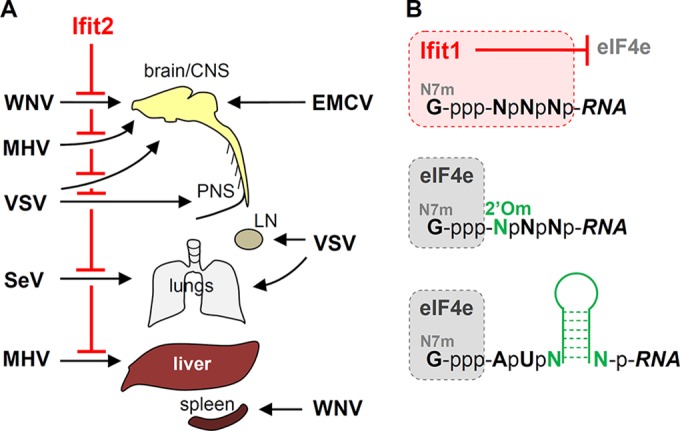
Functions of murine Ifit2 and Ifit1 in viral pathogenesis. (A) Ifit2 protects specific tissues from specific viruses (left) and has no effects on others (right). CNS, central nervous system; PNS, peripheral nervous system; LN, lymph node. (B) Viral strategies to evade Ifit1's antiviral activity. Ifit1 binds to the capped 5′ ends of viral mRNAs if the caps have no 2′-O-methylation and inhibits their translation by blocking the access of eIF4e to the mRNAs. Many viral mRNAs evade the inhibition by 2′-O-methylating their mRNA caps (2′Om), whereas others use RNA hairpin structures, near their 5′ ends, to prevent the access of Ifit1 to the mRNA caps.

References

    1. Muller U, Steinhoff U, Reis LF, Hemmi S, Pavlovic J, Zinkernagel RM, Aguet M. 1994. Functional role of type I and type II interferons in antiviral defense. Science 264:1918–1921. doi:10.1126/science.8009221. - DOI - PubMed
    1. Broz P, Monack DM. 2013. Newly described pattern recognition receptors team up against intracellular pathogens. Nat Rev Immunol 13:551–565. doi:10.1038/nri3479. - DOI - PubMed
    1. Fensterl V, Sen GC. 2009. Interferons and viral infections. BioFactors 35:14–20. doi:10.1002/biof.6. - DOI - PubMed
    1. Der SD, Zhou A, Williams BR, Silverman RH. 1998. Identification of genes differentially regulated by interferon alpha, beta, or gamma using oligonucleotide arrays. Proc Natl Acad Sci U S A 95:15623–15628. doi:10.1073/pnas.95.26.15623. - DOI - PMC - PubMed
    1. Schoggins JW, Rice CM. 2011. Interferon-stimulated genes and their antiviral effector functions. Curr Opin Virol 1:519–525. doi:10.1016/j.coviro.2011.10.008. - DOI - PMC - PubMed

Publication types