. 2015 Jan 1;194(1):438-45.
doi: 10.4049/jimmunol.1401344. Epub 2014 Nov 26.

Tumoral expression of IL-33 inhibits tumor growth and modifies the tumor microenvironment through CD8+ T and NK cells

Affiliations

Tumoral expression of IL-33 inhibits tumor growth and modifies the tumor microenvironment through CD8+ T and NK cells

Xin Gao et al. J Immunol. .

Abstract

Cancer immunotherapy has shown great promise as a new standard cancer therapeutic modality. However, the response rates are limited for current approach that depends on enhancing spontaneous antitumor immune responses. Therefore, increasing tumor immunogenicity by expressing appropriate cytokines should further improve the current immunotherapy. IL-33 is a member of the IL-1 family of cytokines and is released by necrotic epithelial cells or activated innate immune cells and is thus considered a "danger" signal. The role of IL-33 in promoting type 2 immune responses and tissue inflammation has been well established. However, whether IL-33 drives antitumor immune responses is controversial. Our previous work established that IL-33 promoted the function of CD8(+) T cells. In this study, we showed that the expression of IL-33 in two types of cancer cells potently inhibited tumor growth and metastasis. Mechanistically, IL-33 increased numbers and IFN-γ production by CD8(+) T and NK cells in tumor tissues, thereby inducing a tumor microenvironment favoring tumor eradication. Importantly, IL-33 greatly increased tumor Ag-specific CD8(+) T cells. Furthermore, both NK and CD8(+) T cells were required for the antitumor effect of IL-33. Moreover, depletion of regulatory T cells worked synergistically with IL-33 expression for tumor elimination. Our studies established "alarmin" IL-33 as a promising new cytokine for tumor immunotherapy through promoting cancer-eradicating type 1 immune responses.


Figures

Figure 1
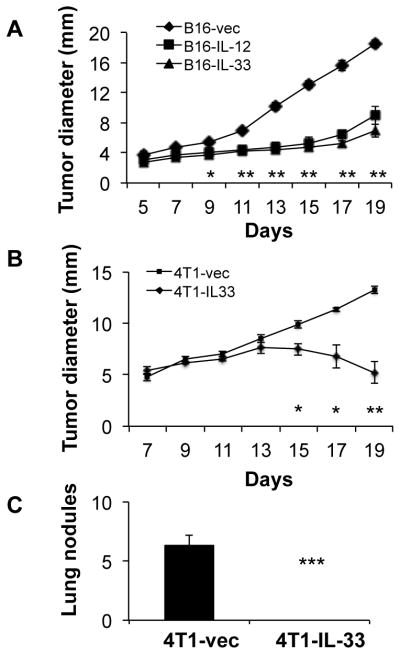
Figure 1. Expression of IL-33 in tumor cell lines inhibited tumor growth and metastasis in vivo
(A) 2×10⁵ B16-vector (B16), B16-IL-12, or B16-IL-33 cells were injected intradermally into B6 mice and the size of the tumor was monitored every two days. Data (mean ±SEM) are representative of three independent experiments. Five mice were in each group. ** P<0.01,*** P<0.001, determined by Mann-Whitney Test. Comparison was performed between the B16-vec and B16-IL-33 groups. (B) 1×10⁵ 4T1-vector or 4T1-IL-33 cells were injected into the mammary fat pad of BALB/c mice and the size of the tumor was monitored every two days. Data (mean ±SEM) are representative of three independent experiments. Five mice were in each group. ** P<0.01,*** P<0.001, determined by Mann-Whitney Test. (C) Metastatic tumor nodules in the lung were quantified 30 days post 4T1 and 4T1-IL-33 tumor inoculation. Data (mean ±SEM) are representative of three independent experiments. Five mice were in each group. ** P<0.01,*** P<0.001, determined by Mann-Whitney Test.
Figure 2
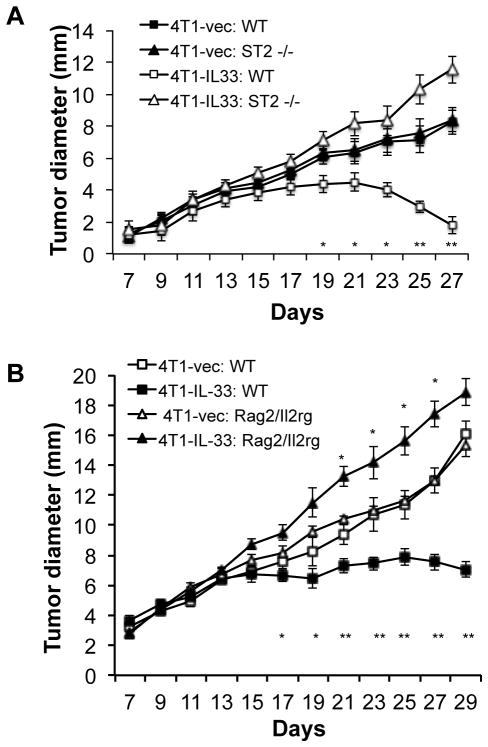
Figure 2. The antitumor effect of IL-33 is dependent on ST2 signaling and lymphocytes
(A) 1×10⁵ 4T1-vector or 4T1-IL-33 cells were injected into the mammary fat pad of BALB/c and ST2−/− mice and the size of the tumor was monitored every two days. Data (mean ±SEM) are representative of three independent experiments. Five mice were in each group. * P<0.05, **P<0.01, determined by Mann-Whitney Test. Significance difference was found between 4T1-IL-33: WT and 4T1: WT groups. (B) 1×10⁵ 4T1-vector or 4T1-IL-33 cells were injected into the mammary fat pad of BALB/c and Rag2−/−IL2rg−/− mice and the size of the tumor was monitored every two days. Data (mean ±SEM) are representative of three independent experiments. Five mice were in each group. * P<0.05, **P<0.01, determined by Mann-Whitney Test. Significant difference was found between 4T1-IL-33: WT and 4T1: WT groups as well as between 4T1-IL-33: Rag2 −/− IL2rg −/− and 4T1: Rag2 −/− IL2rg −/− groups.
Figure 3
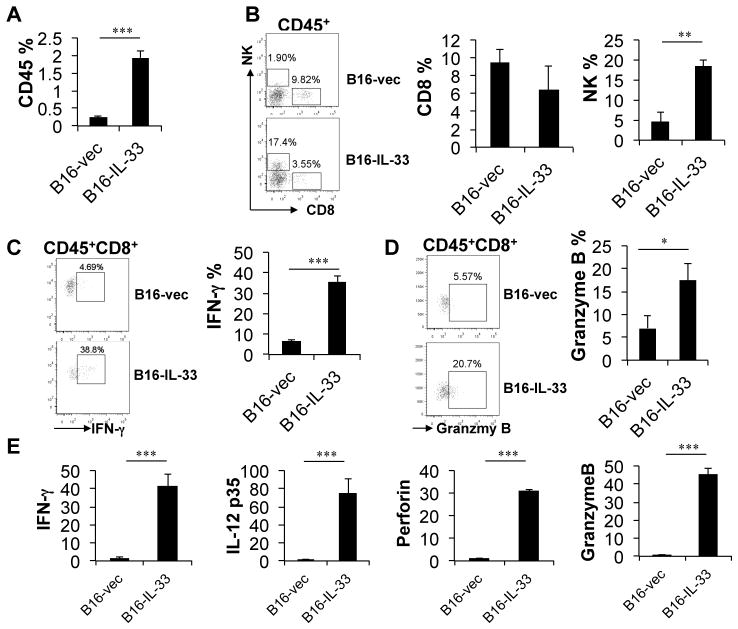
Figure 3. Expression of IL-33 in B16 cells enhanced type 1 immune responses in the tumor microenvironment
2×10⁵ B16-vector or B16-IL-33 cells were injected i.d. into B6 mice. On day 10, tumors were resected and processed to generate single cell suspension. (A) Percentages of CD45+ cells in tumor cell suspension. (B) Flow cytometric plots showing NK and CD8+ T cells in tumor and percentage of CD8+ or NK1.1+ cells within the CD45+ population. (C) Representative flow cytometric plots showing IFNγ+CD8+ T cells in tumor and percentage of IFNγ+ cells in CD8+ TILs. (D) Representative flow cytometric plots showing Granzyme B+CD8+ T cells in tumor and percentage of Granzyme B+ cells in CD8+ TILs. (E) Quantitative RNA analysis of IFNγ, IL-12, perforin and granzyme B in B16-IL-33 tumors compared to B16 control tumors. Results are mean ± SEM of three independent experiments. ** P<0.01 and *** P<0.001, two-tailed unpaired Student’s t-test.
Figure 4
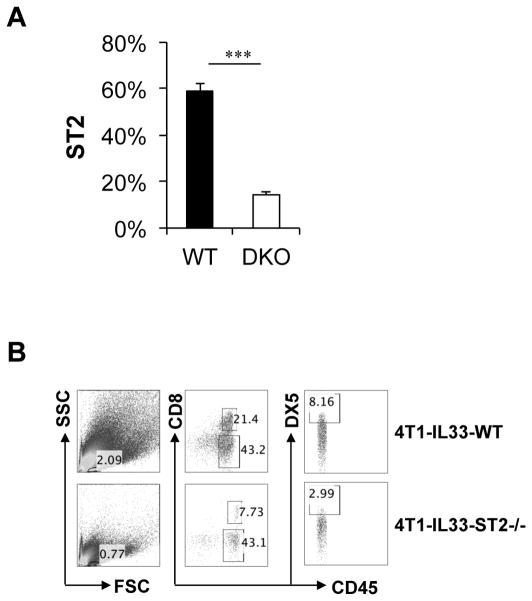
Figure 4. ST2 expression was regulated by T-bet and Eomes in vivo and required for CD8+ T cells and NK cell infiltration of IL-33-expressing tumors
(A) 2×10⁵ B16-IL-33 cells were injected i.d. into B6 and T-bet−/− Eomes−/− (DKO) mice. 20 days after inoculation, tumors were harvested and processed to generate a single cell suspension. The surface expression of ST2 was analyzed by flow cytometry. Results are mean ±SEM of three independent experiments. ***P<0.001, two-tailed unpaired Student’s t-test. (B) 1×10⁵ 4T1-vector or 4T1-IL-33 cells were injected into the mammary fat pad of BALB/c and ST2−/− mice. 20 days after inoculation, tumors were harvested and processed to generate a single cell suspension. Representative flow cytometric plots showing CD8+ T and NK cells in tumor (TIL).
Figure 5
Figure 5. NK and CD8+ T cells as well as IFNγ and perforin were required for the antitumor effect of IL-33
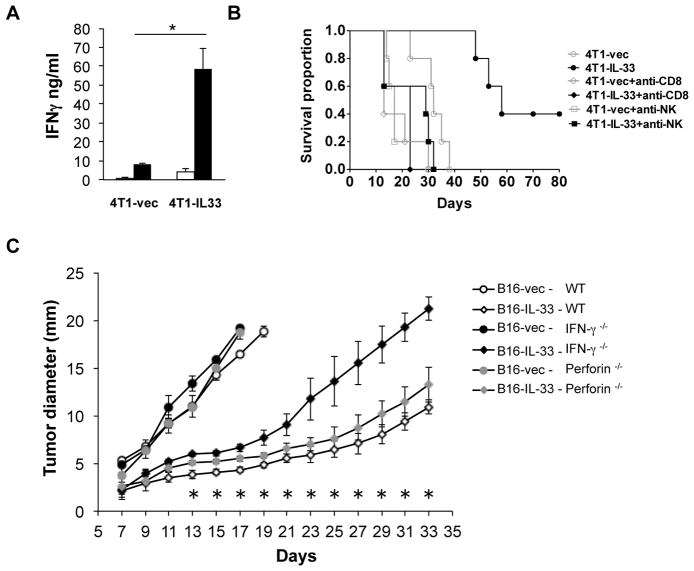
(A) 1×10⁵ 4T1-vector or 4T1-IL-33 cells were injected into the mammary fat pad of BALB/c mice. 30 days after inoculation, CD8+ T cells were purified from the spleens of these mice and re-stimulated with irradiated 4T1 cells for 72h. The level of IFNγ was then measured by ELISA. Results are mean ±SEM of three independent experiments. *P<0.05, two-tailed unpaired Student’s t-test. (B) Mice were inoculated i.d. with 1×10⁵ 4T1 tumor cells (n = 5). These mice were injected intraperitoneally with anti-CD8, or anti-asialo GM1 antibodies, or control IgG four times before and after tumor inoculation (day -2, 1, 7, 14). Kaplan-Meier survival curves are shown and the Log-Rank test was performed. P=0.0018. (C) 2×10⁵ B16-vector or B16-IL-33 cells were injected i.d. into WT B6, IFNγ−/− B6 or perforin−/− B6 mice and the size of the tumor was monitored every two days. Tumor diameters (mean ±SEM) were presented here. Five mice were in each group. * P<0.05, determined by Mann-Whitney Test. Comparison was performed between the B16-IL-33: WT and B16-IL-33: IFNγ−/− groups. The difference between the B16-IL-33: WT and B16-IL-33: perforin−/− groups was significance from days 13 to 19.
Figure 6
Figure 6. IL-33 regulated tumor associated myeloid cells and upregulated MHC II on tumor associated myeloid cells
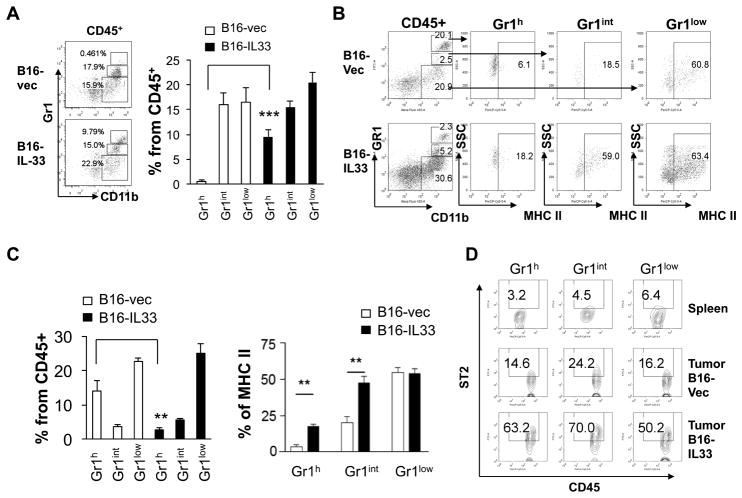
2×10⁵ B16-vector or B16-IL-33 cells were injected i.d. into B6 mice. On day 10 or 20, tumors were resected and processed to generate a single cell suspension. (A) Representative flow cytometric analysis of CD11b+ sub-populations and percentages of CD11b+ subpopulations within CD45+ cells on day 10. (B) Representative flow cytometric analysis of CD11b+ sub-populations on day 20. (C) Percentages of CD11b+ subpopulations in CD45+ cells and percentages of MHC class II expression on three CD11b+ sub-populations. Results are mean ±SEM of three independent experiments. (D) Surface ST2 expression on Gr1high CD11b+, Gr1int CD11b+, and Gr1low CD11b+ cells from spleen and tumor. Results are mean ±SEM of three independent experiments. **P<0.01 and ***P<0.001, two-tailed unpaired Student’s t-test.
Figure 7
Figure 7. Synergistic effect of IL-33 expression and depletion of Treg for eliminating tumors
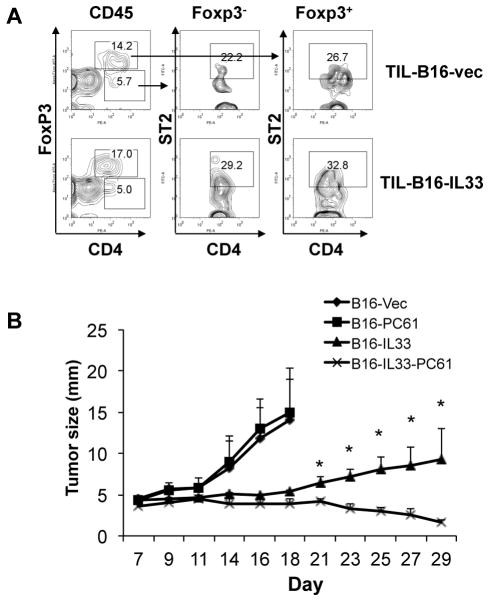
(A) Representative flow cytometric analysis of ST2 on Foxp3+CD4+ and Foxp3-CD4+ in B16 tumor and B16-IL-33 tumor. (B) B6 mice were injected with control Rat IgG or PC61, 200 μg per mouse twice a week. One week after antibody injection, 2×10⁵ B16-vector (B16) or B16-IL-33 cells were injected i.d. into these mice. Tumor sizes were measured every two days. Tumor diameters (mean ±SEM) were presented here. Five mice were in each group. * P<0.05, determined by Mann-Whitney Test. Comparison was performed between B16-IL-33 and PC61 B16-IL-33 groups.

References

    1. Dunn GP, Bruce AT, Ikeda H, Old LJ, Schreiber RD. Cancer immunoediting: from immunosurveillance to tumor escape. Nat Immunol. 2002;3:991–998. - PubMed
    1. Finn OJ. Cancer immunology. The New England journal of medicine. 2008;358:2704–2715. - PubMed
    1. Rosenberg SA, Yang JC, Sherry RM, Kammula US, Hughes MS, Phan GQ, Citrin DE, Restifo NP, Robbins PF, Wunderlich JR, Morton KE, Laurencot CM, Steinberg SM, White DE, Dudley ME. Durable Complete Responses in Heavily Pretreated Patients with Metastatic Melanoma Using T Cell Transfer Immunotherapy. Clinical cancer research : an official journal of the American Association for Cancer Research. 2011;11:11. - PMC - PubMed
    1. Galon J, Costes A, Sanchez-Cabo F, Kirilovsky A, Mlecnik B, Lagorce-Pages C, Tosolini M, Camus M, Berger A, Wind P, Zinzindohoue F, Bruneval P, Cugnenc PH, Trajanoski Z, Fridman WH, Pages F. Type, density, and location of immune cells within human colorectal tumors predict clinical outcome. Science (New York, NY) 2006;313:1960–1964. - PubMed
    1. Wolchok JD, Kluger H, Callahan MK, Postow MA, Rizvi NA, Lesokhin AM, Segal NH, Ariyan CE, Gordon RA, Reed K, Burke MM, Caldwell A, Kronenberg SA, Agunwamba BU, Zhang X, Lowy I, Inzunza HD, Feely W, Horak CE, Hong Q, Korman AJ, Wigginton JM, Gupta A, Sznol M. Nivolumab plus ipilimumab in advanced melanoma. The New England journal of medicine. 2013;369:122–133. - PMC - PubMed

Publication types

MeSH terms