Randomized Controlled Trial
. 2014 Nov 26;34(48):15870-6.
doi: 10.1523/JNEUROSCI.1011-14.2014.

Cued memory reactivation during slow-wave sleep promotes explicit knowledge of a motor sequence

Affiliations
Randomized Controlled Trial

Cued memory reactivation during slow-wave sleep promotes explicit knowledge of a motor sequence

James N Cousins et al. J Neurosci. .

Abstract

Memories are gradually consolidated after initial encoding, and this can sometimes lead to a transition from implicit to explicit knowledge. The exact physiological processes underlying this reorganization remain unclear. Here, we used a serial reaction time task to determine whether targeted memory reactivation (TMR) of specific memory traces during slow-wave sleep promotes the emergence of explicit knowledge. Human participants learned two 12-item sequences of button presses (A and B). These differed in both cue order and in the auditory tones associated with each of the four fingers (one sequence had four higher-pitched tones). Subsequent overnight sleep was monitored, and the tones associated with one learned sequence were replayed during slow-wave sleep. After waking, participants demonstrated greater explicit knowledge (p = 0.005) and more improved procedural skill (p = 0.04) for the cued sequence relative to the uncued sequence. Furthermore, fast spindles (13.5-15 Hz) at task-related motor regions predicted overnight enhancement in procedural skill (r = 0.71, p = 0.01). Auditory cues had no effect on post-sleep memory performance in a control group who received TMR before sleep. These findings suggest that TMR during sleep can alter memory representations and promote the emergence of explicit knowledge, supporting the notion that reactivation during sleep is a key mechanism in this process.

Keywords: consolidation; explicit memory; learning; reactivation; replay; slow-wave sleep.


Figures

Figure 1.
Figure 1.
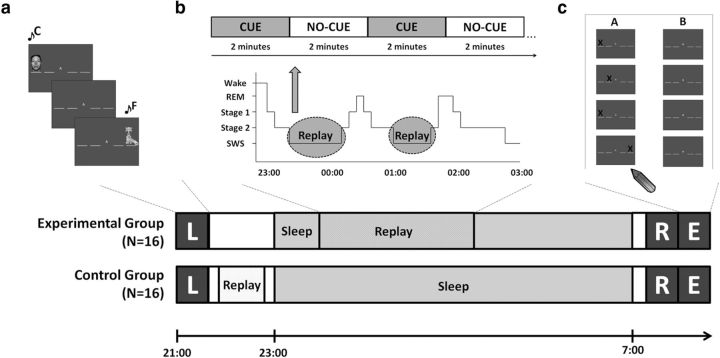
Experimental procedures. a, SRTT learning. Visual stimulus appeared contingent with a unique tone. Correct key response was followed by a 300 ms interval before the next stimulus. Interleaved blocks of sequence A containing low tones (4th octave: C/D/E/F) and sequence B containing high tones (5th octave: A/B/C#/D), and random blocks containing high and low tones were performed. b, One sequence was played to the experimental group during SWS, with 12 repetitions (CUE) followed by silence (NO-CUE). c, In the morning, participants were retested on the SRTT (R) before their explicit sequence knowledge was assessed (E), by marking sequence order on paper.
Figure 2.
Figure 2.
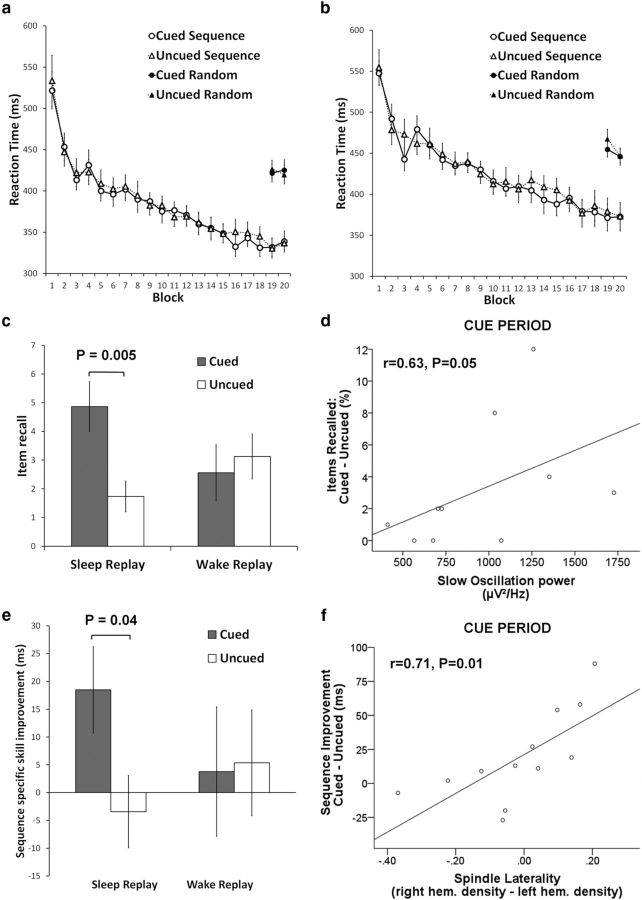
The cueing effect and neural correlates. Pre-sleep SRTT performance across all blocks of learning in the experimental group (a) and the control group (b). c, Cues led to significantly more correctly recalled sequence items for the experimental group but not control group. d, Correlation between slow oscillation power in central electrodes and the explicit cueing effect during CUE (n = 10) in the experimental group. e, SRTT sequence-specific skill improvement was significantly better for the cued than uncued sequence in the experimental group only. f, Spindle laterality at central electrodes predicted the procedural cueing effect in the experimental group during CUE (n = 12) and NO-CUE. Data are presented as mean ± SEM. Correlations are presented with some participants removed as a result of EEG artifacts.

References

    1. Antony JW, Gobel EW, O'Hare JK, Reber PJ, Paller KA. Cued memory reactivation during sleep influences skill learning. Nat Neurosci. 2012;15:1114–1116. doi: 10.1038/nn.3152. - DOI - PMC - PubMed
    1. Barakat M, Doyon J, Debas K, Vandewalle G, Morin A, Poirier G, Martin N, Lafortune M, Karni A, Ungerleider LG, Benali H, Carrier J. Fast and slow spindle involvement in the consolidation of a new motor sequence. Behav Brain Res. 2011;217:117–121. doi: 10.1016/j.bbr.2010.10.019. - DOI - PubMed
    1. Bendor D, Wilson MA. Biasing the content of hippocampal replay during sleep. Nat Neurosci. 2012;15:1439–1444. doi: 10.1038/nn.3203. - DOI - PMC - PubMed
    1. Benjamini Y, Hochberg Y. Controlling the false discovery rate: a practical and powerful approach to multiple testing. J R Stat Soc Ser B Stat Methodol. 1995;57:289–300.
    1. Born J, Rasch B, Gais S. Sleep to remember. Neuroscientist. 2006;12:410–424. doi: 10.1177/1073858406292647. - DOI - PubMed

Publication types