Review
. 2014 Nov 12:5:579.
doi: 10.3389/fimmu.2014.00579. eCollection 2014.

Dynamic Aspects of Macrophage Polarization during Atherosclerosis Progression and Regression

Affiliations
Review

Dynamic Aspects of Macrophage Polarization during Atherosclerosis Progression and Regression

Michael Peled et al. Front Immunol. .

Abstract

It is well recognized that macrophages in many contexts in vitro and in vivo display a spectrum of inflammatory features and functional properties. A convenient system to group together different subsets of macrophages has been the M1 (inflammatory)/M2 (anti-inflammatory) classification. In addition to other sites of inflammation, it is now established that atherosclerotic plaques contain both M1 and M2 macrophages. We review results made possible by a number of recent mouse models of atherosclerotic regression that, taken with other literature, have shown the M1/M2 balance in plaques to be dynamic, with M1 predominating in disease progression and M2 in regression. The regulation of the macrophage phenotype in plaques and the functional consequences of the M1 and M2 states in atherosclerosis will also be discussed.

Keywords: atherosclerosis; cholesterol; macrophages; polarization; regression.


Figures
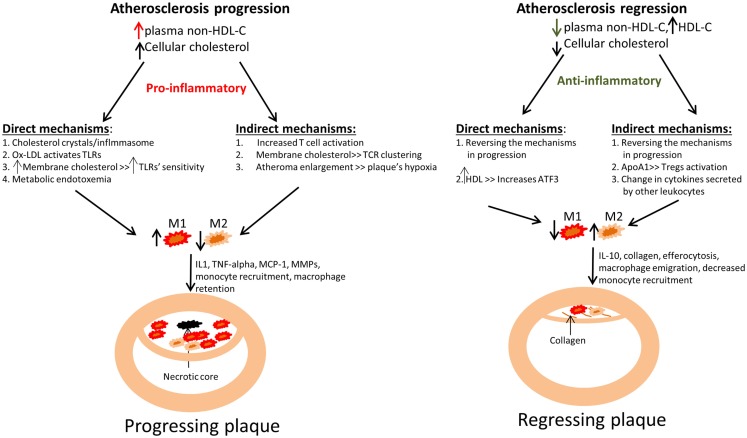
Figure 1
Figure 1
Summary of how changes in plasma cholesterol level and in cellular cholesterol content affect macrophage polarization and kinetics in atherosclerotic plaque progression and regression. Left panel: An increase in non-HDL cholesterol (mainly VLDL cholesterol and LDL cholesterol) in mouse models has been linked to an increase in monocyte recruitment into atherosclerotic plaques, with their subsequent polarization to M1 macrophages, which are retained. This ultimately leads to atherosclerotic plaque progression, as evident by plaque enlargement. The failure to clear dead macrophages by efferocytosis results in the appearance of the necrotic core. Right panel: An opposite effect has been demonstrated in atherosclerosis regression models, where a reduction in non-HDL-C or a selective increase in HDL-C (representing an increase in functional HDL particles) induces a decrease in plaque size and macrophage content (from decreased monocyte recruitment and macrophage retention), as well as enrichment in the expression of markers of the M2 state. Improved efferocytosis is also expected under these conditions, with shrinkage of the necrotic core. There is an increase in collagen content, likely from decreased MMP production by the macrophages. It is also likely that in a regression environment there are decreases in the secretion of inflammatory cytokines and chemokines by the macrophages as a result of the polarization of macrophages toward a M2-like state. The different mechanisms by which cholesterol can drive macrophage activation and polarization are divided into those direct – how cholesterol affects macrophages, and indirect – how cholesterol affects other cell types, for example by the secretion of pro-inflammatory cytokines from T cells.

References

    1. Williams KJ, Tabas I. The response-to-retention hypothesis of early atherogenesis. Arterioscler Thromb Vasc Biol (1995) 15(5):551–6110.1161/01.ATV.15.5.551 - DOI - PMC - PubMed
    1. Ross R. Atherosclerosis – an inflammatory disease. N Engl J Med (1999) 340(2):115–2610.1056/NEJM199901143400207 - DOI - PubMed
    1. Weber C, Noels H. Atherosclerosis: current pathogenesis and therapeutic options. Nat Med (2011) 17(11):1410–22.10.1038/nm.2538 - DOI - PubMed
    1. Hansson GK, Hermansson A. The immune system in atherosclerosis. Nat Immunol (2011) 12(3):204–1210.1038/ni.2001 - DOI - PubMed
    1. Williams KJ, Feig JE, Fisher EA. Rapid regression of atherosclerosis: insights from the clinical and experimental literature. Nat Clin Pract Cardiovasc Med (2008) 5(2):91–102.10.1038/ncpcardio1086 - DOI - PubMed

LinkOut - more resources
