Review
. 2015 Jan;15(1):490.
doi: 10.1007/s11882-014-0490-0.

Upper airway stem cells: understanding the nose and role for future cell therapy

Affiliations
Review

Upper airway stem cells: understanding the nose and role for future cell therapy

De-Yun Wang et al. Curr Allergy Asthma Rep. 2015 Jan.

Abstract

The nose together with the paranasal sinuses has an approximate surface area of 100 to 200 cm(2) in adults, which is lined with pseudostratified columnar ciliated epithelium. It serves several important physiological functions such as conditioning and filtration of the inspired air and the provision of end organ for the sense of smell. It is also a physical and immunological barrier as it is the first site of interaction between the host tissue and foreign invaders (viruses, bacteria, and allergens). Our understanding of the complex cellular events occurring in response to inhaled agents during the development of common airway diseases has been significantly enhanced by the current status of in vivo and in vitro nasal experimental models. This will allow the development of novel therapeutic strategies designed to improve the physiological and immune defense functions of the nasal epithelium, as well as novel therapies for other common nasal diseases.


Figures
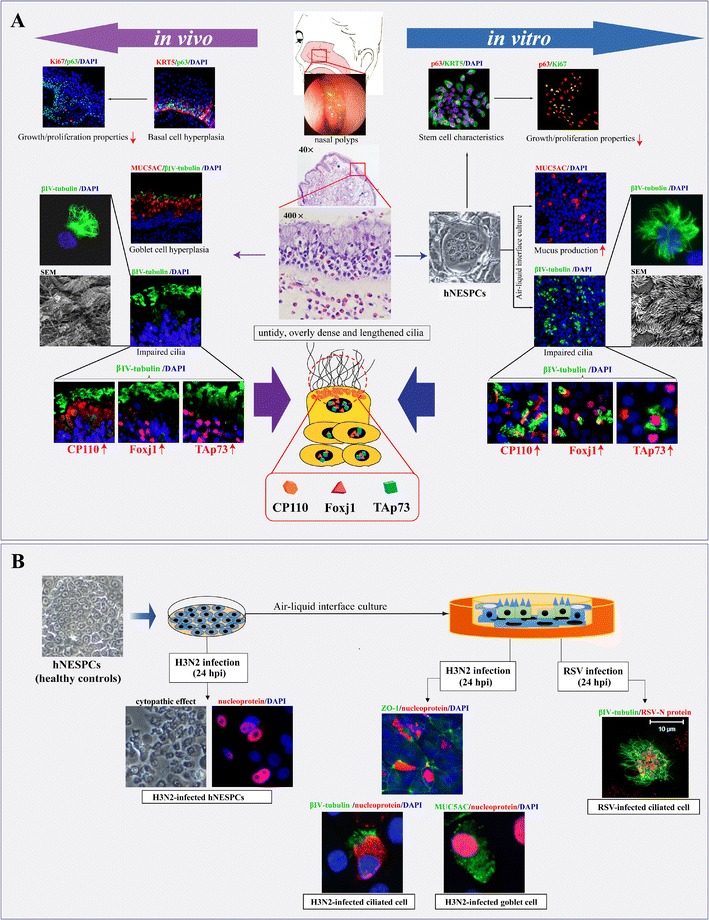
Fig. 1
Fig. 1
Implication of in vitro models of human nasal epithelial stem/progenitor cells (hNESPCs) and differentiated epithelial cells derived from hNESPCs in experimental studies. All pictures with double staining are carried out by using immunofluorescence staining technique. a Schematic summary of the histopathological and pathogenic alterations in nasal polyps (NPs) from recent in vivo and in vitro studies [•, ••, ••, ••]. Our in vivo studies showed that NPs are associated with chronic mucosal inflammation (e.g., eosinophilia), hyperplasia of basal cells (p63+ and KRT5+ cells) and goblet cells (MUC5AC+ cells), impairment of cilia architecture (untidy, overly dense, and lengthened) together with increased protein expression levels of ciliogenesis-associated markers (CP110, Foxj1, and TAp73) in ciliated columnar cells (βIV-tubulin+ cells) by using histo- and immuno-staining and scanning electron microscopy (SEM). These pathological findings are confirmed by the in vitro data with reduced growth and proliferation activities (Ki67+) in hNESPCs (p63+ cells), increased mucus production (MUC5AC+ cells), and abnormal cilia architecture (same as in vivo findings) in differentiated epithelial cells derived from hNESPCs also with increased protein expression levels of CP110, Foxj1, and TAp73. Thus, these ciliogenesis-associated markers are confirmed to be associated with the pathogenesis of epithelial hyperplasia and impairment of cilia architecture in NPs, and their changes are likely intrinsic. b The in vitro models for viral infections. Viral infection of influenza H3N2 virus (Influenza A/Aichi/2/68 stain, MOI of 0.1) is conducted in hNESPCs derived from biopsies of healthy nasal mucosa. The cytopathic effects (e.g., cell detachment, round up, and crimp cell membrane) and H3N2-infected hNESPCs (H3N2 nucleoprotein+) are seen 24 h post infection (hpi). In the differentiated nasal epithelial cells, H3N2 virus can impair the tight junctions by showing an enlarged and irregular pattern of ZO-1 and infect directly the ciliated cells (βIV-tubulin+) and goblet cells (MUC5AC+) as shown by a double staining of viral nucleoprotein at 24 hpi. For respiratory syncytial virus (RSV, MOI of 3), the infection may start from the ciliated cells as shown by a double staining with RSV-N protein (RSV-N) and βIV-tubulin (kindly provided with permission from Professor R. Sugrue)

References

    1. Fokkens WJ, Lund VJ, Mullol J, et al. EPOS 2012: European position paper on rhinosinusitis and nasal polyps 2012. A summary for otorhinolaryngologists. Rhinology. 2012;50(1):1–12. - PubMed
    1. Vareille M, Kieninger E, Edwards MR, et al. The airway epithelium: soldier in the fight against respiratory viruses. Clin Microbiol Rev. 2011;24(1):210–29. doi: 10.1128/CMR.00014-10. - DOI - PMC - PubMed
    1. Kern RC, Conley DB, Walsh W, et al. Perspectives on the etiology of chronic rhinosinusitis: an immune barrier hypothesis. Am J Rhinol. 2008;22(6):549–59. doi: 10.2500/ajr.2008.22.3228. - DOI - PMC - PubMed
    1. Braciale TJ, Sun J, Kim TS. Regulating the adaptive immune response to respiratory virus infection. Nat Rev Immunol. 2012;12(4):295–305. doi: 10.1038/nri3166. - DOI - PMC - PubMed
    1. Hooper RG. Forced inspiratory nasal flow-volume curves: a simple test of nasal airflow. Mayo Clin Proc. 2001;76(10):990–4. doi: 10.4065/76.10.990. - DOI - PubMed

Publication types
