


Tissue adhesives for closure of surgical incisions
- PMID: 25431843
- PMCID: PMC10074547
- DOI: 10.1002/14651858.CD004287.pub4
Tissue adhesives for closure of surgical incisions
Abstract
Background: Sutures (stitches), staples and adhesive tapes have been used for many years as methods of wound closure, but tissue adhesives have entered clinical practice more recently. Closure of wounds with sutures enables the closure to be meticulous, but the sutures may show tissue reactivity and can require removal. Tissue adhesives offer the advantages of an absence of risk of needlestick injury and no requirement to remove sutures later. Initially, tissue adhesives were used primarily in emergency room settings, but this review looks at the use of tissue adhesives in the operating room/theatre where surgeons are using them increasingly for the closure of surgical skin incisions.
Objectives: To determine the effects of various tissue adhesives compared with conventional skin closure techniques for the closure of surgical wounds.
Search methods: In March 2014 for this second update we searched the Cochrane Wounds Group Specialised Register; The Cochrane Central Register of Controlled Trials (CENTRAL) (The Cochrane Library); Ovid MEDLINE; Ovid MEDLINE (In-Process & Other Non-Indexed Citations); Ovid EMBASE and EBSCO CINAHL. We did not restrict the search and study selection with respect to language, date of publication or study setting.
Selection criteria: Only randomised controlled trials were eligible for inclusion.
Data collection and analysis: We conducted screening of eligible studies, data extraction and risk of bias assessment independently and in duplicate. We expressed results as random-effects models using mean difference for continuous outcomes and risk ratios (RR) with 95% confidence intervals (CI) for dichotomous outcomes. We investigated heterogeneity, including both clinical and methodological factors.
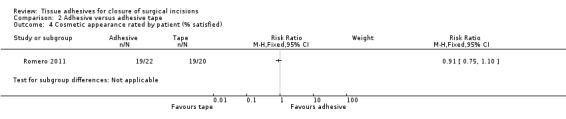
Main results: This second update of the review identified 19 additional eligible trials resulting in a total of 33 studies (2793 participants) that met the inclusion criteria. There was low quality evidence that sutures were significantly better than tissue adhesives for reducing the risk of wound breakdown (dehiscence; RR 3.35; 95% CI 1.53 to 7.33; 10 trials, 736 participants that contributed data to the meta-analysis). The number needed to treat for an additional harmful outcome was calculated as 43. For all other outcomes - infection, patient and operator satisfaction and cost - there was no evidence of a difference for either sutures or tissue adhesives. No evidence of differences was found between tissue adhesives and tapes for minimising dehiscence, infection, patients' assessment of cosmetic appearance, patient satisfaction or surgeon satisfaction. However there was evidence in favour of using tape for surgeons' assessment of cosmetic appearance (mean difference (VAS 0 to 100) 9.56 (95% CI 4.74 to 14.37; 2 trials, 139 participants). One trial compared tissue adhesives with a variety of methods of wound closure and found both patients and clinicians were significantly more satisfied with the alternative closure methods than the adhesives. There appeared to be little difference in outcome for different types of tissue adhesives. One study that compared high viscosity with low viscosity adhesives found that high viscosity adhesives were less time-consuming to use than low viscosity tissue adhesives, but the time difference was small.
Authors' conclusions: Sutures are significantly better than tissue adhesives for minimising dehiscence. In some cases tissue adhesives may be quicker to apply than sutures. Although surgeons may consider the use of tissue adhesives as an alternative to other methods of surgical site closure in the operating theatre, they need to be aware that sutures minimise dehiscence. There is a need for more well designed randomised controlled trials comparing tissue adhesives with alternative methods of closure. These trials should include people whose health may interfere with wound healing and surgical sites of high tension.
Conflict of interest statement
Jo C Dumville: None known Paul Coulthard: was a co‐author in the Blondeel 2004 study. This study was also commercially supported by Ethicon. Philip Riley: None known Helen V Worthington: None known Neil Patel: None known Marco Esposito: None known Maarten van der Elst: None known Oscar J F van Waes: None known James Darcey: None known
Figures







Update of
-
Tissue adhesives for closure of surgical incisions.Cochrane Database Syst Rev. 2010 May 12;(5):CD004287. doi: 10.1002/14651858.CD004287.pub3. Cochrane Database Syst Rev. 2010. Update in: Cochrane Database Syst Rev. 2014 Nov 28;(11):CD004287. doi: 10.1002/14651858.CD004287.pub4. PMID: 20464728 Updated.
References
References to studies included in this review
Amin 2009 {published data only}
-
- Amin M, Glynn F, Timon C. Randomised trial of tissue adhesive vs staples in thyroidectomy integrating patient satisfaction and Manchester score. Otolaryngology ‐ Head and Neck Surgery 2009;140(5):703‐8. - PubMed
Avsar 2009 {published data only}
-
- Avsar A, Ustunnner I, Keskin L, Ozturk O, Tas E. 2‐octylcyanoacrylate tissue adhesive versus polypropylene suture for skin closure of Pfannenestiel incision. Tűrk Jinekoloji ve Obstetrik Derneği Dergisi 2009;6:117‐22.
Blondeel 2004 {published data only}
-
- Blondeel P, Murphy J, Debrosse D, Nix, J, Puls LE, Theodore N, et al. Closure of long surgical incisions with a new formulation of 2‐octylcyanoacrylate tissue adhesive versus commercially available methods. American Journal of Surgery 2004;188:307‐13. - PubMed
Brown 2009 {published data only}
-
- Brown JK, Campbell BT, Drongowski RA, Alderman AK, Geiger JD, Teitelbaum DH, et al. A prospective, randomized comparison of skin adhesive and subcuticular suture for closure of pediatric hernia incisions: cost and cosmetic considerations. Journal of Paediatric Surgery 2009;44(7):1418‐22. - PubMed
Cheng 1997 {published data only}
-
- Cheng W, Saing H. A prospective randomised study of wound approximation with tissue glue in circumcision in children. Journal of Paediatric Child Health 1997;33:515‐6. - PubMed
Chibbaro 2009 {published data only}
-
- Chibbaro S, Tacconi L. Use of skin glue versus traditional wound closure methods in brain surgery: a prospective, randomized, controlled study. Journal of Clinical Neuroscience 2009;16(4):535‐9. - PubMed
Dowson 2006 {published data only}
-
- Dowson C, Gilliam A, Speake W, Lobo D, Beckingham. A prospective, randomised controlled trial comparing n‐butyl cyanoacrylate tissue adhesive (Liquiband) with sutures for skin closure after laparoscopic general surgical procedures. Surgical Laparoscopy, Endoscopy and Percutaneous Techniques 2006;16(3):146‐50. - PubMed
Eggers 2011 {published data only}
-
- Eggers MD, Fang L, Lionberger DR. A comparison of wound closure techniques for total knee arthroplasty. Journal of Arthroplasty 2011;26(8):1251‐8. - PubMed
Greene 1999 {published data only}
-
- Greene D, Kock RJ, Goode RL. Efficacy of octyl‐2‐cyanoacrylate tissue glue in blepharoplasty. Archives of Facial Plastic Surgery 1999;1:292‐6. - PubMed
Jallali 2004 {published data only}
-
- Jallali N, Haji A, Watson CJ. A prospective randomized trial comparing 2‐octylcyanoacrylate to conventional suturing in closure of laparoscopic cholecystectomy incisions. Journal of Laparoendoscopic and Advanced Surgical Techniques 2004 Aug;14(4):209‐11. - PubMed
Keng 1989 {published data only}
-
- Keng TM, Bucknall TE. A clinical trial of tissue adhesive (histoacryl) in skin closure of groin wounds. Medical Journal of Malaysia 1989;44(2):122‐8. - PubMed
Kent 2014 {published data only}
-
- Kent A, Liversedge N, Dobbins B, McWhinnie D, Haider J. A prospective randomised controlled double‐masked multi‐center clinical trial of medical adhesives for the closure of laparoscopic incisions. Journal of Minimally Invasive Gynecology 2014;21:252‐8. - PubMed
Khan 2006 {published data only}
-
- Khan RJK, Fick D, Yao F, Tang K, Hurworth M, Nivbrant B, et al. A comparison of three methods of wound closure following arthroplasty: a prospective randomised controlled trial. The Journal of Bone and Joint Surgery 2006;88:238‐42. - PubMed
Kouba 2011 {published data only}
-
- Kouba DJ, Tierney E, Mahmoud BH, Woo D. Optimizing closure materials for upperlid blepharoplasty: a randomized, controlled trial. Dermatologic Surgery 2011;37(1):19‐30. - PubMed
Krishnamoorthy 2009 {published data only}
-
- Krishnamoorthy B, Najam O, Khan UA, Waterworth P, Fildes JE, Yonan N. Randomized prospective study comparing conventional subcuticular skin closure with Dermabond skin glue after saphenous vein harvesting. The Annals of Thoracic Surgery 2009;88(5):1445‐9. - PubMed
Livesey 2009 {published data only}
-
- Livesey C, Wylde V, Descamps S, Estela CM, Bannister GC, Learmonth ID, et al. Skin closure after total hip replacement: a randomised controlled trial of skin adhesive versus surgical staples. Journal of Bone and Joint Surgery 2009;91(6):725‐9. - PubMed
Maartense 2002 {published data only}
-
- Maartense S, Bemelman WA, Dunker MS, Lint C, Pierik EGJM, Busch ORC, et al. Randomised study of the effectiveness of closing laparoscopic trocar wounds with octylcyanoacrylate, adhesive papertape or poliglecaprone. British Journal of Surgery 2002;89:1370‐5. - PubMed
Maloney 2013 {published data only}
-
- Maloney J, Rogers GS, Kapadia M. Surgical corner: a prospective randomized evaluation of cyanoacrylate glue devices in the closure of surgical wounds. The Journal of Drugs in Dermatology 2013;12(7):810‐4. - PubMed
Millan 2011 {published data only}
-
- Millan P, Olivera R, Sanchez A. Efficacy and safety of 2‐octylcyanoacrylate versus simple suture in surgical wound closure of chronic skin inflammation. Dermatologia Revista Mexicana 2011;55(4):185‐7.
Mota 2009 {published data only}
-
- Mota R, Costa F, Amaral A, Oliveira F, Santos CC, Ayres‐De‐Campos D. Skin adhesive versus subcuticular suture for perineal skin repair after episiotomy ‐ a randomized controlled trial. Acta Obstetricia et Gynecologica Scandinavica 2009;88(6):660‐6. - PubMed
Ong 2002 {published data only}
-
- Ong C, Jacobsen A, Joseph V. Comparing wound closure using tissue glue versus subcuticular suture for paediatric surgical incisions: a prospective, randomised trial. Paediatric Surgery International 2002;18:553‐5. - PubMed
Ozturan 2001 {published data only}
-
- Ozturan O, Miman MC, Aktas D, Oncel S. Butylcyanoacrylate tissue adhesive for columellar incision closure. The Journal of Laryngology and Otology 2001;115:535‐40. - PubMed
Pronio 2011 {published data only}
-
- Pronio A, Fillippo A, Narillii P, Caporilli D, Vestri A, Ciamberlaon B, et al. Closure of cutaneous incision after thyroid surgery: a comparison between metal clips and cutaneous octyl‐2‐cyanoacrylate adhesive. A prospective randomized clinical trial. European Journal of Plastic Surgery 2011;34:103‐10.
Ridgway 2007 {published data only}
Romero 2011 {published data only}
-
- Romero P, Frongia G, Wingerter S, Holland‐Cunz S. Prospective, randomized,controlled trial comparing a tissue adhesive (Dermabond™) with adhesive strips (Steri‐Strips™) for the closure of laparoscopic trocar wounds in children. European Journal of Pediatric Surgery 2011;21(3):159‐62. - PubMed
Sebesta 2004 {published data only}
Shamiyeh 2001 {published data only}
-
- Shamiyeh A, Schrenk P, Stelzer T, Wayand WU. Prospective randomised blind controlled trial comparing sutures, tape, and octylcyanoacrylate tissue adhesive for skin closure after phlebectomy. Dermatologic Surgery 2001;27(10):877‐80. - PubMed
Sinha 2001 {published data only}
-
- Sinha S, Naik M, Wright V, Timmons J, Campbell AC. A single blind, prospective, randomised trial comparing n‐butyl 2‐cyanoacrylate tissue adhesive (Indermil) and sutures for skin closure in hand surgery. Journal of Hand Surgery 2001;26B(3):264‐5. - PubMed
Sniezek 2007 {published data only}
-
- Sniezek P, Walling H, DeBloom III J, Messingham M, VanBeek M, Kreiter C, et al. A randomised controlled trial of high‐viscosity 2‐octyl cyanoacrylate tissue adhesive versus sutures in repairing facial wounds following Mohs micrographic surgery. Dermatological Surgery 2007;33(8):966‐71. - PubMed
Switzer 2003 {published data only}
-
- Swtizer E, Dinsmore R, North J. Subcuticular closure versus dermabond: a prospective randomised trial. The American Surgeon 2003;69:434‐6. - PubMed
Tierny 2009 {published data only}
-
- Tierney EP, Moy RL, Kouba DJ. Rapid absorbing gut suture versus 2‐octylethylcyanoacrylate tissue adhesive in the epidermal closure of linear repairs. Journal of Drugs in Dermatology 2009;8(2):115‐9. - PubMed
Toriumi 1998 {published data only}
-
- Toriumi DM, O'Grady K, Desai D, Bagal AB. Use of octyl‐2‐cyanoacrylate for skin closure in facial plastic surgery. Plastic and Reconstructive Surgery 1998;102(6):2209‐19. - PubMed
van den Ende 2004 {published data only}
-
- Ende ED, Vriens PWHE, Allema JH, Breslau PJ. Adhesive bonds or percutaneous absorbable suture for closure of surgical wounds in children. Results of a prospective randomized trial. Journal of Pediatric Surgery 2004;39:1249‐51. - PubMed
References to studies excluded from this review
Ak 2012 {published data only}
Alhopuro 1976 {published data only}
-
- Alhopuro S, Rintala A, Salo H, Ritsila V. Tissue adhesive versus sutures in closure of incision wounds. A comparative study in human skin. Annales Chirurgiae et Gynaecologiae 1976;65:308‐12. - PubMed
Chen 2010 {published data only}
Chow 2010 {published data only}
-
- Chow A, Marshall H, Zacharakis E, Paraskeva P, Purkayastha S. Use of tissue glue for surgical incision closure: a systematic review and meta‐analysis of randomized controlled trials. Journal of the American College of Surgery 2010;211:115‐25. - PubMed
Giri 2004 {published data only}
-
- Giri P, Das MK, Majumdar Giri A. Management of different types of wound by cyanoacrylate glue fixation: a random study of 213 patients. Journal of the Indian Medical Association 2004;102(11):624, 626. - PubMed
Gorozpe‐Calvillo 1999 {published data only}
-
- Gorozpe‐Calvillo JI, Gonzalez‐Villamil J, Santoya‐Haro S. Closure of the skin with cyanoacrylate in caesarian surgery [Cierre de la piel con cianoacrilato en las cesareas]. Ginecologia y Obstetricia de Mexico 1999;67:491‐5. - PubMed
Jaibaji 2000 {published data only}
-
- Jaibaji M, Liddington M, Geary P, Darcy C, Batchelor A, Roberts A. Evaluation of the long term outcome of wounds closed with "Indermil" adhesive. European Journal of Plastic Surgery 2000;23:330‐2.
Kuo 2006 {published data only}
-
- Kuo F, Lee D, Rodgers G. Prospective, randomised, blinded study of a new wound closure film versus cutaneous suture for surgical wound closure. Dermatological Surgery 2006;32:676‐81. - PubMed
Matin 2003 {published data only}
-
- Matin SF. Prospective randomized trial of skin adhesive versus sutures for closure of 217 laparoscopic port‐site incisions. Journal of the America College of Surgeons 2003;196(6):845‐53. - PubMed
Maw 1997 {published data only}
-
- Maw JL, Quinn JV, Wells GA, Ducic Y, Odell PF, Lamothe A, et al. A prospective comparison of octylcyanoacrylate tissue adhesive and suture for the closure of head and neck incisions. Journal of Otolaryngology 1997;26(1):26‐30. - PubMed
Ong 2010 {published data only}
-
- Ong J, Ho KS, Chew MH, Eu KW. Prospective randomised study to evaluate the use of DERMABOND ProPen (2‐octylcyanoacrylate) in the closure of abdominal wounds versus closure with skin staples in patients undergoing elective colectomy. International Journal of Colorectal Disease 2010;25(7):899‐905. - PubMed
Orozco‐Razon 2002 {published data only}
-
- Orozco‐Razon LF, Millan‐Guerrero RO, Vera‐Rodriguez SE. Butylcyanoacrylate tissue adhesive for columellar incision closure [Cyanoacrylate compared with traditional surgery in tension‐free incision closure [Spanish]]. Gaceta Medica de Mexico 2002;138(6):505‐9. - PubMed
Quinn 1998 {published data only}
-
- Quinn J, Wells G, Sutcliffe T, Jarmuske M, Maw J, Stiell I, et al. Tissue adhesive versus suture wound repair at 1 year: randomized clinical trial correlating early, 3‐month, and 1‐year cosmetic outcome. Annals of Emergency Medicine 1998;32(6):645‐9. - PubMed
Sajid 2009 {published data only}
-
- Sajid MS, Siddiqui MR, Khan MA, Baig MK. Meta‐analysis of skin adhesives versus sutures in closure of laparoscopic port‐site wounds. Surgical Endoscopy 2009;23(6):1191‐7. - PubMed
Silvestri 2006 {published data only}
-
- Silvestri A, Brandi C, Grimaldi L, Nisi G, Brafa A, Calabro M, et al. Octyl‐2‐cyanoacrylate adhesive for skin closure and prevention of infection in plastic surgery. Aesthetic Plastic Surgery 2006;30:695‐9. - PubMed
Singer 2002 {published data only}
-
- Singer AJ, Quinn JV, Clarke RE, Hollander JE. Closure of lacerations and incisions with octylcyanoacrylate: a multicentre randomised controlled trial. Surgery 2002;131:270‐6. - PubMed
Spencker 2011 {published data only}
-
- Spencker S, Coban N, Koch L, Schirdewan A, Mueller D. Comparison of skin adhesive and absorbable intracutaneous suture for the implantation of cardiac rhythm devices. European Journal of Pacing, Arrhythmias and Cardiac Electrophysiology 2011;13(3):416‐20. - PubMed
Steiner 2000 {published data only}
-
- Steiner Z, Mogilner J. Histoacryl vs Dermabond cyanoacrylate glue for closing small operative wounds. Harefuah 2000;139(11‐12):409‐11, 496. - PubMed
Sun 2005 {published data only}
-
- Sun J, Chen Q‐M, Zhang M, Shi C. Octylcyanoacrylate versus absorbable suture in the repair of skin wounds in children. Zhongguo Linchuang Kangfu 2005;9(19):186‐7.
Wong 2011 {published data only}
-
- Wong EM, Rainer TH, Ng YC, Chan MS, Lopez V. Cost‐effectiveness of Dermabond versus sutures for lacerated wound closure: a randomised controlled trial. Hong Kong Medical Journal 2011;17 Suppl 6:4‐8. - PubMed
References to studies awaiting assessment
Additional references
Bruns 1996
-
- Bruns TB, Simon HK, McLario DJ. Laceration repair using a tissue adhesive in a children's emergency department. Pediatrics 1996;98:673‐5. - PubMed
Coover 1959
-
- Coover HN, Joyner FB, Sheere NH. Chemistry and performance of cyanoacrylate adhesive. Journal of the Society of Plastic Surgery of England 1959;1:5‐6.
Deeks 2011
-
- Deeks JJ, Higgins JPT, Altman DG (editors). Chapter 9: Analysing data and undertaking meta‐analyses. In: Higgins JPT, Green S (editors). Cochrane Handbook for Systematic Reviews of Interventions. Version 5.1.0 (updated March 2011). The Cochrane Collaboration, 2011. available from www.cochrane‐handbook.org.
Dunker 1998
-
- Dunker MS, Stiggelbout AM, Hogezand RA, Ringers J, Griffioen G, Bemelman WA. Cosmesis and body image after laparoscopic assisted and ileocolic resection for Crohn's disease. Surgical Endoscopy 1998;12:1334‐40. - PubMed
Emori 1993
Farion 2001
Higgins 2003
Higgins 2011
-
- Higgins JPT, Altman DG, Sterne JAC (editors). Chapter 8: Assessing risk of bias in included studies. In: Higgins JPT, Green S (editors). Cochrane Handbook for Systematic Reviews of Interventions. Version 5.1.0 (updated March 2011). The Cochrane Collaboration, 2011. Available from www.cochrane‐handbook.org.
Hollander 1995
-
- Hollander JE, Singer AJ, Valentine S, Henry MC. Wound registry: development and validation. Annals of Emergency Medicine 1995;25:675‐85. - PubMed
Houston 1969
-
- Houston S, Hodge JW Jr, Ousterhout DK, Leonard F. The effect of alpha‐cyanoacrylates on wound healing. Journal of Biomedical Materials Research 1969;3(2):281‐9. - PubMed
Lefebvre 2011
-
- Lefebvre C, Manheimer E, Glanville J. Chapter 6: Searching for studies. In: Higgins JPT, Green S (editors). Cochrane Handbook for Systematic Reviews of Interventions. Version 5.1.0 (updated March 2011). The Cochrane Collaboration, 2011. Available from www.cochrane‐handbook.org 2011.
Malone 2002
-
- Malone DL, Genuit T, Tracy JK. Surgical site infections: reanalysis of risk factors. Journal of Surgical Research 2002;103:89‐95. - PubMed
Osmond 1999
-
- Osmond MH. Pediatric wound management: the role of tissue adhesives. Pediatric Emergency Care 1999;15(2):137‐40. - PubMed
Perron 2000
-
- Perron AD, Garcia JA, Hays EP. The efficacy of cyanoacrylate‐derived surgical adhesive for use in the repair of lacerations during competitive athletics. American Journal of Emergency Medicine 2000;18:261‐3. - PubMed
Quinn 1993
-
- Quinn JV, Drzewiecki A, Li MM, Stiell IG, Sutcliffe T, Elmslie TJ, et al. A randomised, controlled trial comparing a tissue adhesive with suturing in the repair of paediatric facial lacerations. Annals of Emergency Medicine 1993;22:1130‐5. - PubMed
Quinn 1995
-
- Quinn JV, Drzewiecki AE, Stiell IG, Elmslie TJ. Appearance scales to measure cosmetic outcomes of healed lacerations. American Journal of Emergency Medicine 1995;13:229‐31. - PubMed
Quinn 1997
-
- Quinn J, Wells G, Sutcliffe T. A randomized trial comparing octylcyanoacrylate tissue adhesive and sutures in the management of lacerations. JAMA 1997;277(19):1527‐30. - PubMed
Schunemann 2011a
-
- Schünemann HJ, Oxman AD, Higgins JPT, Vist GE, Glasziou P, Guyatt GH. Chapter 11: Presenting results and 'Summary of findings' tables. In: Higgins JPT, Green S (editors). Cochrane Handbook for Systematic Reviews of Interventions Version 5.1.0 (updated March 2011). The Cochrane Collaboration, 2011. Available from www.cochrane‐handbook.org.
Schunemann 2011b
-
- Schünemann HJ, Oxman AD, Higgins JPT, Deeks JJ, Glasziou P, Guyatt GH. Chapter 12: Interpreting results and drawing conclusions. In: Higgins JPT, Green S (editors). Cochrane Handbook for Systematic Reviews of Interventions Version 5.1.0 (updated March 2011). The Cochrane Collaboration, 2011. Available from www.cochrane‐handbook.org.
SIGN 2011
-
- Scottish Intercollegiate Guidelines Network (SIGN). Search filters. http://www.sign.ac.uk/methodology/filters.html#random 2011.
Publication types
MeSH terms
Substances
Grants and funding
LinkOut - more resources
Full Text Sources
Other Literature Sources
Medical
Miscellaneous
