


Oxytocin increases bias, but not accuracy, in face recognition line-ups
- PMID: 25433464
- PMCID: PMC4483572
- DOI: 10.1093/scan/nsu150
Oxytocin increases bias, but not accuracy, in face recognition line-ups
Abstract
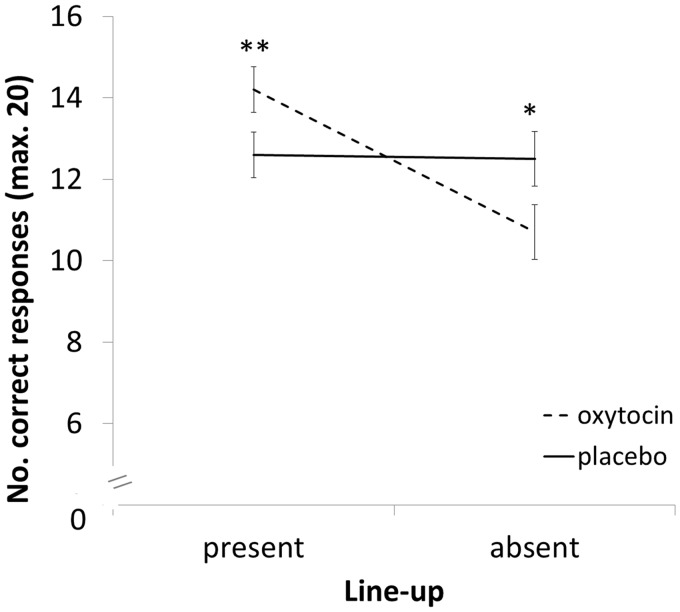
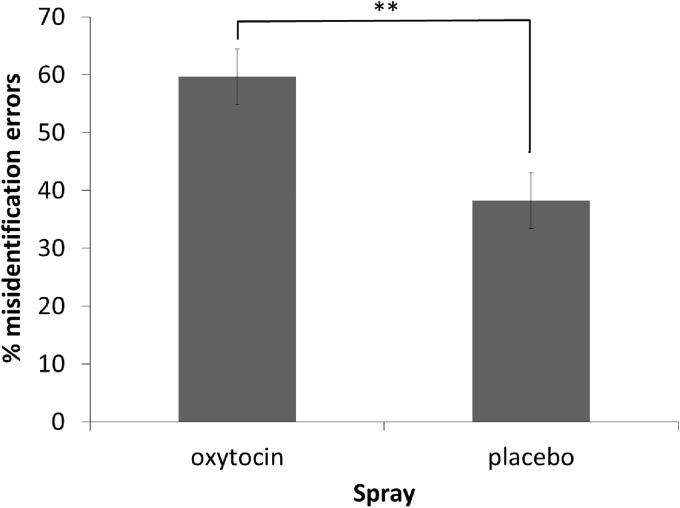
Previous work indicates that intranasal inhalation of oxytocin improves face recognition skills, raising the possibility that it may be used in security settings. However, it is unclear whether oxytocin directly acts upon the core face-processing system itself or indirectly improves face recognition via affective or social salience mechanisms. In a double-blind procedure, 60 participants received either an oxytocin or placebo nasal spray before completing the One-in-Ten task-a standardized test of unfamiliar face recognition containing target-present and target-absent line-ups. Participants in the oxytocin condition outperformed those in the placebo condition on target-present trials, yet were more likely to make false-positive errors on target-absent trials. Signal detection analyses indicated that oxytocin induced a more liberal response bias, rather than increasing accuracy per se. These findings support a social salience account of the effects of oxytocin on face recognition and indicate that oxytocin may impede face recognition in certain scenarios.
Keywords: eyewitness; face recognition; oxytocin; social salience.
© The Author (2014). Published by Oxford University Press. For Permissions, please email: journals.permissions@oup.com.
Figures
References
-
- Bartz JA, Zaki J, Bolger N, Ochsner KN. Social effects of oxytocin in humans: context and person matter. Trends in Cognitive Sciences. 2011;15:301–9. - PubMed
-
- Bate S, Cook SJ, Duchaine B, Tree JJ, Burns EJ, Hodgson TL. Intranasal inhalation of oxytocin improves face processing in developmental prosopagnosia. Cortex. 2014;50:55–63. - PubMed
-
- Bindemann M, Brown C, Koyas T, Russ A. Individual differences in face identification postdict eyewitness accuracy. Journal of Applied Research in Memory and Cognition. 2012;1:96–103.
Publication types
MeSH terms
Substances
LinkOut - more resources
Full Text Sources
Other Literature Sources
