


Sensitive troponin assay and the classification of myocardial infarction
- PMID: 25436428
- PMCID: PMC4414368
- DOI: 10.1016/j.amjmed.2014.10.056
Sensitive troponin assay and the classification of myocardial infarction
Abstract
Background: Lowering the diagnostic threshold for troponin is controversial because it may disproportionately increase the diagnosis of myocardial infarction in patients without acute coronary syndrome. We assessed the impact of lowering the diagnostic threshold of troponin on the incidence, management, and outcome of patients with type 2 myocardial infarction or myocardial injury.
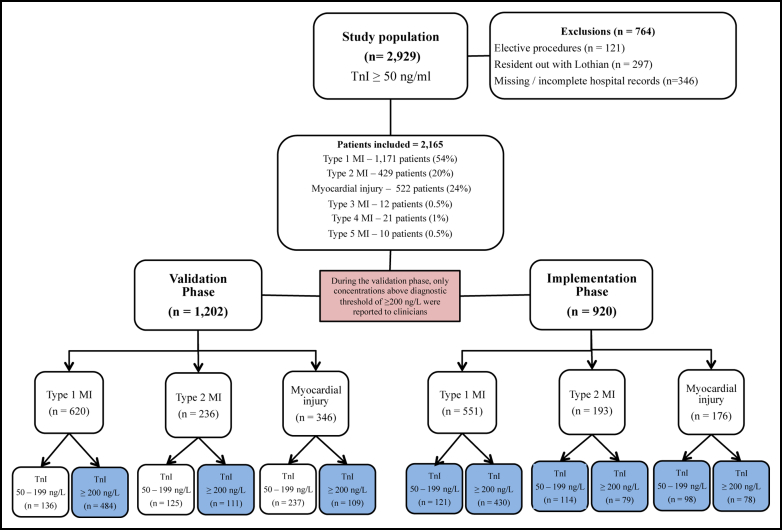
Methods: Consecutive patients with elevated plasma troponin I concentrations (≥50 ng/L; n = 2929) were classified with type 1 (50%) myocardial infarction, type 2 myocardial infarction or myocardial injury (48%), and type 3 to 5 myocardial infarction (2%) before and after lowering the diagnostic threshold from 200 to 50 ng/L with a sensitive assay. Event-free survival from death and recurrent myocardial infarction was recorded at 1 year.
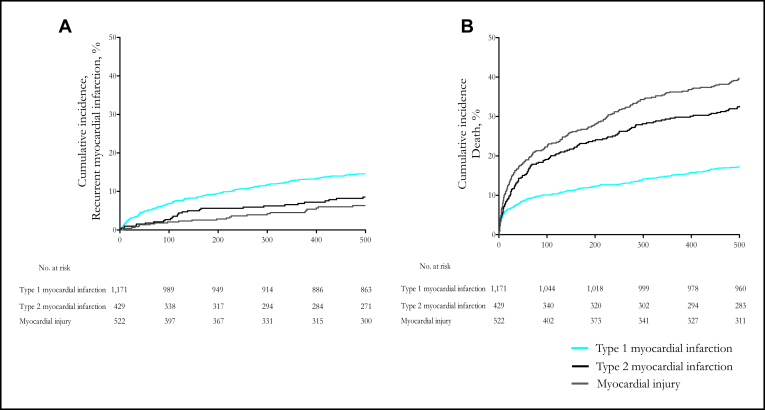
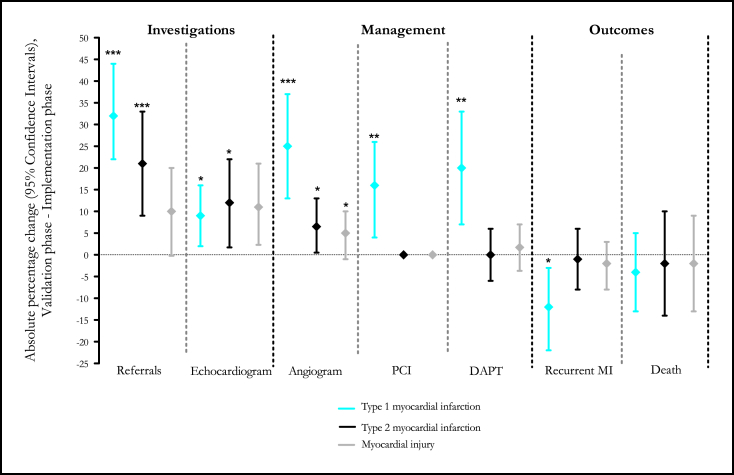
Results: Lowering the threshold increased the diagnosis of type 2 myocardial infarction or myocardial injury more than type 1 myocardial infarction (672 vs 257 additional patients, P < .001). Patients with myocardial injury or type 2 myocardial infarction were at higher risk of death compared with those with type 1 myocardial infarction (37% vs 16%; relative risk [RR], 2.31; 95% confidence interval [CI], 1.98-2.69) but had fewer recurrent myocardial infarctions (4% vs 12%; RR, 0.35; 95% CI, 0.26-0.49). In patients with troponin concentrations 50 to 199 ng/L, lowering the diagnostic threshold was associated with increased healthcare resource use (P < .05) that reduced recurrent myocardial infarction and death for patients with type 1 myocardial infarction (31% vs 20%; RR, 0.64; 95% CI, 0.41-0.99), but not type 2 myocardial infarction or myocardial injury (36% vs 33%; RR, 0.93; 95% CI, 0.75-1.15).
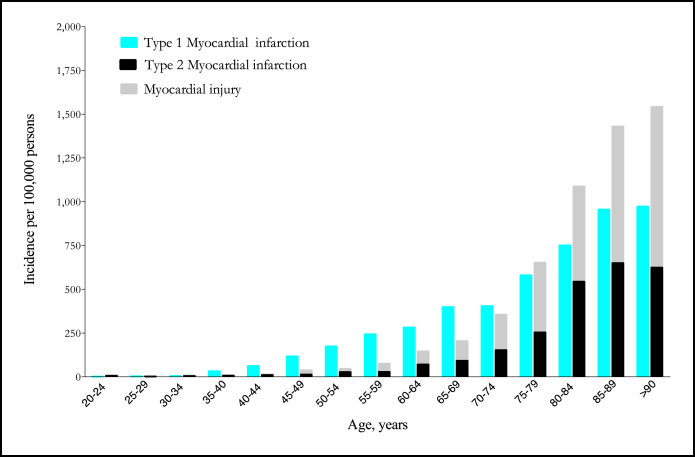
Conclusions: After implementation of a sensitive troponin assay, the incidence of type 2 myocardial infarction or myocardial injury disproportionately increased and is now as frequent as type 1 myocardial infarction. Outcomes of patients with type 2 myocardial infarction or myocardial injury are poor and do not seem to be modifiable after reclassification despite substantial increases in healthcare resource use.
Keywords: Myocardial infarction; Outcomes; Troponin; Type 2.
Copyright © 2015 The Authors. Published by Elsevier Inc. All rights reserved.
Figures
References
-
- Thygesen K., Alpert J.S., Jaffe A.S. Third universal definition of myocardial infarction. Eur Heart J. 2012;33:2551–2567. - PubMed
-
- Morrow D.A., Wiviott S.D., White H.D. Effect of the novel thienopyridine prasugrel compared with clopidogrel on spontaneous and procedural myocardial infarction in the Trial to Assess Improvement in Therapeutic Outcomes by Optimizing Platelet Inhibition with Prasugrel-Thrombolysis in Myocardial Infarction 38: an application of the classification system from the universal definition of myocardial infarction. Circulation. 2009;119:2758–2764. - PubMed
-
- Bonaca M.P., Wiviott S.D., Braunwald E. American College of Cardiology/American Heart Association/European Society of Cardiology/World Heart Federation universal definition of myocardial infarction classification system and the risk of cardiovascular death: observations from the TRITON-TIMI 38 trial. Circulation. 2012;125:577–583. - PubMed
-
- White H.D., Reynolds H.R., Carvalho A.C. Reinfarction after percutaneous coronary intervention or medical management using the universal definition in patients with total occlusion after myocardial infarction: Results from long-term follow-up of the occluded artery trial (OAT) cohort. Am Heart J. 2012;163:563–571. - PMC - PubMed
-
- Alpert J.S., Thygesen K.A., White H.D., Jaffe A.S. Diagnostic and therapeutic implications of type 2 myocardial infarction: review and commentary. Am J Med. 2014;127:105–108. - PubMed
Publication types
MeSH terms
Substances
Grants and funding
LinkOut - more resources
Full Text Sources
Other Literature Sources
Medical
Research Materials
Miscellaneous
