Modeling pubertal timing and tempo and examining links to behavior problems
- PMID: 25437757
- PMCID: PMC4251487
- DOI: 10.1037/a0038096
Modeling pubertal timing and tempo and examining links to behavior problems
Abstract
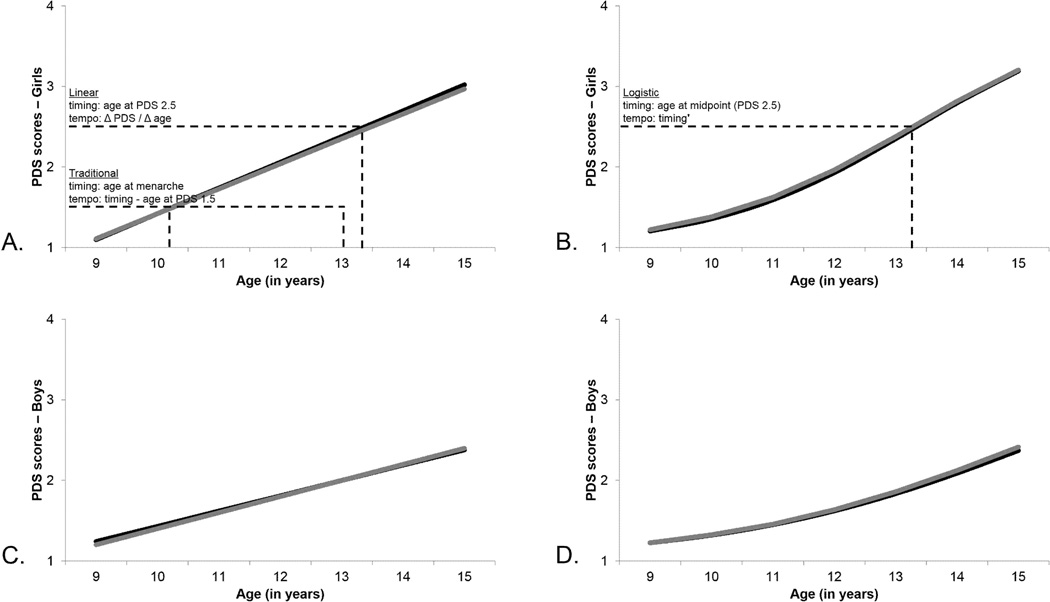
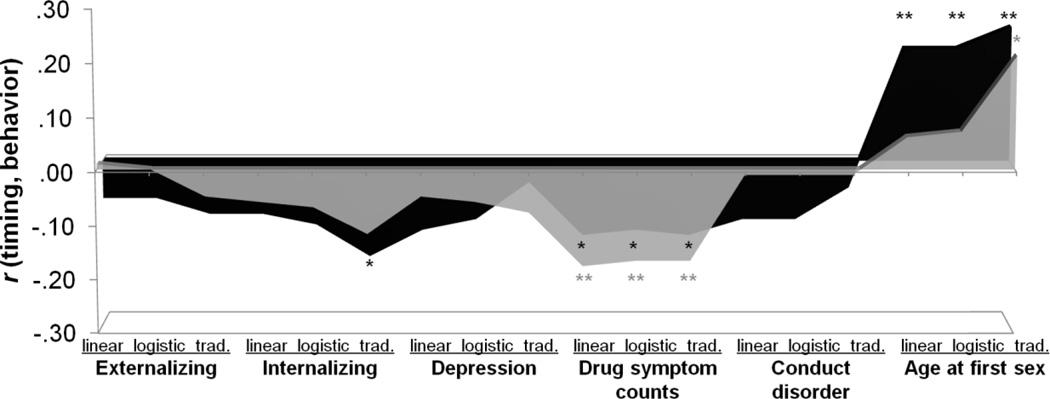
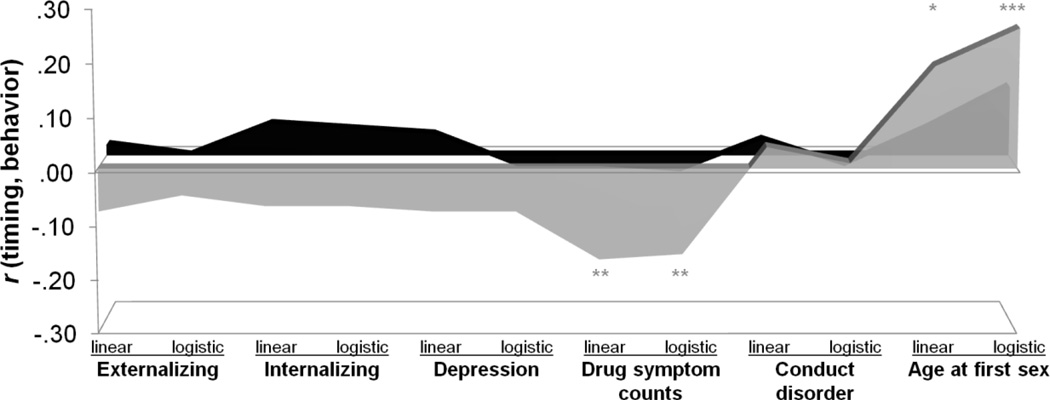
Research on the role of puberty in adolescent psychological development requires attention to the meaning and measurement of pubertal development. Particular questions concern the utility of self-report, the need for complex models to describe pubertal development, the psychological significance of pubertal timing vs. tempo, and sex differences in the nature and psychological significance of pubertal development. We used longitudinal self-report data to model linear and logistic trajectories of pubertal development, and used timing and tempo estimates from these models, and from traditional approaches (age at menarche and time from onset of breast development to menarche), to predict psychological outcomes of internalizing and externalizing behavior problems, and early sexual activity. Participants (738 girls, 781 boys) reported annually from ages 9 through 15 on their pubertal development, and they and their parents reported on their behavior in mid-to-late adolescence and early adulthood. Self-reports of pubertal development provided meaningful data for both boys and girls, producing good trajectories, and estimates of individuals' pubertal timing and tempo. A logistic model best fit the group data. Pubertal timing was estimated to be earlier in the logistic compared to linear model, but linear, logistic, and traditional estimates of pubertal timing correlated highly with each other and similarly with psychological outcomes. Pubertal tempo was not consistently estimated, and associations of tempo with timing and with behavior were model dependent. Advances in modeling facilitate the study of some questions about pubertal development, but assumptions of the models affect their utility in psychological studies.
PsycINFO Database Record (c) 2014 APA, all rights reserved.
Figures
References
-
- Achenbach TM. Manual for the Child Behavior Checklist: 4–18 and 1991 profile. Burlington, VT: University of Vermont Department of Psychiatry; 1991.
-
- Angold A, Costello EJ, Worthman CM. Puberty and depression: The roles of age, pubertal status and pubertal timing. Psychological Medicine. 1998;28(1):51–61. - PubMed
-
- Biro FM, Huang B, Crawford PB, Lucky AW, Streigel-Moore R, Barton BA, et al. Pubertal correlates in Black and White girls. Journal of Pediatrics. 2006;148(2):234–240. - PubMed
-
- Bleidorn W, Kandler C, Riemann R, Angleitner A, Spinath FM. Patterns and sources of adult personality development: Growth curve analyses of the NEO PI-R scales in a longitudinal twin study. Journal of Personality and Social Psychology. 2009;97(1):142–155. - PubMed
-
- Bricker JB, Stallings MC, Corley RP, Wadsworth SJ, Bryan A, Timberlake DS, et al. Genetic and environmental influences on age at sexual initiation in the Colorado Adoption Project. Behavior Genetics. 2006;36:820–832. - PubMed
Publication types
MeSH terms
Grants and funding
LinkOut - more resources
Full Text Sources
Other Literature Sources
Medical