. 2015 Apr;172(7):1859-68.
doi: 10.1111/bph.13032. Epub 2015 Jan 23.

3-iodothyroacetic acid, a metabolite of thyroid hormone, induces itch and reduces threshold to noxious and to painful heat stimuli in mice

Affiliations

3-iodothyroacetic acid, a metabolite of thyroid hormone, induces itch and reduces threshold to noxious and to painful heat stimuli in mice

Annunziatina Laurino et al. Br J Pharmacol. 2015 Apr.

Abstract

Background and purpose: Itch is associated with increased sensitization to nociceptive stimuli. We investigated whether 3-iodothyroacetic acid (TA1), by releasing histamine, induces itch and increases sensitization to noxious and painful heat stimuli.

Experimental approach: Itch was evaluated after s.c. administration of TA1 (0.4, 1.32 and 4 μg·kg(-1) ). Mice threshold to noxious (NHT) and to painful heat stimuli were evaluated by the increasing-temperature hot plate (from 45.5 to 49.5°C) or by the hot plate (51.5°C) test, respectively, 15 min after i.p. injection of TA1 (0.4, 1.32 and 4 μg·kg(-1) ). Itch, NHT and pain threshold evaluation were repeated in mice pretreated with pyrilamine. Itch and NHT were also measured in HDC(+/+) and HDC(-/-) following injection of saline or TA1 (1.32, 4 and 11 μg·kg(-1) ; s.c. and i.p.). pERK1/2 levels were determined by Western blot in dorsal root ganglia (DRG) isolated from CD1 mice 15 min after they received (i.p.): saline, saline and noxious heat stimulus (46.5°C), TA1 (0.1, 0.4, 1.32, 4 μg·kg(-1) ) or TA1 1.32 μg·kg(-1) and noxious heat stimulus.

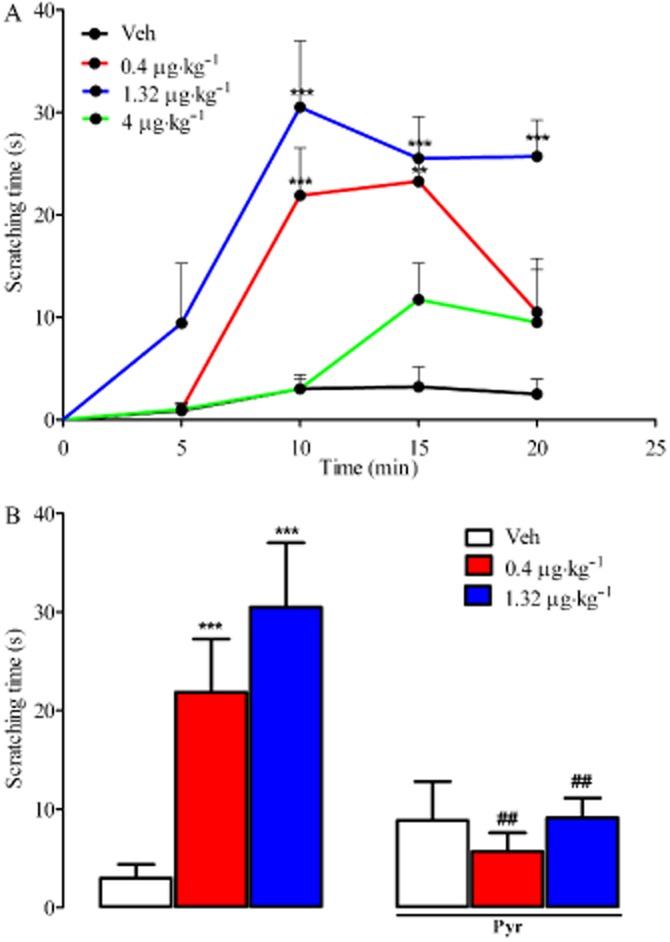
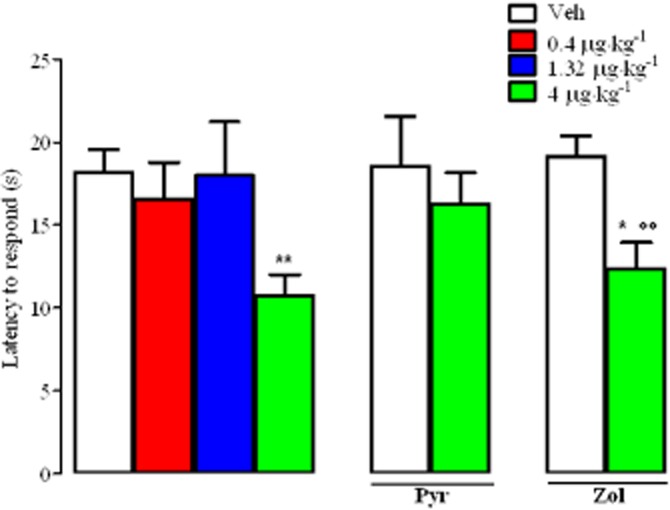
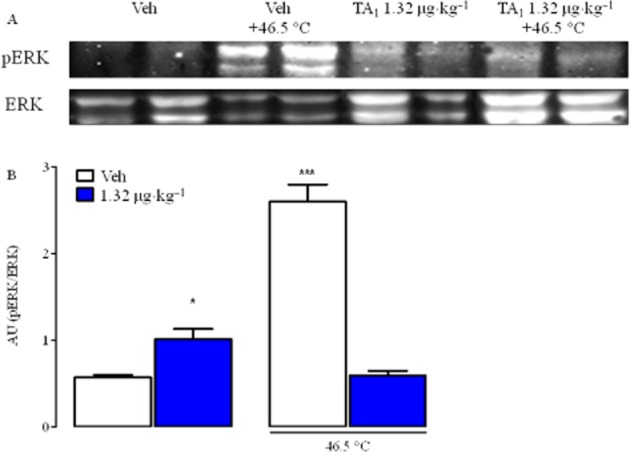
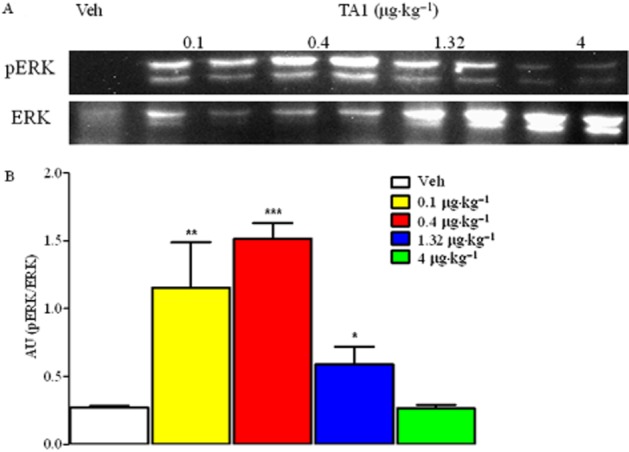
Key results: TA1 0.4 and 1.32 μg·kg(-1) induced itch and reduced NHT; pyrilamine pretreatment prevented both of these effects. TA1 4 μg·kg(-1) (i.p.) reduced pain threshold without inducing itch or modifying NHT. In HDC(-/-) mice, TA1 failed to induce itch and to reduce NHT. In DRG, pERK1/2 levels were significantly increased by noxious heat stimuli and by TA1 0.1, 0.4 and 1.32 μg·kg(-1) ; i.p.

Conclusions and implications: Increased TA1 levels induce itch and an enhanced sensitivity to noxious heat stimuli suggesting that TA1 might represent a potential cause of itch in thyroid diseases.


Figures

Figure 1
Figure 1
TA1 induces itch: the effect of pyrilamine pretreatment. Mice were treated s.c. with saline (Veh) or with TA1 (0.4, 1.32 and 4 μg·kg−1) and observed for the time of onset and intensity of a scratching behaviour as described in Methods (A). Results are mean ± SEM. n = 10 in each group. **P < 0.01 versus Veh; ***P < 0.001 versus Veh. (B) Itch was also measured in mice pretreated with 10 mg·kg−1 pyrilamine (i.p.) or saline (i.p.) 30 min before 0.4, 1.32 and 4 μg·kg−1 TA1 or saline s.c. The intensity of itch after 10 min from TA1 (0.4, 1.32 μg·kg−1) was reported. Results are mean ± SEM. n = 10 in each group. ***P < 0.001 versus Veh; ##P < 0.01 versus TA1 in the absence of pyrilamine.
Figure 2
Figure 2
The NHT of CD1 mice is reduced by TA1: the effect of pyrilamine pretreatment. Mice were treated i.p. with saline (Veh) or TA1 (0.4, 1.32 and 4 μg·kg−1) (A). After 15 min from Veh or TA1 injection their threshold to noxius heat (from 45.5 to 47.5°C) was measured as described in Methods. In another set of experiments, mice were pretreated with 10 mg·kg−1 pyrilamine (i.p.) or Veh (i.p) 15 min before 1.32 μg·kg−1 TA1 i.p. (B). The NHT of the mice was measured as described in ‘Methods’. Results are mean ± SEM of 10 mice per group. *P < 0.05 versus Veh; ***P < 0.001 versus Veh.
Figure 3
Figure 3
TA1 reduces pain threshold of CD1 mice: the effect of pyrilamine or zolantidine pretreatment. Mice were treated i.p. with saline (Veh) or TA1 (0.4, 1.32 and 4 μg·kg−1). After 15 min, their pain threshold was measured as described in Methods by the hot plate test (51.5°C). Experiments were repeated in mice pretreated (i.p.) with 10 mg·kg−1 pyrilamine or zolatidine (5 mg·kg−1) or saline (Veh) 15 min before 4 μg·kg−1 TA1. Results are mean ± SEM obtained from 10 mice for each group. *P < 0.05 versus Veh; **P < 0.01 versus Veh; °°P < 0.01 versus zolantidine alone.
Figure 4
Figure 4
Noxious heat temperature (NHT) and TA1 induces pERK1/2 in DRG from CD1 mice. DRG were isolated from mice randomly treated with saline, TA1 1.32 μg·kg−1 with and without noxious heat stimulus and analysed for pERK1/2 levels by Western blot as described in Methods. (A) pERK1/2 in DRG protein lysates. A representative experiment is shown. (B) Densitometric analysis of pERK1/2 levels in DRG from CD1 mice. Results represent mean ± SEM of two different gels. *P < 0.05 versus Veh; ***P < 0.001 versus Veh.
Figure 5
Figure 5
pERK1/2 levels in DRG from mice receiving increasing TA1 doses. DRG were isolated from mice randomly treated with saline or TA1 (0.1, 0.4, 1.32 and 4 μg·kg−1) and analysed for pERK1/2 levels by Western blot as described in Methods. (A) pERK1/2 in DRG protein lysates. A representative experiment is shown. (B) Densitometric analysis of pERK1/2 levels in DRG from CD1 mice. Results represent mean ± SEM of two different gels. *P < 0.05 versus Veh; **P < 0.01 versusVeh; ***P < 0.001 versus Veh.
Figure 6
Figure 6
Effect of TA1 on TRPV1 channels. (A) Typical whole-cell current traces recorded from putative nociceptors in culture. TA1 (1, 10 or 100 nM) shows no effect per se on whole-cell current in capsaicin-sensitive neurons (n = 5). (B) Left, representative traces obtained from cultured DRG neurons showing the capsaicin-induced, TRPV1-mediated currents in control and in presence of TA1. Right, scatter graph comparing the effect of capsaicin (150 nM) in control conditions and in neurons pre-incubated with TA1 (10 min, 10 nM). Pre-incubation with TA1 did not modulate capsaicin induced-inward currents (P = 0.632; n = 5).
Figure 7
Figure 7
NHT of HDC+/+ and HDC−/− mice: effect of TA1 administration. HDC+/+ were treated i.p. with saline (Veh) or TA1 (1.32, 4 and 11 μg·kg−1). After 15 min, their threshold to noxious heat (from 46.5°C to 49.5°C) was measured as described in Methods (A). In another set of experiments mice were pretreated with 10 mg·kg−1 pyrilamine (i.p.) or Veh (i.p.) 15 min before, 1.32 and 4 μg·kg−1 TA1 i.p. (B). HDC−/− mice were treated i.p. with saline (Veh) or with TA1 (1.32 μg·kg−1) to measure their NHT as described in Methods (C). Results are the means ± SEM of observations from 10 mice. *P < 0.05 versus Veh; **P < 0.01 versus Veh; #P < 0.05 and ##P < 0.01 versus TA1 without pyrilamine respectively. Results are the means ± SEM of observation from 10 mice.

References

    1. Alexander SPH, Benson HE, Faccenda E, Pawson AJ, Sharman JL, Spedding M, et al. The Concise Guide to PHARMACOLOGY 2013/14: G protein-coupled receptors. Br J Pharmacol. 2013a;170:1459–1581. - PMC - PubMed
    1. Alexander SPH, Benson HE, Faccenda E, Pawson AJ, Sharman JL, Spedding M, et al. The Concise Guide to PHARMACOLOGY 2013/14: Ion channels. Br J Pharmacol. 2013b;170:1607–1651. - PMC - PubMed
    1. Alexander SPH, Benson HE, Faccenda E, Pawson AJ, Sharman JL, Spedding M, et al. The Concise Guide to PHARMACOLOGY 2013/14: Enzymes. Br J Pharmacol. 2013c;170:1797–1867. - PMC - PubMed
    1. Almási R, Pethő G, Bölcskei K, Szolcsányi J. Effect of resiniferatoxin on the noxious heat threshold temperature in the rat: a novel heat allodynia model sensitive to analgesics. Br J Pharmacol. 2003;139:49–58. - PMC - PubMed
    1. Anaclet C, Parmentier R, Ouk K, Guidon G, Buda C, Sastre JP, et al. Orexin/hypocretin and histamine: distinct roles in the control of wakefulness demonstrated using knock-outmouse models. J Neurosci. 2009;29:14423–14438. - PMC - PubMed

Publication types

MeSH terms