


Longitudinal patterns of cortisol regulation differ in maltreated and nonmaltreated children
- PMID: 25440310
- PMCID: PMC4254515
- DOI: 10.1016/j.jaac.2014.08.006
Longitudinal patterns of cortisol regulation differ in maltreated and nonmaltreated children
Abstract
Objective: Child maltreatment is associated with dysregulation of stress-mediating systems and an increased risk of mental and physical health problems. Specifically, disruptions in hypothalamic-pituitary-adrenal (HPA) axis regulation have been reported in maltreated children. The current study investigates whether increased cortisol variability is responsible for inconsistent patterns in the literature.
Method: This study modeled cortisol activity over 20 weeks in 187 maltreated and 154 nonmaltreated children (mean = 8.4 years, SD = 1.8 years) in order to capture week-to-week cortisol patterns. Maltreatment was assessed through coding of Department of Human Services records. Children attended an after-school program 1 day per week for 20 weeks, where saliva was collected at the same time each day and subsequently assayed for cortisol.
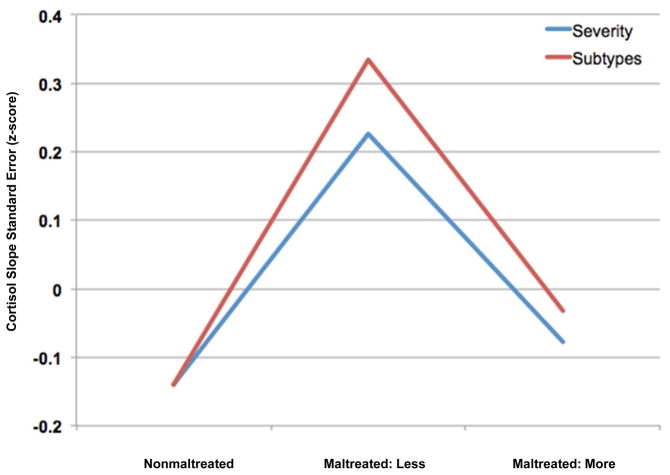
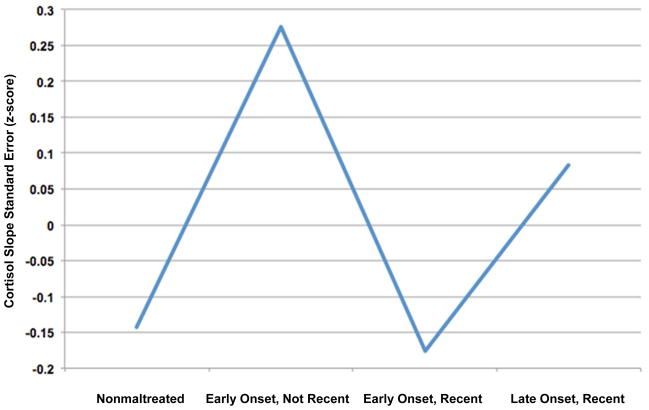
Results: Multiple-group growth curves indicated that maltreated and non-maltreated children differ in longitudinal cortisol patterns. Maltreated children showed higher variance in the initial cortisol levels and slope over time compared to nonmaltreated children, indicating greater between-person variability in the maltreated group. Maltreated children with higher cortisol at the first assessment showed cortisol suppression over time, indicating potential HPA blunting after chronic high cortisol levels. The severity, timing, and number of subtypes of maltreatment predicted individuals' cortisol variability, and both maltreatment status and greater cortisol variability predicted more behavior problems.
Conclusion: Interventions for maltreated children may benefit from pre- and post-intervention HPA assessments to determine a component of treatment efficacy. As maltreatment dimensions predicted differential cortisol regulation, assessment of maltreatment experiences is necessary to understand alterations in behavior and HPA regulation post-intervention.
Keywords: behavior problems; cortisol; maltreatment; middle childhood; structural equation modeling.
Copyright © 2014 American Academy of Child and Adolescent Psychiatry. Published by Elsevier Inc. All rights reserved.
Conflict of interest statement
Disclosure: Drs. Cicchetti and Rogosch and Ms. Doom report no biomedical financial interests or potential conflicts of interest.
Figures
References
-
- Cicchetti D, Toth SL. A multilevel perspective on child maltreatment. In: Lamb M, Garcia Coll C, editors. Handbook of Child Psychology and Developmental Science. 7. Vol. 3. New York: Wiley; Socioemotional process. in press.
-
- Shonkoff JP, Boyce WT, McEwen BS. Neuroscience, molecular biology, and the childhood roots of health disparities: Building a new framework for health promotion and disease prevention. JAMA. 2009;301:2252–2259. - PubMed
-
- Miller GE, Chen E, Zhou ES. If it goes up, must it come down? Chronic stress and the hypothalamic-pituitary-adrenocortical axis in humans. Psychol Bull. 2007;133:25–45. - PubMed
-
- Tarullo AR, Gunnar MR. Child maltreatment and the developing HPA axis. Horm Behav. 2006;50:632–639. - PubMed
Publication types
MeSH terms
Substances
Grants and funding
LinkOut - more resources
Full Text Sources
Other Literature Sources
Medical
Research Materials
