Review
. 2014 Nov 5;84(3):608-22.
doi: 10.1016/j.neuron.2014.10.038. Epub 2014 Nov 5.

The evolution of preclinical Alzheimer's disease: implications for prevention trials

Affiliations
Review

The evolution of preclinical Alzheimer's disease: implications for prevention trials

Reisa Sperling et al. Neuron. .

Abstract

As the field begins to test the concept of a "preclinical" stage of neurodegenerative disease, when the pathophysiological process has begun in the brain, but clinical symptoms are not yet manifest, a number of intriguing questions have already arisen. In particular, in preclinical Alzheimer's disease (AD), the temporal relationship of amyloid markers to markers of neurodegeneration and their relative utility in the prediction of cognitive decline among clinically normal older individuals remains to be fully elucidated. Secondary prevention trials in AD have already begun in both genetic at-risk and amyloid at-risk cohorts, with several more trials in the planning stages, and should provide critical answers about whether intervention at this very early stage of disease can truly bend the curve of clinical progression. This review will highlight recent progress in cognitive, imaging, and biomarker outcomes in the field of preclinical AD, and the remaining gaps in knowledge.


Figures

Figure 1
Figure 1
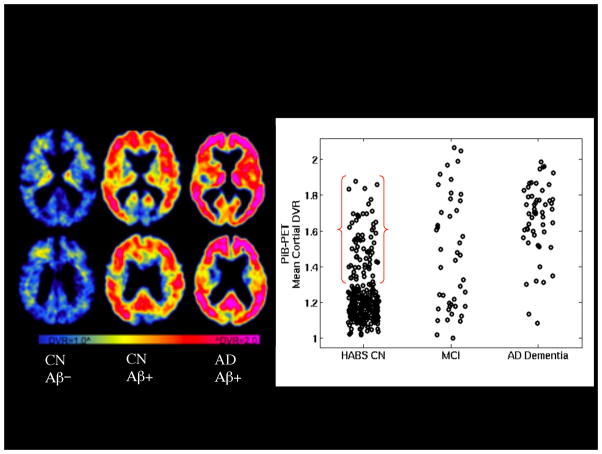
PET amyloid imaging with 11C-PiB. Left: Representative PET images from three older individuals: Clinically normal older individual without evidence of elevated Aβ accumulation (CN Aβ−), Clinically normal older individual with elevated Aβ accumulation (CN Aβ+) and patient with AD dementia with very elevated Aβ accumulation (AD Aβ+) in frontal and parietal heteromodal cortices Right: Scattergram of PiB distribution value ratios (DVR) by diagnostic group: Harvard Aging Brain Study Clinically normal older individuals (HABS CN), Mild Cognitive Impairment (MCI), and AD dementia. Approximately 30% of HABS CN demonstrate elevated Aβ accumulation in the range of MCI and AD dementia Aβ+.
Figure 2
Figure 2
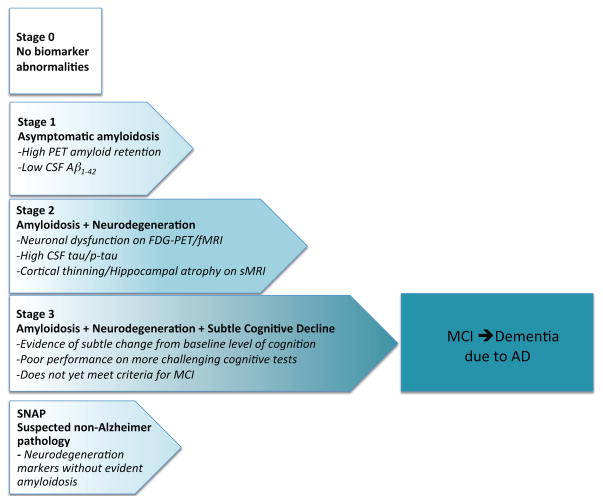
Updated staging framework for preclinical AD (adapted from Sperling et al. 2011a with updates from Jack et al. 2012). Stage 0 represents individuals without biomarker abnormalities who are not thought to be on the AD trajectory. Stage 1 begins with cerebral amyloidosis; Stage 2 is amyloidosis plus markers of neurodegeneration; Stage 3 is amyloidosis + neurodegeneration + evidence of subtle cognitive and behavioral decline that is not yet sufficient to meet criteria for mild cognitive impairment or dementia due to AD. SNAP or Suspected Non-Alzheimer Pathology has evidence of neurodegeneration without apparent amyloidosis.
Figure 3
Figure 3
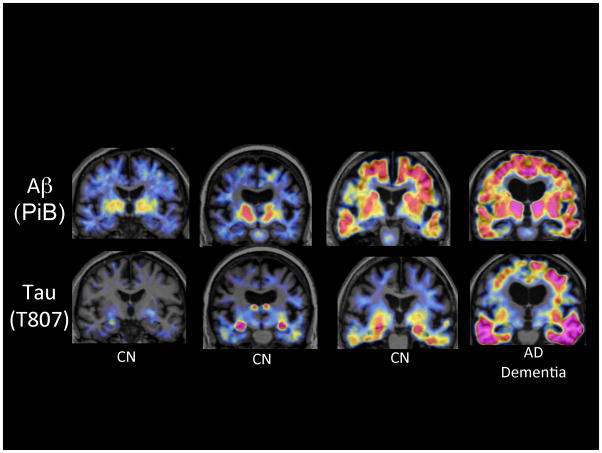
Amyloid and Tau PET imaging. Coronal PET images superimposed on structural Magnetic Resonance) of PiB Aβ (upper row) and T807 Tau (lower row) acquired on 4 participants in the Harvard Aging Brain Study. The first three columns of images are from clinically normal older individuals (CN) with the far right image acquired from a patient with AD dementia. Moving from left to right exemplifies increasing levels of Aβ in necortical regions associated with increasing levels of Tau, particularly prominent in the inferior temporal cortices.
Figure 4
Figure 4
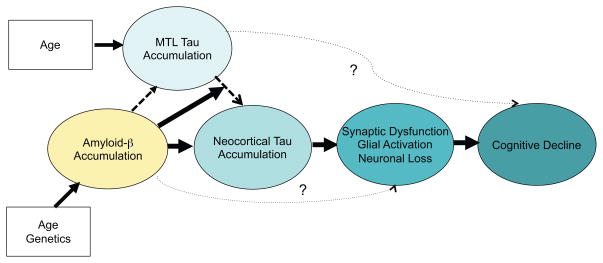
Hypothetical model of the interaction of amyloid-β (Aβ) and tau accumulation. Advancing age is nearly ubiquitously associated with the gradual accumulation of Tau aggregates in medial temporal lobe (MTL), but it remains unknown whether MTL tau in isolation is associated with “age-related cognitive change. Age and genetics influence likelihood of accumulating elevated levels of amyloid-β (Aβ) aggregates. Aβ is hypothesized to increase the accumulation of Tau aggregates and in particular to accelerate the spread of Tau out of the MTL into the neocortex through local diffusion and perhaps via transynaptic spread across neural networks. Tau accumulation leads to synaptic dysfunction, glial activation, and eventually neuronal loss. Aβ may also have direct synaptic toxicity that is not mediated through Tau. The spreading of Tau into neocortex and associated neurodegenerative processes are thought to result in cognitive impairment and further progression along the clinical trajectory of Alzheimer’s disease.
Figure 5
Figure 5
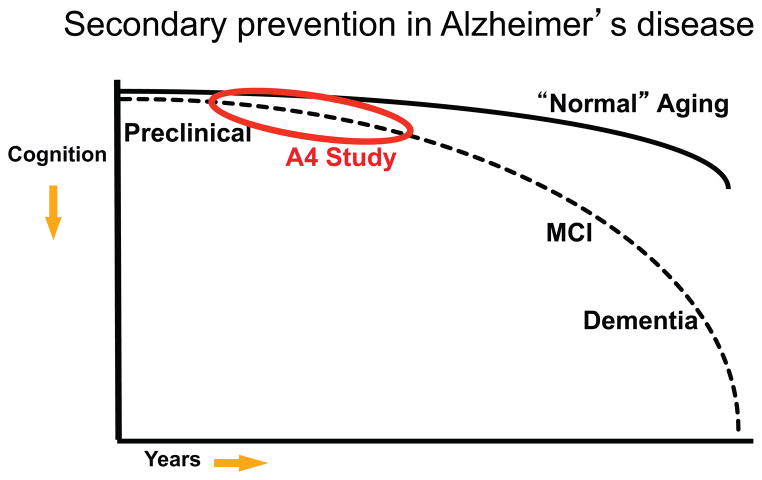
Continuum of Alzheimer’s disease (AD). Cognitive trajectory of “normal aging (starting in late life) demonstrates some decline over decades with increased deterioration in very late life. Preclinical stage of AD at the asymptomatic stage initially demonstrates similar cognitive trajectory as “normal aging but in later stages of preclinical AD demonstrates increased rate of cognitive decline towards mild cognitive impairment (MCI) and dementia due to AD. The Anti-Amyloid Treatment in Asymptomatic AD (A4) Study will test an anti-amyloid interview in preclinical AD aimed at slowing the rate of cognitive decline.

References

    1. Ahmed Z, Cooper J, Murray TK, Garn K, McNaughton E, Clarke H, Parhizkar S, Ward MA, Cavallini A, Jackson S, et al. A novel in vivo model of tau propagation with rapid and progressive neurofibrillary tangle pathology: the pattern of spread is determined by connectivity, not proximity. Acta Neuropathol. 2014;127:667–683. - PMC - PubMed
    1. Aizenstein HJ, Nebes RD, Saxton JA, Price JC, Mathis CA, Tsopelas ND, Ziolko SK, James JA, Snitz BE, Houck PR, et al. Frequent amyloid deposition without significant cognitive impairment among the elderly. Arch Neurol. 2008;65:1509–1517. - PMC - PubMed
    1. Amariglio RE, Becker JA, Carmasin J, Wadsworth LP, Lorius N, Sullivan C, Maye JE, Gidicsin C, Pepin LC, Sperling RA, et al. Subjective cognitive complaints and amyloid burden in cognitively normal older individuals. Neuropsychologia. 2012;50:2880–2886. - PMC - PubMed
    1. Arriagada PV, Growdon JH, Hedley-Whyte ET, Hyman BT. Neurofibrillary tangles but not senile plaques parallel duration and severity of Alzheimer’s disease. Neurology. 1992a;42:631–639. - PubMed
    1. Arriagada PV, Marzloff K, Hyman BT. Distribution of Alzheimer-type pathologic changes in nondemented elderly individuals matches the pattern in Alzheimer’s disease. Neurology. 1992b;42:1681–1688. - PubMed

Publication types

MeSH terms

Substances