. 2014 Dec 2;15(1):1049.
doi: 10.1186/1471-2164-15-1049.

Diversity, expression and mRNA targeting abilities of Argonaute-targeting miRNAs among selected vascular plants

Affiliations

Diversity, expression and mRNA targeting abilities of Argonaute-targeting miRNAs among selected vascular plants

Soham Jagtap et al. BMC Genomics. .

Abstract

Background: Micro (mi)RNAs are important regulators of plant development. Across plant lineages, Dicer-like 1 (DCL1) proteins process long ds-like structures to produce micro (mi) RNA duplexes in a stepwise manner. These miRNAs are incorporated into Argonaute (AGO) proteins and influence expression of RNAs that have sequence complementarity with miRNAs. Expression levels of AGOs are greatly regulated by plants in order to minimize unwarranted perturbations using miRNAs to target mRNAs coding for AGOs. AGOs may also have high promoter specificity-sometimes expression of AGO can be limited to just a few cells in a plant. Viral pathogens utilize various means to counter antiviral roles of AGOs including hijacking the host encoded miRNAs to target AGOs. Two host encoded miRNAs namely miR168 and miR403 that target AGOs have been described in the model plant Arabidopsis and such a mechanism is thought to be well conserved across plants because AGO sequences are well conserved.

Results: We show that the interaction between AGO mRNAs and miRNAs is species-specific due to the diversity in sequences of two miRNAs that target AGOs, sequence diversity among corresponding target regions in AGO mRNAs and variable expression levels of these miRNAs among vascular plants. We used miRNA sequences from 68 plant species representing 31 plant families for this analysis. Sequences of miR168 and miR403 are not conserved among plant lineages, but surprisingly they differ drastically in their sequence diversity and expression levels even among closely related plants. Variation in miR168 expression among plants correlates well with secondary structures/length of loop sequences of their precursors.

Conclusions: Our data indicates a complex AGO targeting interaction among plant lineages due to miRNA sequence diversity and sequences of miRNA targeting regions among AGO mRNAs, thus leading to the assumption that the perturbations by viruses that use host miRNAs to target antiviral AGOs can only be species-specific. We also show that rapid evolution and likely loss of expression of miR168 isoforms in tobacco is related to the insertion of MITE-like transposons between miRNA and miRNA* sequences, a possible mechanism showing how miRNAs are lost in few plant lineages even though other close relatives have abundantly expressing miRNAs.


Figures
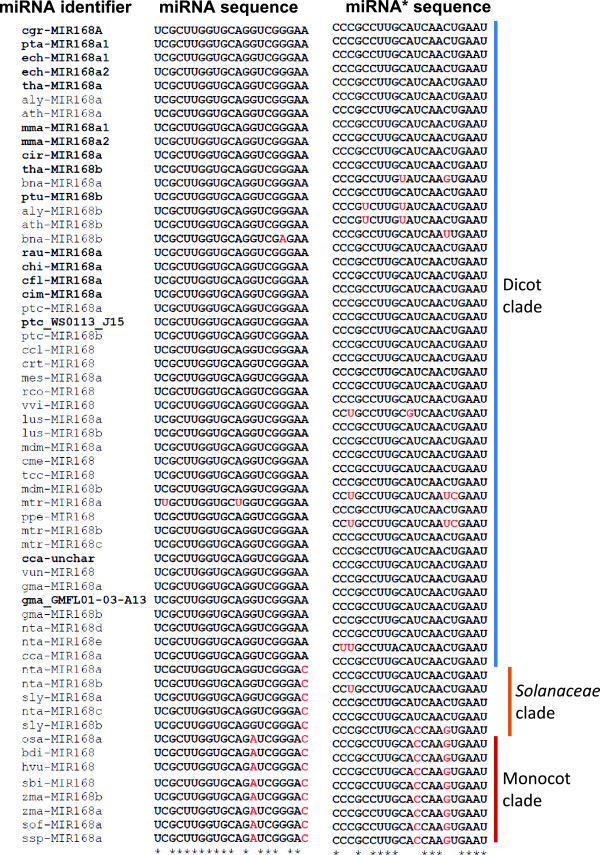
Figure 1
Figure 1
Multiple sequence alignment of miR168 and miR168* sequences from vascular plants. Sequences from miRBase as well those fetched from other sources (in bold, see materials and methods) were aligned using ClustalW. Residues in red are not conserved among others. Expanded names of species that are abbreviated are given in Additional file 1: Table S1.
Figure 2
Figure 2
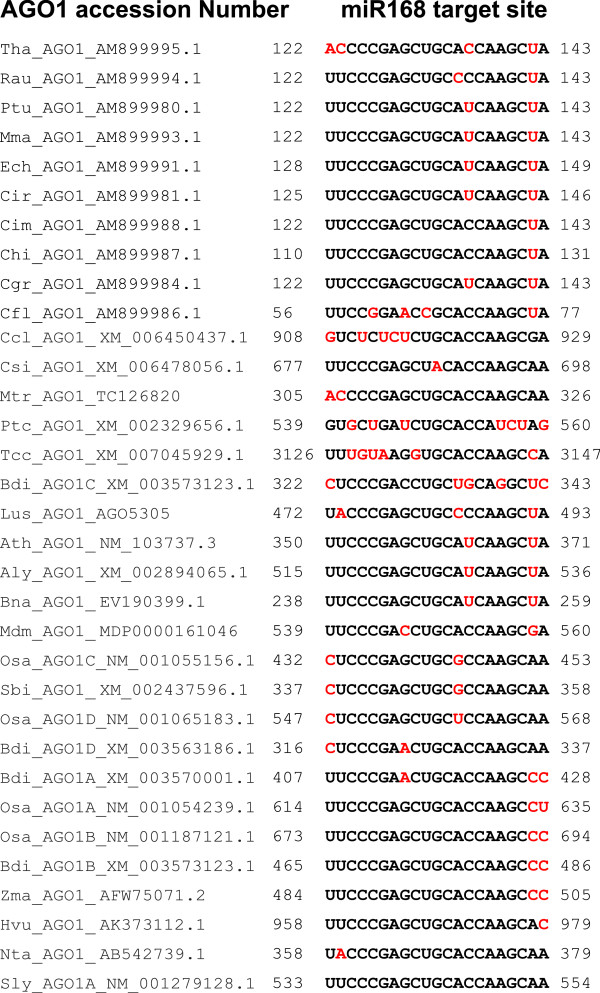
Alignment of miR168 targeting regions in AGO1 from various plant species. Residues in red are not conserved among others. Start and stop regions in AGO1 mRNAs have been mentioned.
Figure 3
Figure 3
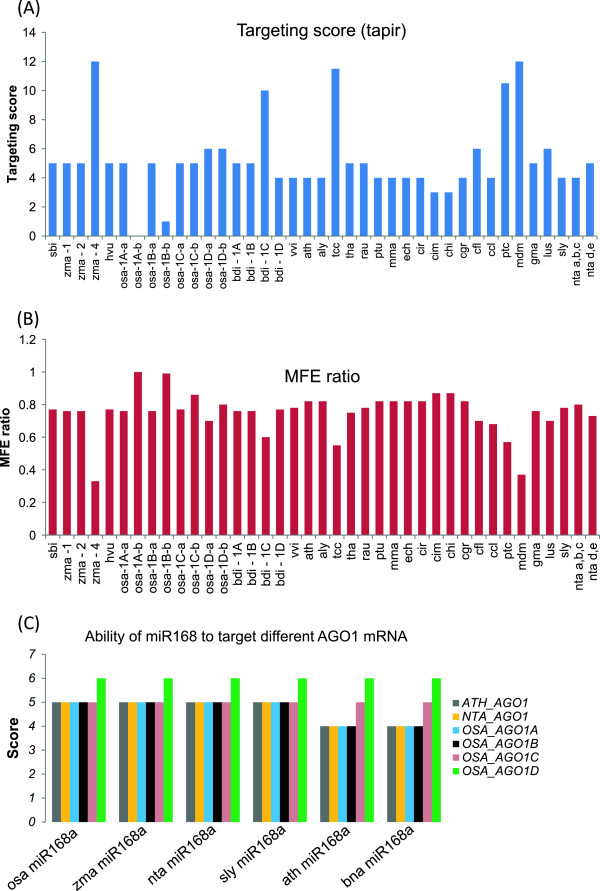
AGO1 targeting abilities of miR168 from corresponding species. (A) Target score for AGO1 targeting in different species by their miR168. TAPIR analysis was carried out as described in methods section. Abbreviation of plant names are given in Additional file 1: Table S1. (B) MFe ratios for the target/miR168 complementarity. Best targets have lower score and higher MFe ratio. (C) Predicted AGO1 targeting of miR168 from few representative species along with AGO1 from other species for comparison.
Figure 4
Figure 4
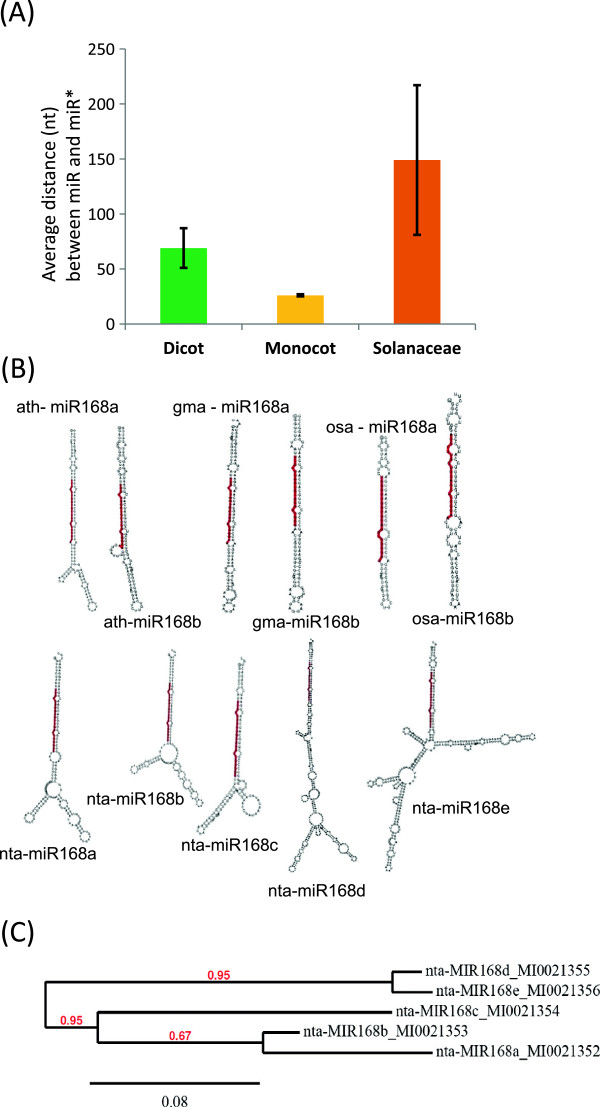
Structural variations in tobacco miR168 isoforms compared to other representative plants. (A) Variation in average length between miR168 and miR168* sequences among monocots, all dicots except Solanaceae and among Solanaceae. (B) Secondary structures of miR168 members from few plants. Although rice, soybean and Arabidopsis have 2 identical mature miR168 isoforms with almost similar secondary structures, tobacco isoforms have diverse secondary structures. RNA fold (http://rna.tbi.univie.ac.at/cgi-bin/RNAfold.cgi) was used to determine secondary structures. (C) Phylogenetic analysis of miR168 isoforms from tobacco indicating two clusters. Tree was constructed as described in methods section.
Figure 5
Figure 5
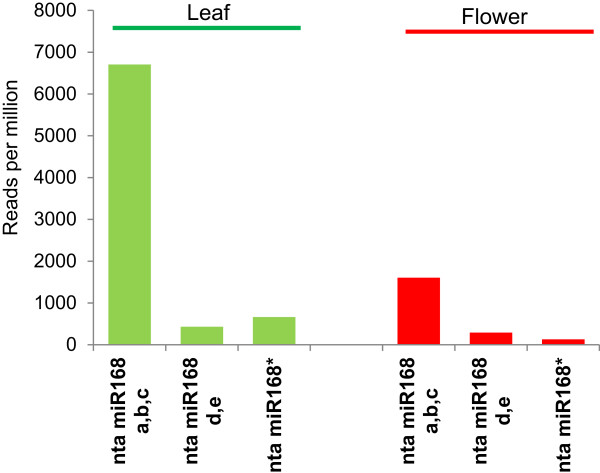
Accumulation of miR168 a,b,c and miR168 d,e isoforms among tobacco tissues (floral and leaf). Reads of miRNA or miRNA* per million reads was taken from GEO accession GSE28977. Similar ratio between a,b,c and d,e were observed among tobacco pods. miR168 sequences were retrieved as discussed in methods section.
Figure 6
Figure 6
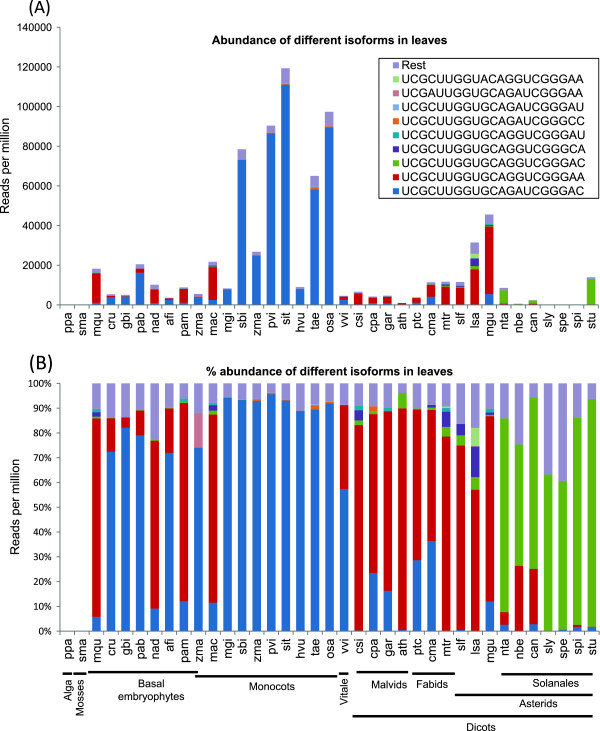
Abundance and sequence diversity of miR168 members across plant families. (A) Highest abundance of miR168 among monocots. Color bars represent most abundant forms of miR168 in leaf tissues. Blue, red and green bars represent monocot, dicot and Solanaceae-specific forms as shown in Figure 1. Abundance was measured as discussed in methods section. (B) Percentage abundance of miR168 across plant families. Phylogenetic relationships among plant species have been indicated.
Figure 7
Figure 7
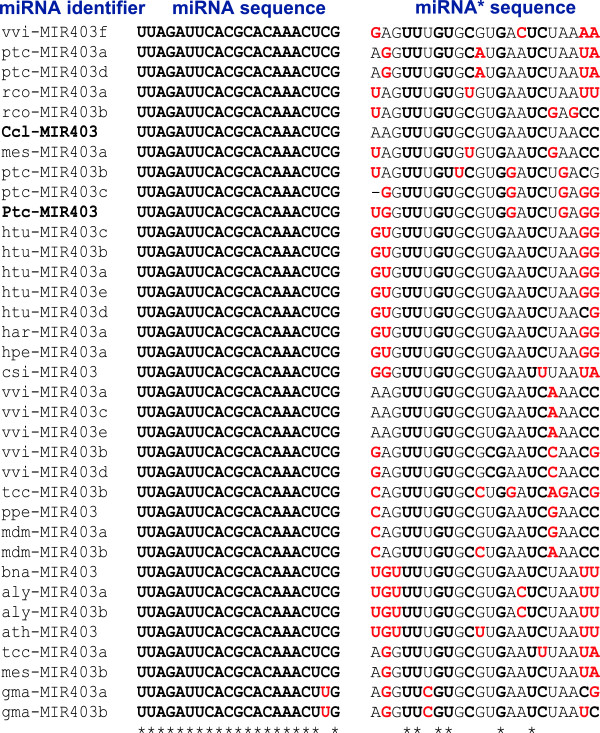
Diversity of miR403 sequences. CLUSTAL alignment with sequences from miRBase as well as from other sources (in bold). Residues in red are not conserved among the family members.
Figure 8
Figure 8
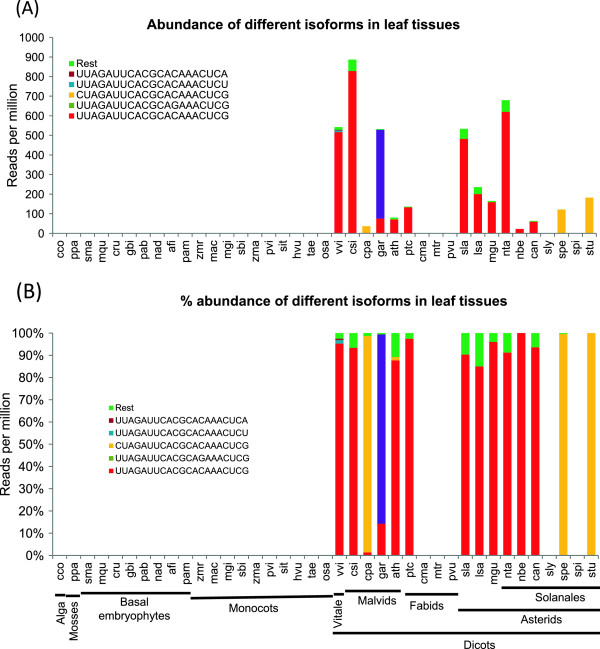
Abundance and sequence diversity of miR403 members across plant families. (A) miR403 is conserved only among Rosiid members namely Malvids and Vitales and few Fabids. Color bars represent most abundant forms of miR403 in leaf tissues. Abundance was measured as discussed in methods section. (B) Percentage abundance of miR403 across plant families.

References

    1. Baulcombe D. RNA silencing in plants. Nature. 2004;431:356–363. doi: 10.1038/nature02874. - DOI - PubMed
    1. Voinnet O. Origin, biogenesis, and activity of plant microRNAs. Cell. 2009;136:669–687. doi: 10.1016/j.cell.2009.01.046. - DOI - PubMed
    1. Axtell MJ. Evolution of microRNAs and their targets: are all microRNAs biologically relevant? Biochim Biophys Acta. 2008;1779:725–734. doi: 10.1016/j.bbagrm.2008.02.007. - DOI - PubMed
    1. Cuperus JT, Fahlgren N, Carrington JC. Evolution and Functional Diversification of MIRNA Genes. Plant Cell. 2011;23:431–442. doi: 10.1105/tpc.110.082784. - DOI - PMC - PubMed
    1. Zhai J, Jeong D-H, De Paoli E, Park S, Rosen BD, Li Y, Gonzalez AJ, Yan Z, Kitto SL, Grusak MA, Jackson SA, Stacey G, Cook DR, Green PJ, Sherrier DJ, Meyers BC. MicroRNAs as master regulators of the plant NB-LRR defense gene family via the production of phased, trans-acting siRNAs. Genes Dev. 2011;25:2540–2553. doi: 10.1101/gad.177527.111. - DOI - PMC - PubMed

Publication types

MeSH terms

LinkOut - more resources