


Size of distal radial and distal ulnar arteries in adults of southern Rajasthan and their implications for percutaneous coronary interventions
- PMID: 25443603
- PMCID: PMC4223202
- DOI: 10.1016/j.ihj.2014.08.010
Size of distal radial and distal ulnar arteries in adults of southern Rajasthan and their implications for percutaneous coronary interventions
Abstract
Aims and objectives: Transradial interventions are gaining popularity in recent years. However the radial artery being small, there is a limitation in using interventional devices through this route. We have measured radial and ulnar arteries size in adult patients at our tertiary care cardiology center in southern Rajasthan.
Method: Adult patients >30 years, who came for Echocardiography at a tertiary care center were included. Radial and ulnar arteries inner diameters were measured 2-3 cm above the Styloid process in both forearms with the Ultrasonography. Patient information about weight, height, diabetes and hypertension were collected. Body mass index and Body surface area were calculated.
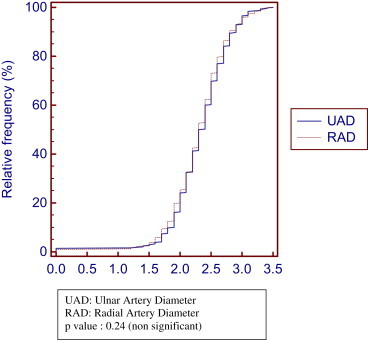
Results: We studied 204 patients, which includes 60.8% males. Mean diameter was 2.325 ± 0.4 mm mm for radial arteries and 2.358 ± 0.39 mm for ulnar arteries (p = 0.24). Hypertensive and male patients had larger mean radial artery diameter than non hypertensive (2.383 mm v/s 2.272 mm, p = 0.006) and female patients (2.37 mm v/s 2.26 mm, p = 0.008) respectively. Diabetic patients (2.305 mm) had nonsignificantly smaller radial arteries diameters than nondiabetics (2.329 mm, p = 0.6). We calculated correlations between radial arteries diameters and Body surface area, Body mass index, height and weight of patients, none of these correlations were statistically significant (r = 0.30, r = 0.28, r = 0.07, r = 0.031 respectively).
Conclusion: Mean radial artery diameter (2.325 ± 0.4 mm) in the study was slightly smaller than ulnar artery (2.358 ± 0.39 mm). Males and hypertensives had a larger mean radial artery diameter than females and non hypertensives. Radial artery inner diameter measurement by Ultrasonography may be more helpful than Allen's test for ideal selection of cases.
Keywords: Radial; Ulnar; Ultrasound.
Copyright © 2014 Cardiological Society of India. Published by Elsevier B.V. All rights reserved.
Figures
References
-
- Campeau L. Percutaneous radial artery approach for coronary angiography. Catheter Cardiovasc Diagn. 1989;16:111–121. - PubMed
-
- Kiemeneij F., Laarman G.J. Percutaneous transradial artery approach for coronary stent implantation. Catheter Cardiovasc Diagn. 1993;30:173–178. - PubMed
-
- Brueck M., Bandorski D., Kramer W. A randomized comparison of transradial versus transfemoral approach for coronary angiography and angioplasty. J Am Coll Cardiol Intv. 2009;2:1047–1054. - PubMed
-
- Loh Y.J., Naka M., Tan W.D., Lin C.H., Tan Y.S., Chua Y.L. Factors influencing radial artery size. Asian Cardiovasc Thorac Ann. 2007;15:324–326. - PubMed
-
- Khder Y., Bray-Deboscs L., Aliot E., Zannad F. Effects of blood pressure control on radial artery diameter and compliance in hypertensive patients. Am J Hypertens. 1997;10:269–274. - PubMed
Publication types
MeSH terms
LinkOut - more resources
Full Text Sources
Other Literature Sources
