Drug-induced liver injury: results from the hospital-based Berlin Case-Control Surveillance Study
- PMID: 25444550
- PMCID: PMC4456131
- DOI: 10.1111/bcp.12565
Drug-induced liver injury: results from the hospital-based Berlin Case-Control Surveillance Study
Abstract
Aim: Drug-induced liver injury (DILI) is often responsible for acute liver failure, drug withdrawal, boxed warnings or drug non-approval. Therefore, we conducted a case-control study to determine the hepatotoxic risk of a wide range of drugs.
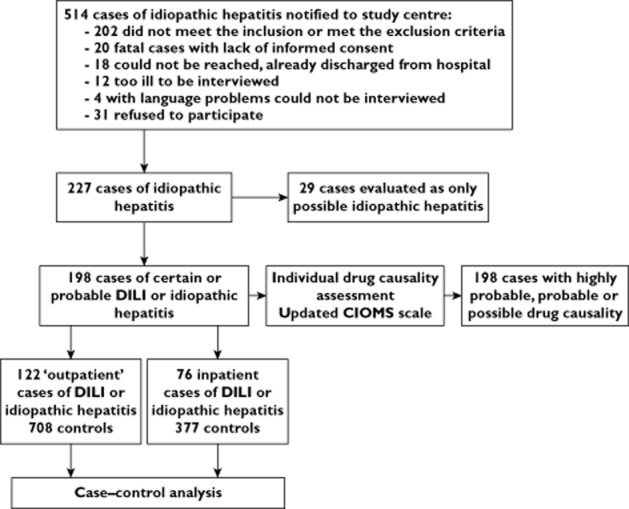
Methods: The Berlin Case-Control Surveillance Study FAKOS included all 51 Berlin hospitals in a hospital network. Between 2002 and 2011, 198 patients with acute idiopathic hepatitis, 377 inpatient controls and 708 outpatient controls were ascertained. Case patients were thoroughly validated using anamnestic, clinical, laboratory and histological data. Drug exposure was obtained in a face-to-face interview. A possible drug aetiology was assessed in individual patients by applying the updated Council for International Organizations of Medical Sciences (CIOMS) scale. Drug risks were further quantified [odds ratios (OR) with 95% confidence intervals (CI)] in a case-control design with unconditional logistic regression analysis. Drug intake in the last 28 days before index date was considered for the analysis.
Results: The study corroborated hepatotoxic risks for a number of drugs, including phenprocoumon (OR 3.3, 95% CI 1.5, 6.7), amiodarone (OR 5.5, 95% CI 1.3, 21.2), clozapine (OR 34.6, 95% CI 2.8, 824.9) and flupirtine (OR 40.2, 95% CI 5.5, 856.9). Increased risks were also suggested for less commonly reported substances such as angiotensin II receptor blockers, atypical antipsychotics and for biperiden, a drug never before reported to be hepatotoxic.
Conclusions: Our study identified a large number of drugs as possible causes of hepatotoxicity. The observed risk for seldom reported substances highlights the need for further post-authorization safety studies not exclusively focusing on drugs already labelled as potentially hepatotoxic.
Keywords: drug safety; hepatotoxicity; pharmacovigilance.
© 2014 The British Pharmacological Society.
Figures
References
-
- Hayashi PH, Fontana RJ. Clinical features, diagnosis, and natural history of drug-induced liver injury. Semin Liver Dis. 2014;34:134–144. - PubMed
-
- Benichou C. Criteria of drug-induced liver disorders – report of an international consensus meeting. J Hepatol. 1990;11:272–276. - PubMed
-
- Ostapowicz G, Fontana RJ, Schiodt FV, Larson A, Davern TJ, Han SH, McCashland TM, Shakil AO, Hay JE, Hynan L, Crippin JS, Blei AT, Samuel G, Reisch J, Lee WM. Results of a prospective study of acute liver failure at 17 tertiary care centers in the United States. Ann Intern Med. 2002;137:947–954. - PubMed
-
- Hussaini SH, Farrington EA. Idiosyncratic drug-induced liver injury: an overview. Expert Opin Drug Saf. 2007;6:673–684. - PubMed
Publication types
MeSH terms
Substances
LinkOut - more resources
Full Text Sources
Other Literature Sources
Medical