


A new look at the science of weight control: how acceptance and commitment strategies can address the challenge of self-regulation
- PMID: 25445199
- PMCID: PMC4314333
- DOI: 10.1016/j.appet.2014.10.004
A new look at the science of weight control: how acceptance and commitment strategies can address the challenge of self-regulation
Abstract
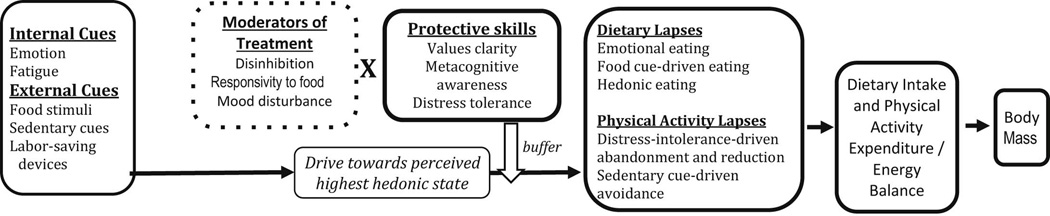
The current manuscript proposes an acceptance-based, self-regulation framework for understanding the challenge of weight maintenance and describes how this framework can be integrated into the behavioral treatment of obesity. According to this framework, intrinsic drives to consume palatable, high-calorie food interact with a modern environment in which high calorie foods are easily accessible. This combination produces a chronic desire to eat unhealthy foods that exists in opposition to individuals' weight control goals. Similarly, low energy expenditure requirements reduce physical activity. We suggest that individuals vary in their responsivity to cues that motivate overeating and sedentary behavior, and that those higher in responsivity need specialized self-regulatory skills to maintain healthy eating and exercise behaviors. These skills include an ability to tolerate uncomfortable internal reactions to triggers and a reduction of pleasure, behavioral commitment to clearly-defined values, and metacognitive awareness of decision-making processes. So-called "acceptance-based" interventions based on these skills have so far proven efficacious for weight control, especially for those who are the most susceptible to eating in response to internal and external cues (as predicted by the model). Despite the current empirical support for the postulated model, much remains to be learned including whether acceptance-based interventions will prove efficacious in the longer-term.
Keywords: Acceptance; Behavioral therapy; Mindfulness; Self-regulation; Weight control; Weight loss.
Copyright © 2014 Elsevier Ltd. All rights reserved.
Figures
References
-
- Annunziato RA, Zettle RD, Bissett RT. Acceptance and commitment therapy (act) vs. Systematic desensitization in treatment of mathematics anxiety. Psychological Record. 2003;53(2):197–215.
-
- Baumeister R. The self. In: Gilbert D, Fiske S, Lindzey G, editors. The handbook of social psychology. Boston: McGraw-Hill; 1998.
-
- Bonato DP, Boland FJ. Predictors of weight loss at the end of treatment and 1-year follow-up for a behavioral weight loss program. Int J Eat Disord. 1987;6:573–577.
-
- Bond FW, Bunce D. Mediators of change in emotion-focused and problem-focused worksite stress management interventions. Journal of Occupational Health Psychology. 2000;5(1):156–163. - PubMed
Publication types
MeSH terms
Grants and funding
LinkOut - more resources
Full Text Sources
Other Literature Sources
Medical
