. 2015 Jan;185(1):139-50.
doi: 10.1016/j.ajpath.2014.09.009. Epub 2014 Nov 6.

Chronic continuous exenatide infusion does not cause pancreatic inflammation and ductal hyperplasia in non-human primates

Affiliations

Chronic continuous exenatide infusion does not cause pancreatic inflammation and ductal hyperplasia in non-human primates

Teresa Vanessa Fiorentino et al. Am J Pathol. 2015 Jan.

Abstract

In this study, we aimed to evaluate the effects of exenatide (EXE) treatment on exocrine pancreas of nonhuman primates. To this end, 52 baboons (Papio hamadryas) underwent partial pancreatectomy, followed by continuous infusion of EXE or saline (SAL) for 14 weeks. Histological analysis, immunohistochemistry, Computer Assisted Stereology Toolbox morphometry, and immunofluorescence staining were performed at baseline and after treatment. The EXE treatment did not induce pancreatitis, parenchymal or periductal inflammatory cell accumulation, ductal hyperplasia, or dysplastic lesions/pancreatic intraepithelial neoplasia. At study end, Ki-67-positive (proliferating) acinar cell number did not change, compared with baseline, in either group. Ki-67-positive ductal cells increased after EXE treatment (P = 0.04). However, the change in Ki-67-positive ductal cell number did not differ significantly between the EXE and SAL groups (P = 0.13). M-30-positive (apoptotic) acinar and ductal cell number did not change after SAL or EXE treatment. No changes in ductal density and volume were observed after EXE or SAL. Interestingly, by triple-immunofluorescence staining, we detected c-kit (a marker of cell transdifferentiation) positive ductal cells co-expressing insulin in ducts only in the EXE group at study end, suggesting that EXE may promote the differentiation of ductal cells toward a β-cell phenotype. In conclusion, 14 weeks of EXE treatment did not exert any negative effect on exocrine pancreas, by inducing either pancreatic inflammation or hyperplasia/dysplasia in nonhuman primates.


Figures

Figure 1
Figure 1
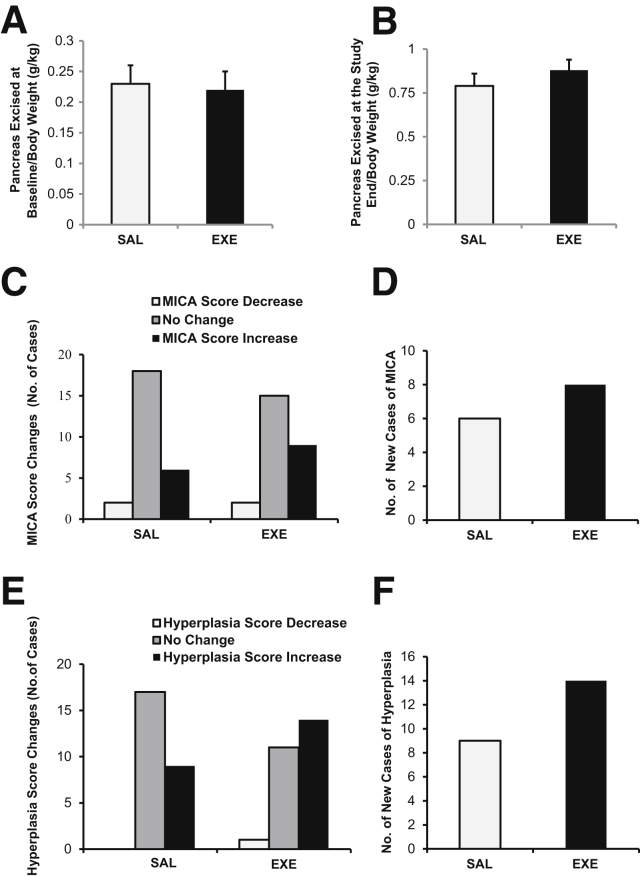
Pancreatic tissue weight and mononuclear inflammatory cell accumulation (MICA) and ductal hyperplasia score changes in saline (SAL) and exenatide (EXE) groups. A: Weight of pancreas (g) excised at baseline/body weight (kg) at baseline. B: Weight of pancreas (g) excised at study end/body weight (kg) at the EOS. C: Number of baboons with increase, decrease, and no change in MICA score after EXE or SAL treatment. D: Number of animals with pancreas MICA newly identified after SAL (white bar) and EXE treatment (black bar). E: Number of baboons with increase, decrease, and no change in ductal hyperplasia score after EXE or SAL treatment. F: Number of animals with pancreatic hyperplasia newly identified after SAL (white bar) and EXE treatment (black bar). Number of sections for each baboon = 4 (H&E staining; 2 sections at baseline and 2 sections at the end of the study). None of the comparisons were statistically significant.
Figure 2
Figure 2
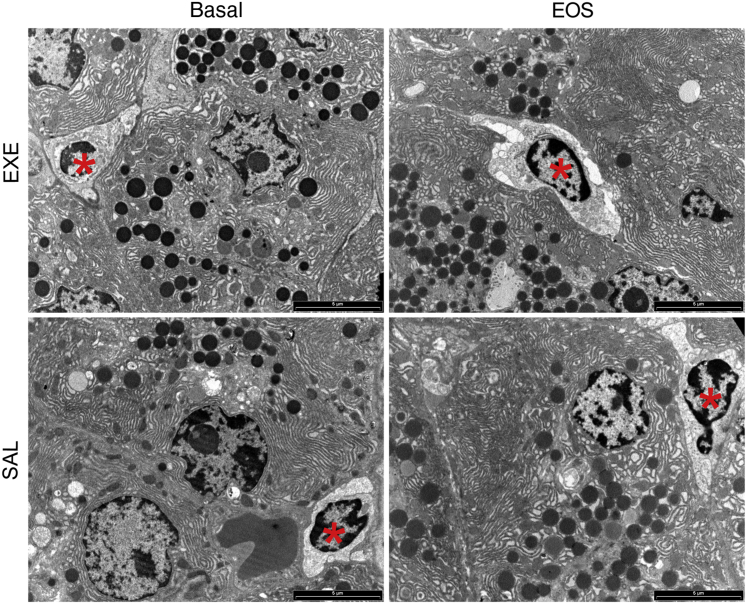
Exocrine pancreas electron microscopy. Electron microscopic analysis confirms the presence of lymphocytes (asterisks) among exocrine acinar cells in both saline (SAL) and exenatide (EXE) groups, at baseline and at the study end. Acinar cells are morphologically normal appearing with regular nuclei, abundant endoplasmic reticulum, and zymogen granules, before and after EXE treatment as well as before and after SAL treatment.
Figure 3
Figure 3
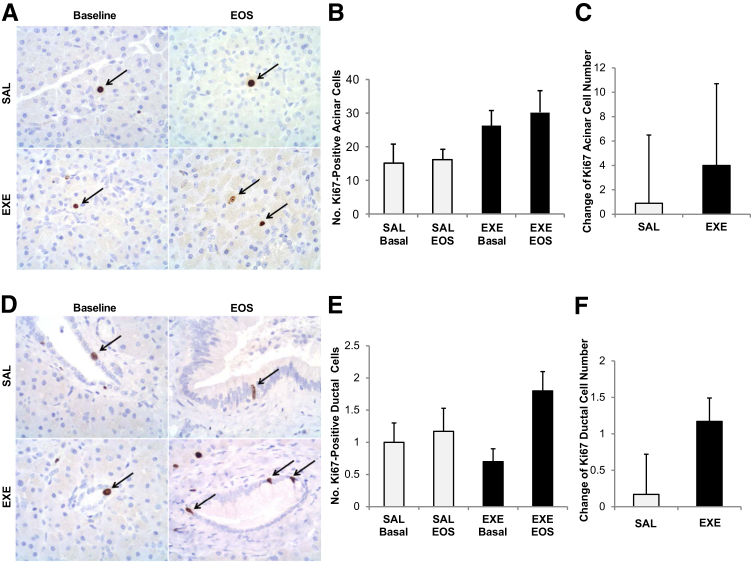
Exocrine pancreatic cell proliferation evaluation by Ki-67 immunostaining. A: Acinar cells positive for Ki-67 immunostaining (arrows). B: Mean number of Ki-67–positive acinar cells in aline (SAL, white bars) and exenatide (EXE, black bars) groups at baseline and at the end of the study (EOS) (B). C: Change in Ki-67–positive acinar cell number between baseline and EOS in both groups. D: Ductal cells positive for Ki-67 immunostaining (arrows). E: Mean number of Ki-67–positive ductal cells in SAL (white bars) and EXE (black bars) groups at baseline and at EOS. F: Change in the number of Ki-67–positive ductal cells between baseline and EOS in both groups. Number of sections with Ki-67 staining for each baboon = 4 (2 sections at baseline and 2 sections at the EOS). None of the comparisons were statistically significant.
Figure 4
Figure 4
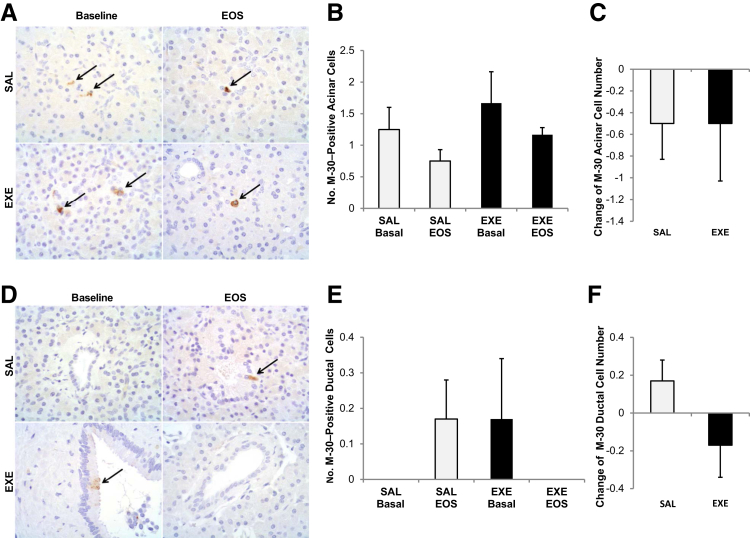
Exocrine pancreatic cell apoptosis evaluation by M-30 immunostaining. A: Acinar cells positive for M-30 immunostaining (arrows). B: Mean number of M-30–positive acinar cells in saline (SAL, white bars) and exenatide (EXE, black bars) groups at baseline and at end of the study (EOS) (B). C: Change in M-30–positive acinar cell number. D: Ductal cells positive for M-30 immunostaining (arrows). E: Mean number of M-30–positive ductal cells in SAL (white bars) and EXE (black bars) groups at baseline and at EOS. F: Change in the number of M-30–positive ductal cells. Number of sections with M-30 immunostaining for each baboon = 4 (2 sections at baseline and 2 sections at the EOS). None of the comparisons were statistically significant.
Figure 5
Figure 5
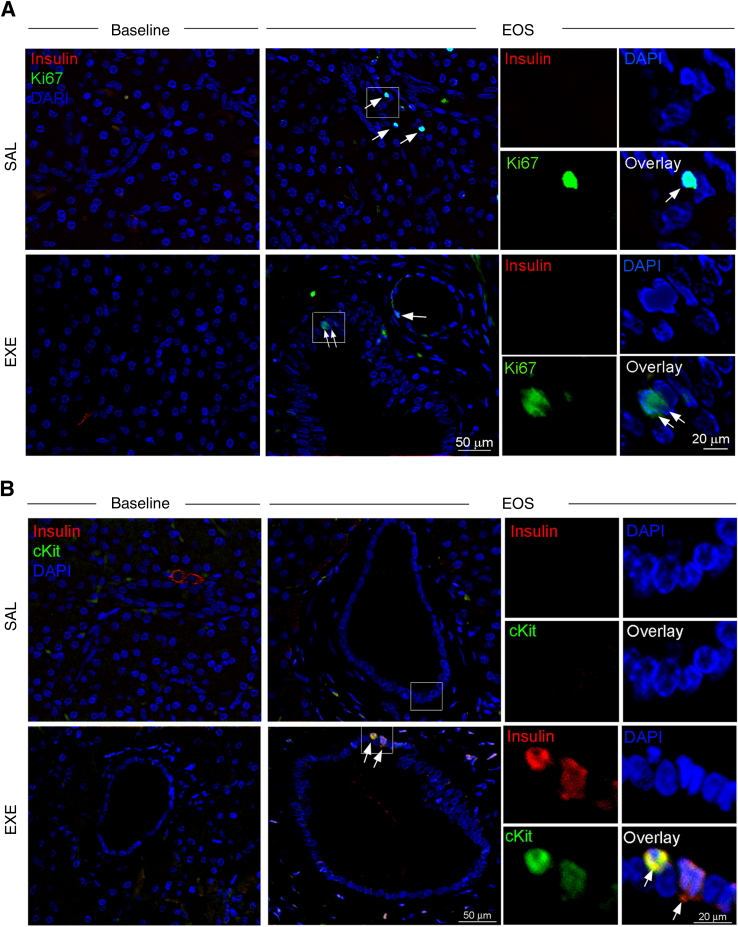
Detection of insulin-expressing cells in pancreatic ducts by immunofluorescence staining. A: Representative images of pancreas sections triple stained with insulin (red), Ki-67 (green), and DAPI (blue), at baseline and at study end, in saline (SAL) and exenatide (EXE) groups. After pancreatectomy (EOS), Ki-67–positive nuclei (arrows) were found in duct structures of either the SAL or EXE group. B: Representative images of pancreas sections triple stained with insulin (red), c-kit (a marker of differentiation) (green), and DAPI (blue) at baseline and at study end in SAL and EXE groups. Rare cells double labeled with c-kit and insulin (yellow staining) were identified in duct structures only at study end in the EXE group (arrows). Examples of c-kit–positive ductal cells co-expressing insulin are also shown at higher magnification. The boxed areas in white in the SAL- and EXE-treated samples are magnified in the single channel and overlay photos on the right. Original magnification, ×2.5.

References

    1. Xu G., Stoffers D.A., Habener J.F., Bonner-Weir S. Exendin-4 stimulates both beta-cell replication and neogenesis, resulting in increased beta-cell mass and improved glucose tolerance in diabetic rats. Diabetes. 1999;48:2270–2276. - PubMed
    1. Farilla L., Hui H., Bertolotto C., Kang E., Bulotta A., Di Mario U., Perfetti R. Glucagon-like peptide-1 promotes islet cell growth and inhibits apoptosis in Zucker diabetic rats. Endocrinology. 2002;143:4397–4408. - PubMed
    1. Hui H., Wright C., Perfetti R. Glucagon-like peptide 1 induces differentiation of islet duodenal homeobox-1-positive pancreatic ductal cells into insulin-secreting cells. Diabetes. 2001;50:785–796. - PubMed
    1. Fineman M.S., Bicsak T.A., Shen L.Z., Taylor K., Gaines E., Varns A., Kim D., Baron A.D. Effect on glycemic control of exenatide (synthetic exendin-4) additive to existing metformin and/or sulfonylurea treatment in patients with type 2 diabetes. Diabetes Care. 2003;26:2370–2377. - PubMed
    1. Campbell J.E., Drucker D.J. Pharmacology, physiology, and mechanisms of incretin hormone action. Cell Metab. 2013;17:819–837. - PubMed

Publication types

MeSH terms