


A pilot randomized trial of a cognitive reappraisal obesity prevention program
- PMID: 25447334
- PMCID: PMC4258533
- DOI: 10.1016/j.physbeh.2014.10.022
A pilot randomized trial of a cognitive reappraisal obesity prevention program
Abstract
Background/objectives: Evaluate a selective obesity prevention program promoting use of cognitive reappraisals to reduce reward region response and increase inhibitory region response to high-fat/high-sugar foods and reduce intake of fat and sugar to prevent blunted reward region response to intake of such foods.
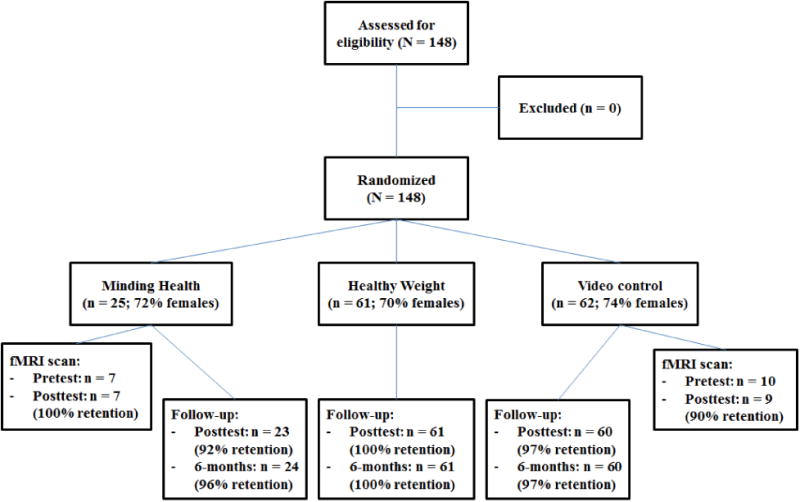
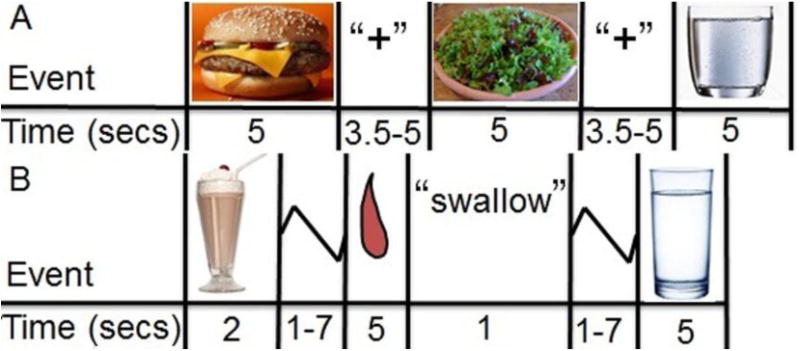
Subjects/methods: Young adults at risk for future weight gain by virtue of weight concerns (N=148) were randomized to this new prevention program (Minding Health), an alternative prevention program promoting participant-driven gradual reductions in caloric intake and increases in physical activity (Healthy Weight), or an obesity education video control condition, completing assessments at pre-, post-, and 6-month follow-up. A subset of Minding Health and control participants completed an fMRI scan at pre- and post-assessing neural response to images of high-fat/sugar foods and to receipt and anticipated receipt of a high-fat/sugar food.
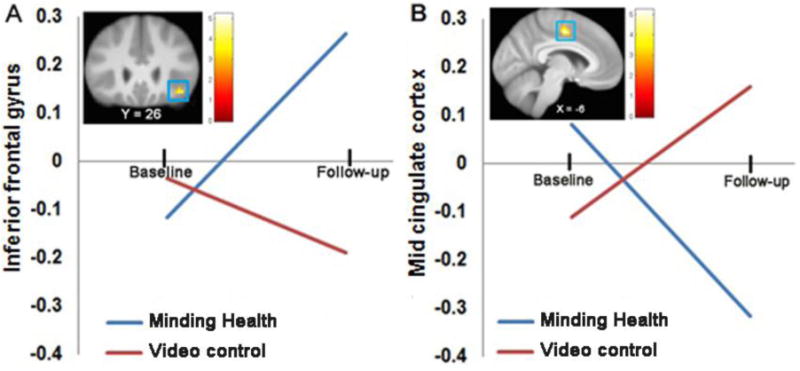
Results: Minding Health participants showed significantly greater reductions in body fat than controls and caloric intake from fat and sugar than Healthy Weight participants. Minding Health participants also showed greater activation of an inhibitory control region and reduced activation of an attention/expectation region in response to palatable food images relative to pretest and controls. However, Healthy Weight participants showed greater reductions in BMI and eating disorder symptoms than Minding Health participants.
Conclusions: Although the Minding Health intervention produced some of the hypothesized effects, it did not produce lasting reductions in body fat or BMI and showed limited effects on neural responsivity, implying it will be vital to increase the efficacy of this new prevention program.
Keywords: Inhibitory regions; Obesity; Prevention; Reward regions; Weight gain; fMRI.
Copyright © 2014 Elsevier Inc. All rights reserved.
Conflict of interest statement
The authors report no conflict of interest with respect to the content of this paper.
Figures
References
-
- Flegal KM, Carroll MD, Kit BK, Ogden CL. Prevalence of obesity and trends in the distribution of body mass index among US adults, 1999-2010. JAMA. 2012;307:491–497. - PubMed
-
- Martin LE, Holsen LM, Chambers RJ, Bruce AS, Brooks WM, Zarcone JR, et al. Neural mechanisms associated with food motivation in obese and healthy weight adults. Obesity. 2010;18:254–260. - PubMed
-
- Rothemund Y, Preuschhof C, Bohner G, Bauknecht HC, Klingebiel R, Flor H, et al. Differential activation of the dorsal striatum by high-calorie visual food stimuli in obese individuals. NeuroImage. 2007;37:410–421. - PubMed
Publication types
MeSH terms
Grants and funding
LinkOut - more resources
Full Text Sources
Other Literature Sources
Medical
