


A dedicated research program increases the quantity and quality of orthopaedic resident publications
- PMID: 25448329
- PMCID: PMC4353544
- DOI: 10.1007/s11999-014-4080-1
A dedicated research program increases the quantity and quality of orthopaedic resident publications
Abstract
Background: Programs seek to expose trainees to research during residency. However, little is known in any formal sense regarding how to do this effectively, or whether these efforts result in more or better-quality research output.
Questions/purposes: The objective of our study was to evaluate a dedicated resident research program in terms of the quantity and quality of resident research peer-reviewed publications. Specifically we asked: (1) Did residents mentored through a dedicated resident research program have more peer-reviewed publications in higher-impact journals with higher citation rates compared with residents who pursued research projects under a less structured approach? (2) Did this effect continue after graduation?
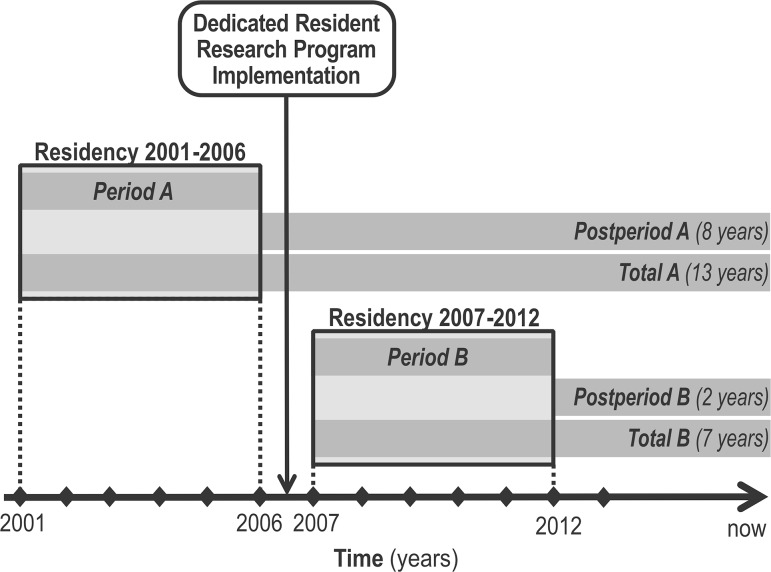
Methods: In 2006, our department of orthopaedic surgery established a dedicated resident research program, which consisted of a new research policy and a research committee to monitor quality and compliance with this policy. Peer-reviewed publications (determined from PubMed) of residents who graduated 6 years before establishing the dedicated resident research program were compared with publications from an equal period of the research-program-directed residents. The data were assessed using descriptive statistics and regression analysis. Twenty-four residents graduated from 2001 to 2006 (before implementation of the dedicated resident research program); 27 graduated from 2007 to 2012 (after implementation of the dedicated resident research program). There were 74 eligible publications as defined by the study inclusion and exclusion criteria.
Results: Residents who trained after implementation of the dedicated resident research program published more papers during residency than did residents who trained before the program was implemented (1.15 versus 0.79 publications per resident; 95% CI [0.05,0.93]; p = 0.047) and the journal impact factor was greater in the group that had the research program (1.25 versus 0.55 per resident; 95% CI [0.2,1.18]; p = 0.005). There were no differences between postresidency publications by trainees who graduated with versus without the research program in the number of publications, citations, and average journal impact factor per resident. A regression analysis showed no difference in citation rates of the residents' published papers before and since implementation of the research program.
Conclusions: Currently in the United States, there are no standard policies or requirements that dictate how research should be incorporated in orthopaedic surgery residency training programs. The results of our study suggest that implementation of a dedicated resident research program improves the quantity and to some extent quality of orthopaedic resident research publications, but this effect did not persist after graduation.
Figures
Comment in
-
CORR Insights ®: A dedicated research program increases the quantity and quality of orthopaedic resident publications.Clin Orthop Relat Res. 2015 Apr;473(4):1522-3. doi: 10.1007/s11999-014-4111-y. Epub 2014 Dec 17. Clin Orthop Relat Res. 2015. PMID: 25516003 Free PMC article. No abstract available.
References
-
- Accreditation Council for Graduate Medical Education . ACGME Program Requirements for Graduate Medical Education in Orthopaedic Surgery: Approved Focus Revision. Chicago, IL: ACGME; 2013.
-
- Bernstein J, Ahn J, Iannotti JP, Brighton CT. The required research rotation in residency: the University of Pennsylvania experience, 1978–1993. Clin Orthop Relat Res. 2006;449:95–99. - PubMed
-
- Garfield E. The Science Citation Index and Institute for Scientific Information’s Journal Citation Reports: Their Implications for Journal Editors. Available at: http://garfield.library.upenn.edu/papers/255.html. Accessed on Sept 26, 2014.
MeSH terms
LinkOut - more resources
Full Text Sources
