Review
. 2015 Sep 24:1621:345-54.
doi: 10.1016/j.brainres.2014.10.069. Epub 2014 Nov 10.

Time and space in the hippocampus

Affiliations
Review

Time and space in the hippocampus

Marc W Howard et al. Brain Res. .

Abstract

It has been hypothesized that one of the functions of the hippocampus is to enable the learning of relationships between different stimuli experienced in the environment. These relationships might be spatial ("the bathroom is about 5m down the hall from the bedroom") or temporal ("the coffee is ready about 3 min after the button was pressed"). Critically, these spatial and temporal relationships may exist on a variety of scales from a few hundred milliseconds up to minutes. In order to learn consistent relationships between stimuli separated by a variety of spatial and temporal scales using synaptic plasticity that has a fixed temporal window extending at most a few hundred milliseconds, information about the spatial and temporal relationships of distant stimuli must be available to the hippocampus in the present. Hippocampal place cells and time cells seem well suited to represent the spatial and temporal locations of distant stimuli in order to support learning of these relationships. We review a recent computational hypothesis that can be used to construct both spatial and temporal relationships. We suggest that there is a deep computational connection between spatial and temporal coding in the hippocampus and that both serve the overarching function of learning relationships between stimuli-constructing a "memory space." This article is part of a Special Issue entitled SI: Brain and Memory.

Keywords: Place code; Relational memory; Temporal code.


Figures

Figure 1
Figure 1
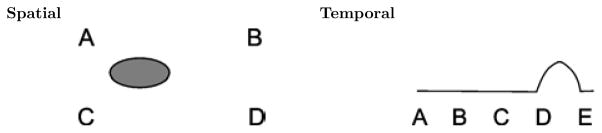
Firing of hippocampal cells must be controlled by events distant in space and time. Left: A place cell fires in a location within an environment with four landmarks, A B C D. It is unclear whether the cell fires because it is SE of A, NE of B, SW of C, NW of D, or any conjunction of those variables. In order to determine this, it would be necessary to systematically move the landmarks and establish control over the cell’s firing. Right: A cell fires during a temporal sequence of events A B C D E. It is not clear whether the cell fires because D has just been presented, because it is one time step after C, or because it is two time steps after B. If the sequence is consistent and well-learned it is also possible that it is firing because E is predicted. In order to determine which of these relationships is responsible for the cell firing, it would be necessary to present the stimuli many times in many different orders to establish stimulus control of the firing.
Figure 2
Figure 2
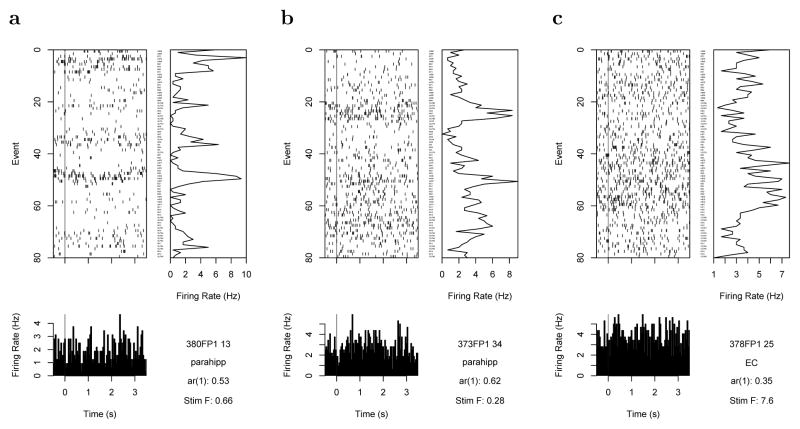
Examples of neural firing correlated over long periods of time. Each panel gives the spikes fired over a recording session. Each row gives a different trial of a continuous recognition task, aligned to the presentation of the stimulus (vertical line). At the bottom a PSTH is shown. On the right of each panel, the cell’s firing rate for each trial is shown. Note the robust autocorrelation—the firing of each cell changes gradually over many many trials. The entire experiment takes about 300 s. a. This cell shows autocorrelated firing over a few trials. Each trial is approximately 4 s, so this constitutes a change over about a dozen seconds. b. This cell shows autocorrelation over about 10 trials, corresponding to several dozen seconds. c. This cell shows autocorrelation over a few dozen trials, corresponding to a few minutes. After Howard, et al. (2012).
Figure 3
Figure 3
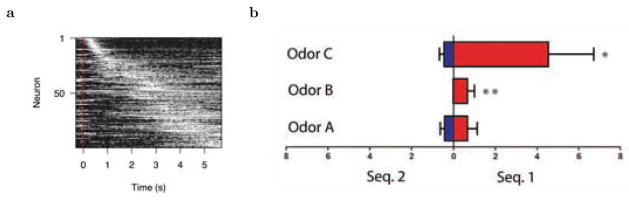
A relational memory code in the hippocampus could rely on temporal memory representations. a. Neurons in the rodent hippocampus during the delay of an object memory task. The cells are sorted according to their peak of firing. Across cells, the time into the delay interval can be reconstructed. After MacDonald, et al., (2011). b. Non-spatial “splitter cells” retain information about past events. Rats were presented with sequences of odors with overlapping subsequences such as M N A B C O P and W X A B C Y Z. Some cells responded differentially to the odors in the subsequence depending on which sequence they were presented in. This cell fires more to B and C when they were preceded by the other odors of sequence 1 than when they were preceded by the other odors of sequence 2. After Ginther et al., (2011).
Figure 4
Figure 4
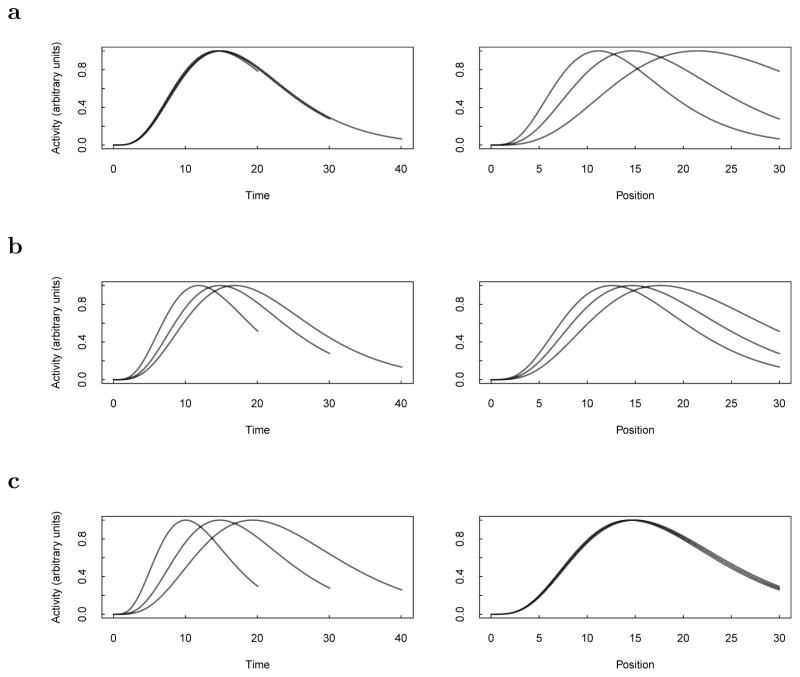
A continuity between spatial and temporal coding. We simulated results from the Kraus et al., (2013) experiment using the computational framework introduced in Howard et al., (2014). In the simulated experiment, the rat ran on a treadmill at a constant speed (0.75, 1, or 1.5) each trial. The trials continued for different durations until 30 units of distance had been traversed. In each panel we plot the activity of the cell as a function of time (left) and as a function of distance traveled (right). a. A “time cell” that codes for time since the treadmill started. We set a close to 1 and b close to zero (with a slight offset so the different lines would be visible). Note that the response of the cell is almost completely controlled by time (left) whereas the activity as a function of position varies greatly depending on the speed (right). b. A cell showing coding intermediate between a temporal and spatial coding. Here a = 0.5 and b = 0.5. c. A “distance cell” that codes for elapsed distance since the treadmill started. We set a close to 0 and b close to 1 (with a slight offset so the different lines would be visible). Note that the response of the cell is almost completely controlled by position (right) whereas the activity as a function of time varies greatly depending on the speed (left).

References

    1. Arcediano F, Escobar M, Miller RR. Temporal integration and temporal backward associations in human and nonhuman subjects. Learning & Behavior. 2003;31(3):242–56. - PubMed
    1. Balsam PD, Gallistel CR. Temporal maps and informativeness in associative learning. Trends in Neuroscience. 2009;32(2):73–78. - PMC - PubMed
    1. Barry C, Lever C, Hayman R, Hartley T, Burton S, O’Keefe J, Burgess N. The boundary vector cell model of place cell firing and spatial memory. Reviews in Neuroscience. 2006;17(1–2):71–97. - PMC - PubMed
    1. Bunsey M, Eichenbaum HB. Conservation of hippocampal memory function in rats and humans. Nature. 1996;379(6562):255–257. - PubMed
    1. Burgess N, O’Keefe J. Neuronal computations underlying the firing of place cells and their role in navigation. Hippocampus. 1996;6(6):749–62. - PubMed

Publication types

LinkOut - more resources