


Impact of a randomized controlled educational trial to improve physician practice behaviors around screening for inherited breast cancer
- PMID: 25451990
- PMCID: PMC4351290
- DOI: 10.1007/s11606-014-3113-5
Impact of a randomized controlled educational trial to improve physician practice behaviors around screening for inherited breast cancer
Abstract
Background: Many primary care physicians (PCPs) are ill-equipped to provide screening and counseling for inherited breast cancer.
Objective: To evaluate the outcomes of an interactive web-based genetics curriculum versus text curriculum for primary care physicians.
Design: Randomized two-group design.
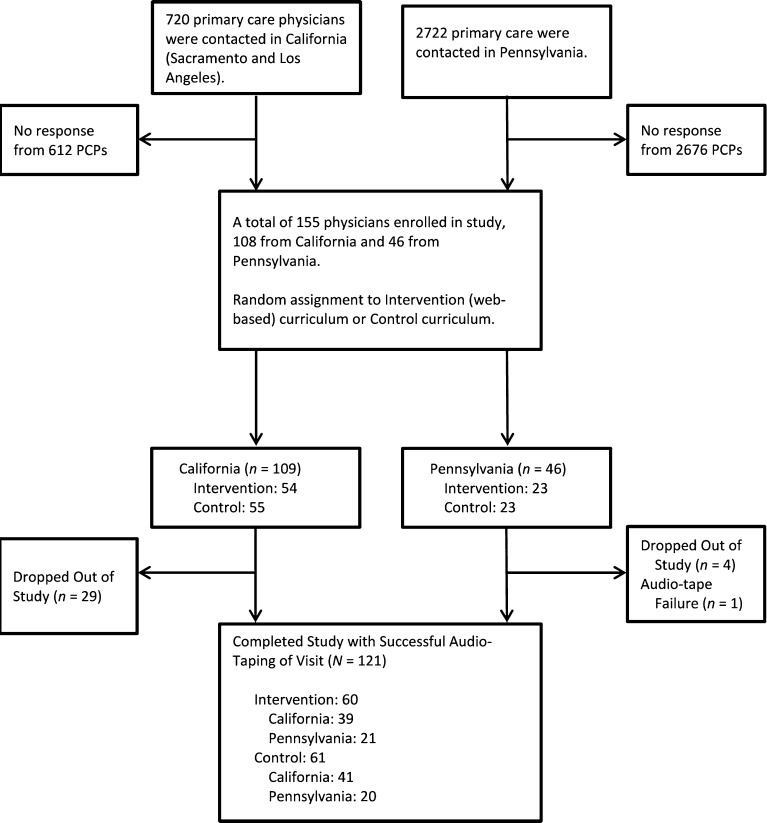
Participants: 121 California and Pennsylvania community physicians.
Intervention: Web-based interactive genetics curriculum, evaluated against a control group of physicians who studied genetics review articles. After education, physicians interacted with an announced standardized patient (SP) at risk for inherited breast cancer.
Main measures: Transcripts of visit discussions were coded for presence or absence of 69 topics relevant to inherited breast cancer.
Key results: Across all physicians, history-taking, discussions of test result implications, and exploration of ethical and legal issues were incomplete. Approximately half of physicians offered a genetic counseling referral (54.6%), and fewer (43.8%) recommended testing. Intervention physicians were more likely than controls to explore genetic counseling benefits (78.3% versus 60.7%, P = 0.048), encourage genetic counseling before testing (38.3% versus 21.3%, P = 0.048), ask about a family history of prostate cancer (25.0% versus 6.6%, P = 0.006), and report that a positive result indicated an increased risk of prostate cancer for male relatives (20.0% versus 1.6%, P = 0.001). Intervention-group physicians were less likely than controls to ask about Ashkenazi heritage (13.3% versus 34.4%, P = 0.01) or to reply that they would get tested when asked, "What would you do?" (33.3% versus 54.1%, P = 0.03).
Conclusions: Physicians infrequently performed key counseling behaviors, and this was true regardless of whether they had completed the web-based interactive training or read clinical reviews.
Comment in
-
Capsule Commentary on Bell et al., Impact of a Randomized Control Educational Trial to Improve Physician Practice Behaviors Around Screening for Inherited Breast Cancer.J Gen Intern Med. 2016 Mar;31(3):326. doi: 10.1007/s11606-014-3175-4. J Gen Intern Med. 2016. PMID: 25608741 Free PMC article. No abstract available.
References
-
- Whittemore AS, Gong G, John EM, McGuire V, Li FP, Ostrow KL, et al. Prevalence of BRCA1 mutation carriers among U.S. non-Hispanic Whites. Cancer Epidemiol Biomarkers Prev. 2004;13(12):2078–2083. - PubMed
-
- Srinivasan M, Day FC, Griffin E, Tancredi DJ, Burke W, Pinsky L, et al. Implementation outcomes of a multiinstitutional web-based ethical, legal, and social implications genetics curriculum for primary care residents in three specialties. Genet Med. 2011;13(6):553–562. doi: 10.1097/GIM.0b013e31820e279a. - DOI - PubMed
-
- Moyer VA. Risk assessment, genetic counseling, and genetic testing for BRCA-related cancer in women: U.S. Preventive Services Task Force Recommendation Statement. Ann Intern Med. 2014;160(4). - PubMed
Publication types
MeSH terms
Supplementary concepts
Grants and funding
LinkOut - more resources
Full Text Sources
Other Literature Sources
