Review
. 2014 Dec 1;6(12):a018663.
doi: 10.1101/cshperspect.a018663.

Bromodomain and extraterminal domain inhibitors (BETi) for cancer therapy: chemical modulation of chromatin structure

Affiliations
Review

Bromodomain and extraterminal domain inhibitors (BETi) for cancer therapy: chemical modulation of chromatin structure

Jun Qi. Cold Spring Harb Perspect Biol. .

Abstract

In cancer, epigenetic proteins are intensely studied targets for therapeutic drug discovery, showing great promise. These proteins include the chromatin-modifying enzymes that "write" and "erase" histone posttranslational modifications (PTM), and those that "read" these marks through binding modules. In an effort to find a compound that could disrupt the protein-protein interactions between a PTM and reader, JQ1 has proven to be a first-in-class, drug-like inhibitor of the "bromodomain and extraterminal domain" epigenetic readers (BETs), which recognize histone lysine acetylation marks. JQ1 has facilitated the mechanistic study and therapeutic application in cancer of this kind of epigenetic inhibition. By using this chemical probe, we have discovered that the bromodomain inhibitors (BETi) have compelling activity in preclinical models of multiple myeloma and acute myeloid leukemia. In particular, BETi down-regulates the MYC, IL-7R, and E2F transcriptional programs. We are continuously integrating the transcriptional consequences of BETi with changes in the epigenomic landscapes of cancer cells to elucidate the mechanisms underlying response to BETi using chemical and genetic perturbations.


Figures

Figure 1.
Figure 1.
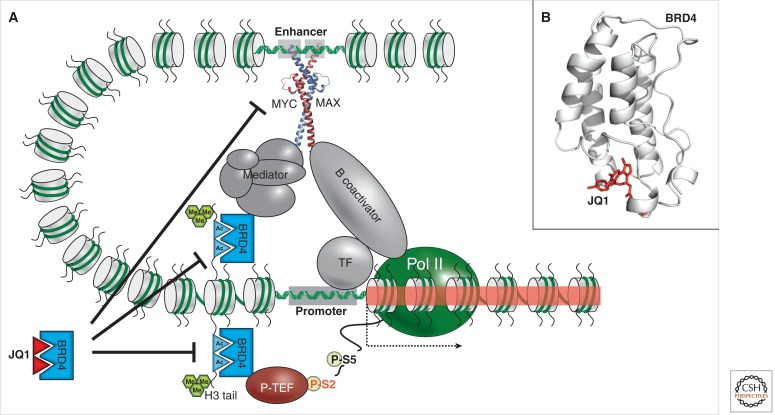
Model for JQ1 small-molecule inhibition of the BRD4 bromodomain in cancer. (A) The aberrant transcriptional activation of MYC target genes (indicated as red shaded regions of chromatin) is a common feature of many cancers. Transcriptional activation requires the bromodomain “reading” function of BRD4, which recognizes acetylation marks (“Ac”-labeled cyan triangles) on histone H3 tails at promoter-proximal target sequences. Acetyl-bound BRD4 interacts with both the MYC-MAX complex bound to enhancer sequences (via a mediator complex) and the PTEFb phosphorylase required for the release of RNA polymerase II (Pol II) during transcriptional elongation. The competitive binding of the JQ1 bromodomain inhibitor (red triangle) to BRD4 not only reduces transcription of the MYC gene (top inhibition arrow) but also its target genes by abrogating recruitment of enhancer complexes and PTEFb (middle and bottom inhibition arrows), possibly via chromatin looping. The active chromatin mark histone H3K4me3 is illustrated as triple green hexagons. (B) Crystal structure of the human BRD4 protein in complex with JQ1 (red).

References

    1. Delmore JE, Issa GC, Lemieux ME, Rahl PB, Shi JW, Jacobs HM, Kastritis E, Gilpatrick T, Paranal RM, Qi J, et al. 2011. BET bromodomain inhibition as a therapeutic strategy to target c-Myc. Cell 146: 904–917. - PMC - PubMed
    1. Filippakopoulos P, Qi J, Picaud S, Shen Y, Smith WB, Fedorov O, Morse EM, Keates T, Hickman TT, Felletar I, et al. 2010. Selective inhibition of BET bromodomains. Nature 468: 1067–1073. - PMC - PubMed
    1. Matzuk MM, McKeown MR, Filippakopoulos P, Li Q, Ma L, Agno JE, Lemieux ME, Picaud S, Yu RN, Qi J, et al. 2012. Small-molecule inhibition of BRDT for male contraception. Cell 150: 673–684. - PMC - PubMed
    1. Ott CJ, Kopp N, Bird L, Paranal RM, Qi J, Bowman T, Rodig SJ, Kung AL, Bradner JE, Weinstock DM 2012. BET bromodomain inhibition targets both c-Myc and IL7R in high-risk acute lymphoblastic leukemia. Blood 120: 2843–2852. - PMC - PubMed
    1. Zuber J, Shi J, Wang E, Rappaport AR, Herrmann H, Sison EA, Magoon D, Qi J, Blatt K, Wunderlich M, et al. 2011. RNAi screen identifies BRD4 as a therapeutic target in acute myeloid leukaemia. Nature 478: 524–528. - PMC - PubMed

MeSH terms