


BREX is a novel phage resistance system widespread in microbial genomes
- PMID: 25452498
- PMCID: PMC4337064
- DOI: 10.15252/embj.201489455
BREX is a novel phage resistance system widespread in microbial genomes
Abstract
The perpetual arms race between bacteria and phage has resulted in the evolution of efficient resistance systems that protect bacteria from phage infection. Such systems, which include the CRISPR-Cas and restriction-modification systems, have proven to be invaluable in the biotechnology and dairy industries. Here, we report on a six-gene cassette in Bacillus cereus which, when integrated into the Bacillus subtilis genome, confers resistance to a broad range of phages, including both virulent and temperate ones. This cassette includes a putative Lon-like protease, an alkaline phosphatase domain protein, a putative RNA-binding protein, a DNA methylase, an ATPase-domain protein, and a protein of unknown function. We denote this novel defense system BREX (Bacteriophage Exclusion) and show that it allows phage adsorption but blocks phage DNA replication. Furthermore, our results suggest that methylation on non-palindromic TAGGAG motifs in the bacterial genome guides self/non-self discrimination and is essential for the defensive function of the BREX system. However, unlike restriction-modification systems, phage DNA does not appear to be cleaved or degraded by BREX, suggesting a novel mechanism of defense. Pan genomic analysis revealed that BREX and BREX-like systems, including the distantly related Pgl system described in Streptomyces coelicolor, are widely distributed in ~10% of all sequenced microbial genomes and can be divided into six coherent subtypes in which the gene composition and order is conserved. Finally, we detected a phage family that evades the BREX defense, implying that anti-BREX mechanisms may have evolved in some phages as part of their arms race with bacteria.
Keywords: CRISPR; PGL; pglZ; phage defense.
© 2014 The Authors.
Figures
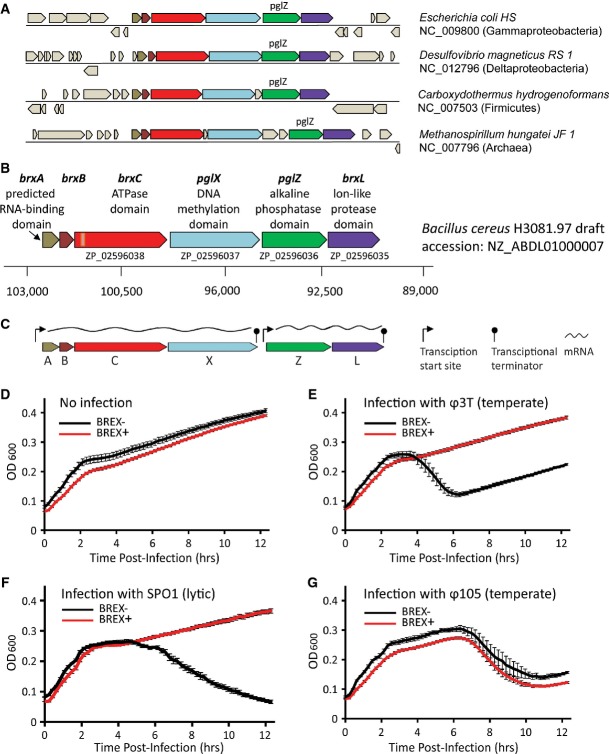
A The pglZ gene reproducibly appears within a six-gene cluster in various genomes. Representative appearances are shown.
B The BREX locus in B. cereus H3081.97. Coordinates below the genes denote the position along the NZ_ABDL01000007 contig in the draft genome of B. cereus H3081.97. Orange box within brxC represents the position of the ATPase P-loop motif.
C Operon organization of the B. cereusBREX system integrated in the B. subtilis genome. Expression throughout the operons was validated by RNA-seq. Positions of promoters and terminators were inferred by 5′ and 3′ RACE, respectively.
D–G Culture dynamics of phage-infected wild-type (black) versus BREX-containing (red) strains of B. subtilisBEST7003. Bacterial strains were exposed to phage at time = 0 h, and optical density measurements were read in a 96-well plate format. Each experiment was performed three times with three technical triplicates for each biological replicate. Error bars represent SEM. Shown are representative results for three of the ten phages tested; data for the remaining seven phages are found in Supplementary Fig S2.
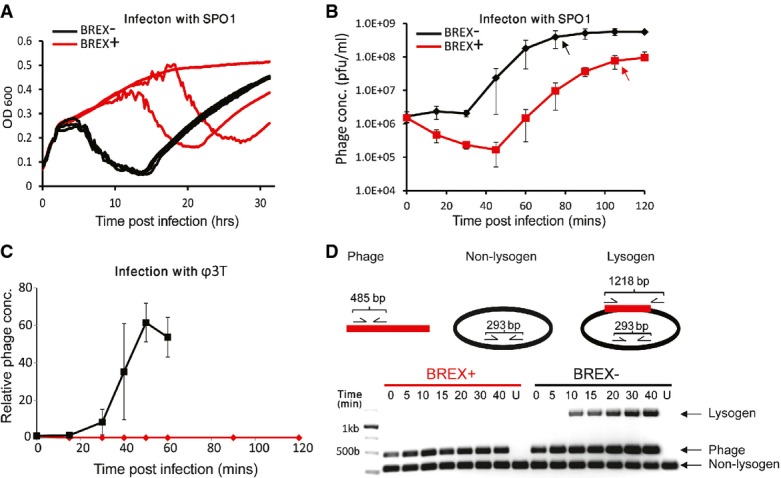
Culture dynamics over an extended period (> 30 h) for SPO1-infected wild-type (black) versus BREX-containing (red) strains of B. subtilisBEST7003. Each curve represents a single technical replicate grown in a single well on a 96-well plate. Culture decline is temporally reproducible for the BREX-lacking strain but occurs later, at apparently stochastic time points, for the BREX-containing strain. Re-growth following culture crash represents phage-resistant mutants.
Phage production during a one-step phage growth curve experiment with wild-type (black) and BREX-containing (red) strains of B. subtilisBEST7003 infected with SPO1. Error bars represent SD. Y-axis represents absolute phage concentrations. Black and red arrows point to the time point of maximal burst for BREX-lacking and BREX-containing strains, respectively.
Phage production during a one-step phage growth curve experiment with wild-type (black) and BREX-containing (red) strains of B. subtilis BEST7003 infected with Φ3T. Error bars represent SD. Y-axis represents relative phage concentrations normalized to the value at the beginning of the infection.
Multiplex PCR assay showing lysogeny during a phage infection time course in the strain lacking BREX (black), but not in BREX-containing strain (red), or uninfected (U) strains. Amplicons for the bacterial DNA, phage DNA, and lysogen-specific DNA are 293, 485, and 1,218 bp, respectively.
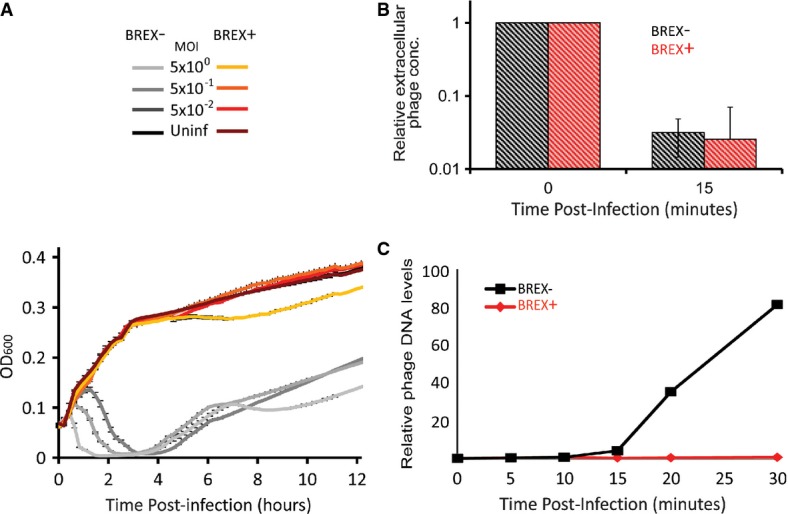
BREX does not work via an abortive infection mechanism. Increasing the MOI of the Φ3T infection from 0.05 to 5 shortens the time to culture crash for the BREX-lacking strain, but does not result in culture decline for BREX-containing strain. Error bars represent SD of technical triplicates.
The system does not interfere with phage adsorption to bacterial cells. Strains either containing (red) or lacking (black) the BREX system were infected with phage Φ3T and then chloroform-treated 15 min following infection. The culture was plated on Φ3T-sensitive B. subtilis cells and plaques, representing extracellular, unadsorbed phages, were counted.
Phage DNA replication does not occur in BREX-containing cells (red), but is observed in the BREX-lacking strain (black). Y-axis represents relative phage concentrations normalized to the value at the beginning of the infection, as measured by Illumina sequencing.
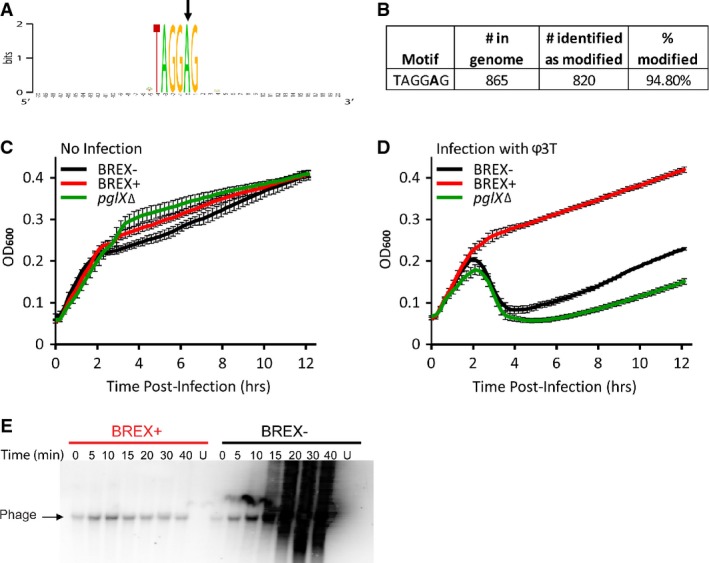
A Consensus sequence around m6A modified bases in the BREX-containing B. subtilis genome. The modified base is marked by an arrow. Modifications were directly detected by DNA sequencing using the PacBio platform.
B Statistics of modified motifs in the BREX-containing B. subtilis genome.
C, D Culture dynamics of non-infected (C) or phage-infected (D) cultures. Curves depict culture dynamics of strains lacking BREX (black) and BREX-containing (red) strains of B. subtilisBEST7003, as well as a BREX-containing strain where the pglX methylase was deleted (green). Axes and error bars are as in Fig1.
E Southern blot analysis of phage Φ3T genome during infection. Numbers indicate time (in min) following infection; U, uninfected. Probe was designed to match positions 94,645–95,416 in the phage genome. Each lane contains 200 ng total DNA.
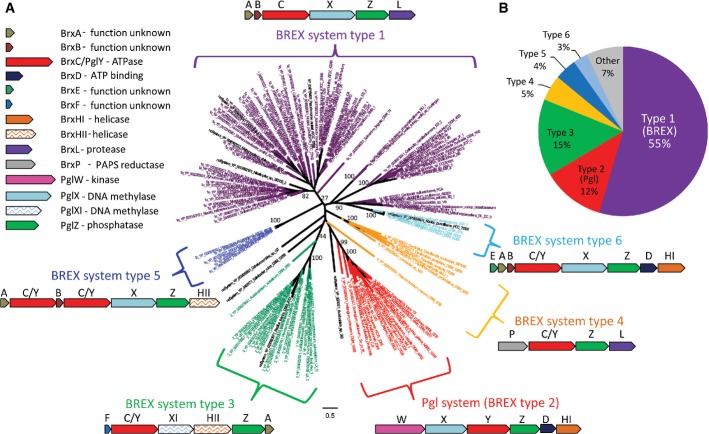
Shown is a phylogenetic tree of the PglZ protein instances detected in this study. The tree is color-coded according to the operon organization of the neighboring genes (BREX types). The gene order and genomic organization of each type is illustrated next to its relevant branch on the PglZ tree. Numbers depict bootstrap values.
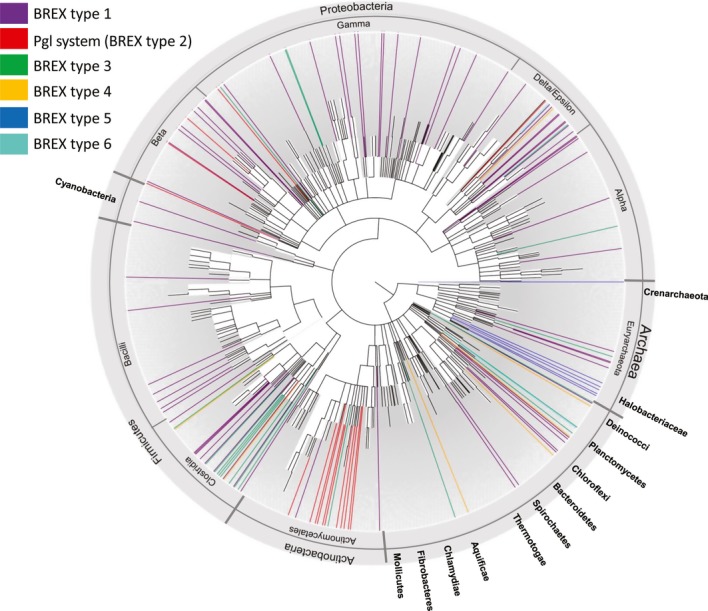
Prevalence of the different BREX subtypes within the BREX superfamily of defense systems among the sequenced genomes that were analyzed.
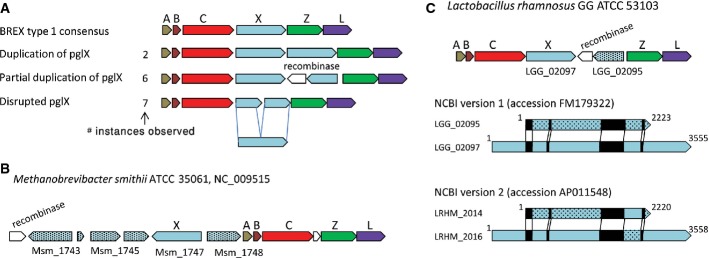
Irregular genotypes (duplication, inversion, and premature stop codon) associated with pglX.
Genomic organization of BREX system type 1 in Methanobrevibacter smithii ATCC 35061.
Genomic organization of BREX system type 1 in Lactobacillus rhamnosusGG. A cassette switch between the short and the long forms of pglX is observed when the sequences of two isolates of Lactobacillus rhamnosusGG (accessions FM179322 and AP011548, respectively) are compared. Repeat sequences between the short and long forms are shown in black.
Comment in
-
Bacteriophage exclusion, a new defense system.EMBO J. 2015 Jan 13;34(2):134-5. doi: 10.15252/embj.201490620. Epub 2014 Dec 12. EMBO J. 2015. PMID: 25502457 Free PMC article.
-
Bacterial physiology: putting the 'BREX' on phage replication.Nat Rev Microbiol. 2015 Mar;13(3):129. doi: 10.1038/nrmicro3437. Epub 2015 Feb 2. Nat Rev Microbiol. 2015. PMID: 25639679 No abstract available.
References
-
- Bikard D, Marraffini LA. Innate and adaptive immunity in bacteria: mechanisms of programmed genetic variation to fight bacteriophages. Curr Opin Immunol. 2012;24:15–20. - PubMed
-
- Carlson K. Working with Bacteriophages: common techniques and methodological approaches. In: Kutter E, Sulakvelidze A, et al., editors. Bacteriophages, Biology and Applications. Florida: CRC Press; 2005. pp. 437–494.
-
- Cerdeño-Tárraga AM, Patrick S, Crossman LC, Blakely G, Abratt V, Lennard N, Poxton I, Duerden B, Harris B, Quail MA, Barron A, Clark L, Corton C, Doggett J, Holden MT, Larke N, Line A, Lord A, Norbertczak H, Ormond D, et al. Extensive DNA inversions in the B. fragilis genome control variable gene expression. Science. 2005;307:1463–1465. - PubMed
-
- Chinenova TA, Mkrtumian NM, Lomovskaia ND. Genetic characteristics of a new phage resistance trait in Streptomyces coelicolor A3(2) Genetika. 1982;18:1945–1952. - PubMed
Publication types
MeSH terms
Substances
LinkOut - more resources
Full Text Sources
Other Literature Sources
Molecular Biology Databases
