


Referral interventions from primary to specialist care: a systematic review of international evidence
- PMID: 25452541
- PMCID: PMC4240149
- DOI: 10.3399/bjgp14X682837
Referral interventions from primary to specialist care: a systematic review of international evidence
Abstract
Background: Demand management defines any method used to monitor, direct, or regulate patient referrals. Strategies have been developed to manage the referral of patients to secondary care, with interventions that target primary care, specialist services, or infrastructure.
Aim: To review the international evidence on interventions to manage referral from primary to specialist care.
Design and setting: Systematic review.
Method: Iterative, systematic searches of published and unpublished sources public health, health management, management, and grey literature databases from health care and other industries were undertaken to identify recent, relevant studies. A narrative synthesis of the data was completed to structure the evidence into groups of similar interventions.
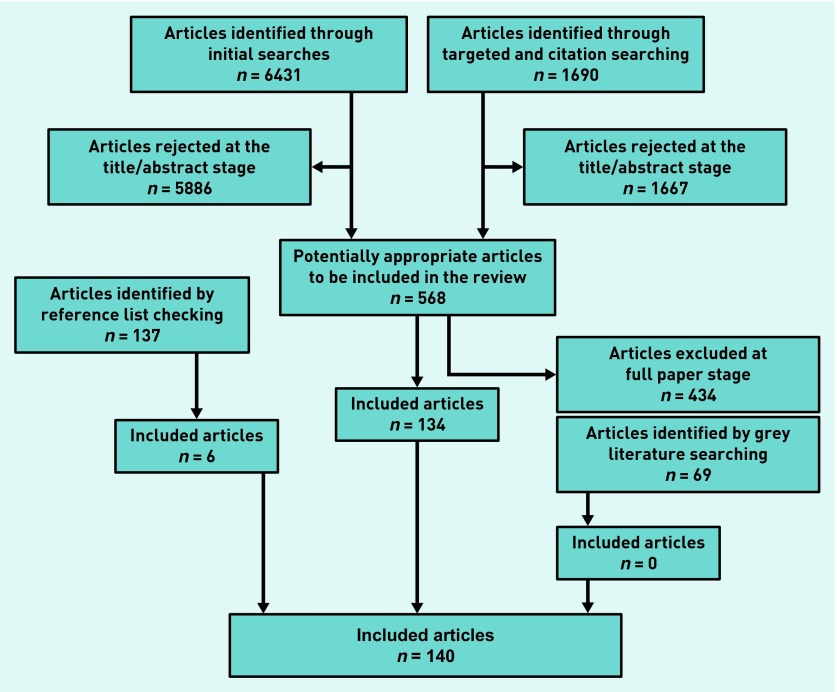
Results: The searches generated 8327 unique results, of which 140 studies were included. Interventions were grouped into four intervention categories: GP education (n = 50); process change (n = 49); system change (n = 38); and patient-focused (n = 3). It is clear that there is no 'magic bullet' to managing demand for secondary care services: although some groups of interventions may have greater potential for development, given the existing evidence that they can be effective in specific contexts.
Conclusions: To tackle demand management of primary care services, the focus cannot be on primary care alone; a whole-systems approach is needed because the introduction of interventions in primary care is often just the starting point of the referral process. In addition, more research is needed to develop and evaluate interventions that acknowledge the role of the patient in the referral decision.
Keywords: demand management; general practice; narrative synthesis; primary care; referral; systematic review.
© British Journal of General Practice 2014.
Figures
References
-
- The King’s Fund. An alternative guide to the new NHS in England. London: The King’s Fund; 2013. http://www.kingsfund.org.uk/projects/nhs-65/alternative-guide-new-nhs-en... (accessed 15 Oct 2014)
-
- Jones NM, Charlesworth A. The anatomy of health spending 2011/12. London: Nuffield Trust; 2013. http://www.nuffieldtrust.org.uk/sites/files/nuffield/publication/130305_... (accessed 15 Oct 2014)
-
- Imison C, Naylor C. Referral management: lessons for success. London: The King’s Fund; 2010. http://www.kingsfund.org.uk/sites/files/kf/Referral-management-lessons-f... (accessed 15 Oct 2014)
Publication types
MeSH terms
Grants and funding
LinkOut - more resources
Full Text Sources
Other Literature Sources
