. 2015 Oct;25(10):3903-10.
doi: 10.1093/cercor/bhu275. Epub 2014 Dec 1.

A Neural Mechanism for Nonconscious Activation of Conditioned Placebo and Nocebo Responses

Affiliations

A Neural Mechanism for Nonconscious Activation of Conditioned Placebo and Nocebo Responses

Karin B Jensen et al. Cereb Cortex. 2015 Oct.

Abstract

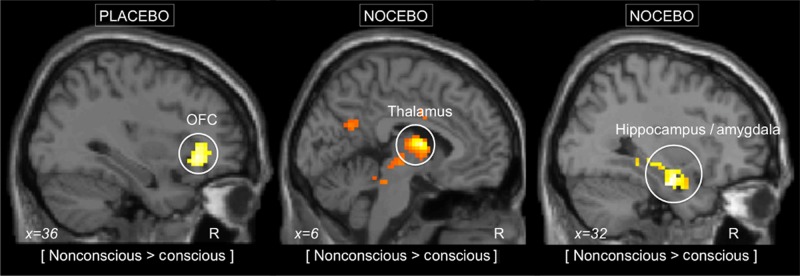
Fundamental aspects of human behavior operate outside of conscious awareness. Yet, theories of conditioned responses in humans, such as placebo and nocebo effects on pain, have a strong emphasis on conscious recognition of contextual cues that trigger the response. Here, we investigated the neural pathways involved in nonconscious activation of conditioned pain responses, using functional magnetic resonance imaging in healthy participants. Nonconscious compared with conscious activation of conditioned placebo analgesia was associated with increased activation of the orbitofrontal cortex, a structure with direct connections to affective brain regions and basic reward processing. During nonconscious nocebo, there was increased activation of the thalamus, amygdala, and hippocampus. In contrast to previous assumptions about conditioning in humans, our results show that conditioned pain responses can be elicited independently of conscious awareness and our results suggest a hierarchical activation of neural pathways for nonconscious and conscious conditioned responses. Demonstrating that the human brain has a nonconscious mechanism for responding to conditioned cues has major implications for the role of associative learning in behavioral medicine and psychiatry. Our results may also open up for novel approaches to translational animal-to-human research since human consciousness and animal cognition is an inherent paradox in all behavioral science.

Keywords: amygdala; conditioning; nocebo effect; placebo effect; subliminal perception.


Figures

Figure 1.
Figure 1.
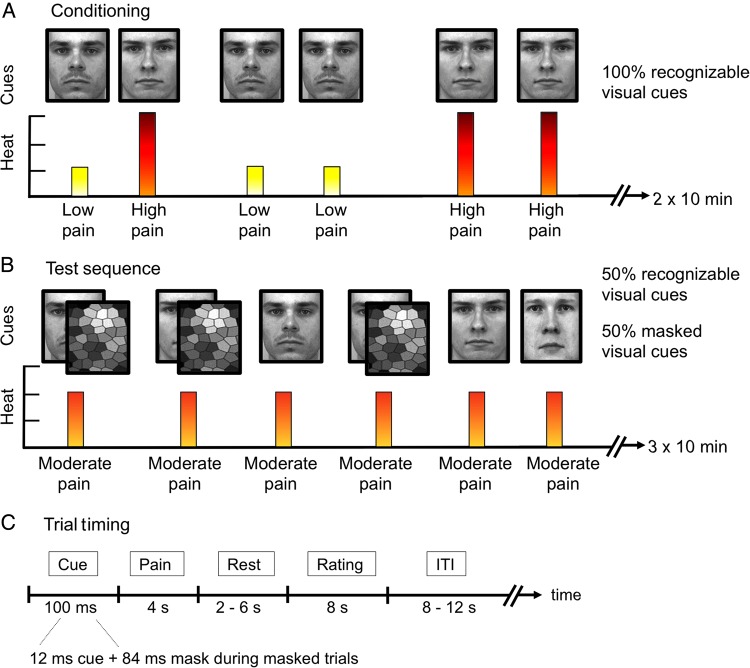
Experimental procedure. The conditioning procedure (A) included clearly recognizable images of 2 male faces (experimental cues) presented on a computer screen. Each face cue was consistently paired with either a high or low heat pain stimulus on the volar forearm. After conditioning, a test sequence was performed (B) in which the high cue, low cue, and a neutral control cue were paired with identical moderate heat stimuli. During the test sequence, 50% of the cue exposures were exposed long enough for all subjects to clearly recognize them (100 ms), and 50% of the face cues were exposed for only 12 ms and then followed by a mask to prevent conscious recognition (backward-masking). (C) A detailed description of the trial timing during fMRI scans. The ITI lasted between 8 and 12 s.
Figure 2.
Figure 2.
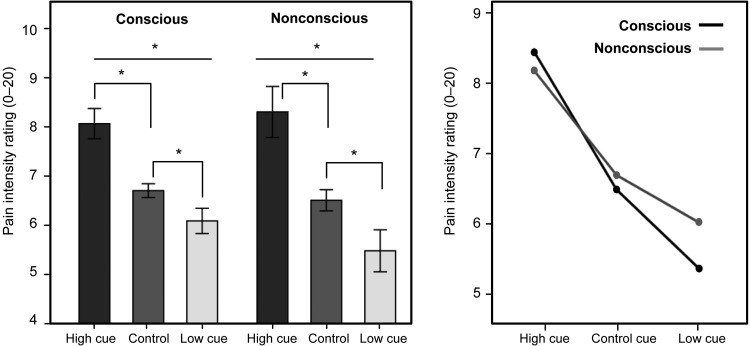
Pain ratings during conscious and nonconscious placebo and nocebo trials. Identical moderate temperatures were paired with a conditioned “high pain cue,” “low pain cue,” or “control cue” to test how predictive cues changed participants' pain perception. Participants rated pain intensity on a 0–20 Numerical Response Scale (NRS). Left panel: representation of the within-subject pain ratings during the test sequence that followed the initial conditioning sequence. Bars represent the average pain rating in response to identical moderate temperatures. Error bars represent 2 intrasubject standard errors. Top asterisks (*) represent overall significance for “cue type” and lower asterisks represent significant pairwise comparisons between the cues. Right panel: illustration of the interaction of “cue type” (high, low, control) by “exposure type” (conscious, nonconscious), based on a within-subject design.
Figure 3.
Figure 3.
Neural correlates to nonconscious placebo and nocebo responses. Left panel: the nonconscious placebo condition, compared with conscious placebo, was associated with increased activity in the OFC, as illustrated by the circle. Middle and right panel: the nonconscious nocebo condition, compared with conscious nocebo, was associated with increased activity in the amygdala, hippocampus, and thalamus. The initial statistical threshold was P < 0.01, family-wise corrected for ROI.
Figure 4.
Figure 4.
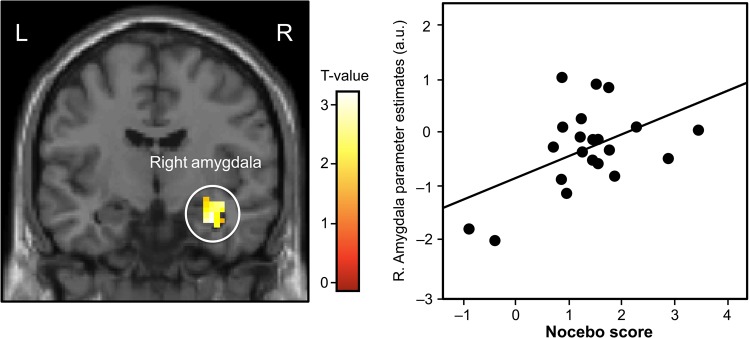
Amygdala activation during nocebo and correlation to pain ratings. Left panel: coronal representation of the increased activation in the right amygdala during nonconscious nocebo. The initial statistical threshold was P < 0.01, family-wise corrected for ROI. Right panel: a correlation analysis between extracted amygdala parameter estimates during nonconscious nocebo trials and the associated nocebo rating (r = 0.60, P < 0.005).

References

    1. Amanzio M, Benedetti F. 1999. Neuropharmacological dissection of placebo analgesia: expectation-activated opioid systems versus conditioning-activated specific subsystems. J Neurosci. 19:484–494. - PMC - PubMed
    1. Benedetti F, Amanzio M, Vighetti S, Asteggiano G. 2006. The biochemical and neuroendocrine bases of the hyperalgesic nocebo effect. J Neurosci. 26:12014–12022. - PMC - PubMed
    1. Benedetti F, Pollo A, Lopiano L, Lanotte M, Vighetti S, Rainero I. 2003. Conscious expectation and unconscious conditioning in analgesic, motor, and hormonal placebo/nocebo responses. J Neurosci. 23:4315–4323. - PMC - PubMed
    1. Bingel U, Lorenz J, Schoell E, Weiller C, Büchel C. 2006. Mechanisms of placebo analgesia: rACC recruitment of a subcortical antinociceptive network. Pain. 120:8–15. - PubMed
    1. Bingel U, Wanigasekera V, Wiech K, Ni Mhuircheartaigh R, Lee MC, Ploner M, Tracey I. 2011. The effect of treatment expectation on drug efficacy: imaging the analgesic benefit of the opioid remifentanil. Sci Transl Med. 3:70ra14. - PubMed

Publication types

MeSH terms