


Trends in infant bedding use: National Infant Sleep Position study, 1993-2010
- PMID: 25452654
- PMCID: PMC4279068
- DOI: 10.1542/peds.2014-1793
Trends in infant bedding use: National Infant Sleep Position study, 1993-2010
Abstract
Background: Use of potentially hazardous bedding, as defined by the American Academy of Pediatrics (eg, pillows, quilts, comforters, loose bedding), is a modifiable risk factor for sudden infant death syndrome and unintentional sleep-related suffocation. The proportion of US infants sleeping with these types of bedding is unknown.
Methods: To investigate the US prevalence of and trends in bedding use, we analyzed 1993-2010 data from the National Infant Sleep Position study. Infants reported as being usually placed to sleep with blankets, quilts, pillows, and other similar materials under or covering them in the last 2 weeks were classified as bedding users. Logistic regression was used to describe characteristics associated with bedding use.
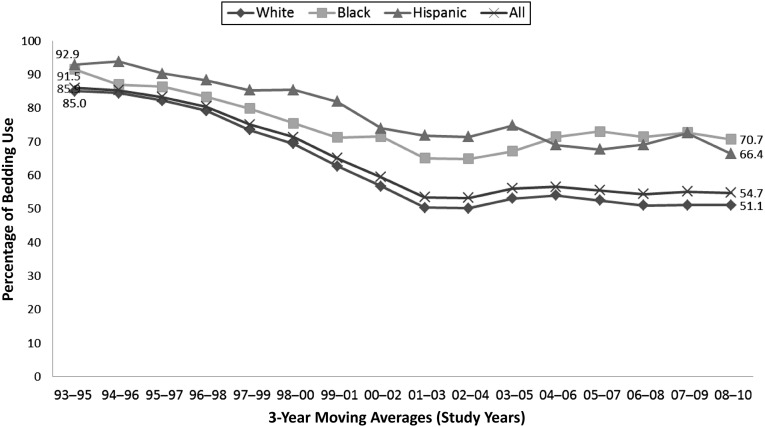
Results: From 1993 to 2010, bedding use declined but remained a widespread practice (moving average of 85.9% in 1993-1995 to 54.7% in 2008-2010). Prevalence was highest for infants of teen-aged mothers (83.5%) and lowest for infants born at term (55.6%). Bedding use was also frequently reported among infants sleeping in adult beds, on their sides, and on a shared surface. The rate of decline in bedding use was markedly less from 2001-2010 compared with 1993-2000. For 2007 to 2010, the strongest predictors (adjusted odds ratio: ≥1.5) of bedding use were young maternal age, non-white race and ethnicity, and not being college educated.
Conclusions: Bedding use for infant sleep remains common despite recommendations against this practice. Understanding trends in bedding use is important for tailoring safe sleep interventions.
Keywords: accidental suffocation; infant mortality; safe sleep; sudden infant death syndrome; sudden unexpected infant death; surveillance.
Copyright © 2015 by the American Academy of Pediatrics.
Figures
Comment in
-
Hazardous bedding in infants' sleep environment is still common and a cause for concern.Pediatrics. 2015 Jan;135(1):178-9. doi: 10.1542/peds.2014-3218. Epub 2014 Dec 1. Pediatrics. 2015. PMID: 25452652 No abstract available.
References
-
- Centers for Disease Control and Prevention, National Center for Health Statistics. Compressed Mortality File 1999–2012 on CDC WONDER Online Database, released October 2014. Data are from the Compressed Mortality File 1999–2012 Series 20 No. 2R, 2014, as compiled from data provided by the 57 vital statistics jurisdictions through the Vital Statistics Cooperative Program. Available at: http://wonder.cdc.gov/cmf-icd10.html. Accessed November 3, 2014
-
- Moon RY, Darnall RA, Goodstein MH, et al. Task Force on Sudden Infant Death Syndrome . SIDS and other sleep-related infant deaths: expansion of recommendations for a safe infant sleeping environment. Pediatrics. 2011;128(5). Available at: www.pediatrics.org/cgi/content/full/128/5/e1341 - PubMed
-
- American Academy of Pediatrics Task Force on Sudden Infant Death Syndrome . The changing concept of sudden infant death syndrome: diagnostic coding shifts, controversies regarding the sleeping environment, and new variables to consider in reducing risk. Pediatrics. 2005;116(5):1245–1255 - PubMed
-
- Hauck FR, Herman SM, Donovan M, et al. Sleep environment and the risk of sudden infant death syndrome in an urban population: the Chicago Infant Mortality Study. Pediatrics. 2003;111(5 pt 2):1207–1214 - PubMed
-
- Fu LY, Moon RY, Hauck FR. Bed sharing among black infants and sudden infant death syndrome: interactions with other known risk factors. Acad Pediatr. 2010;10(6):376–382 - PubMed
Publication types
MeSH terms
Grants and funding
LinkOut - more resources
Full Text Sources
Other Literature Sources
Medical
Molecular Biology Databases
