Review
. 2014 Nov 14:2:52.
doi: 10.3389/fbioe.2014.00052. eCollection 2014.

Connections matter: channeled hydrogels to improve vascularization

Affiliations
Review

Connections matter: channeled hydrogels to improve vascularization

Severin Muehleder et al. Front Bioeng Biotechnol. .

Abstract

The use of cell-laden hydrogels to engineer soft tissue has been emerging within the past years. Despite, several newly developed and sophisticated techniques to encapsulate different cell types the importance of vascularization of the engineered constructs is often underestimated. As a result, cell death within a construct leads to impaired function and inclusion of the implant. Here, we discuss the fabrication of hollow channels within hydrogels as a promising strategy to facilitate vascularization. Furthermore, we present an overview on the feasible use of removable spacers, 3D laser-, and planar processing strategies to create channels within hydrogels. The implementation of these structures promotes control over cell distribution and increases oxygen transport and nutrient supply in vitro. However, many studies lack the use of endothelial cells in their approaches leaving out an important factor to enhance vessel ingrowth and anastomosis formation upon implantation. In addition, the adequate endothelial cell type needs to be considered to make these approaches bridge the gap to in vivo applications.

Keywords: channel; endothelial cells; hydrogel; tissue engineering; vascularization.


Figures
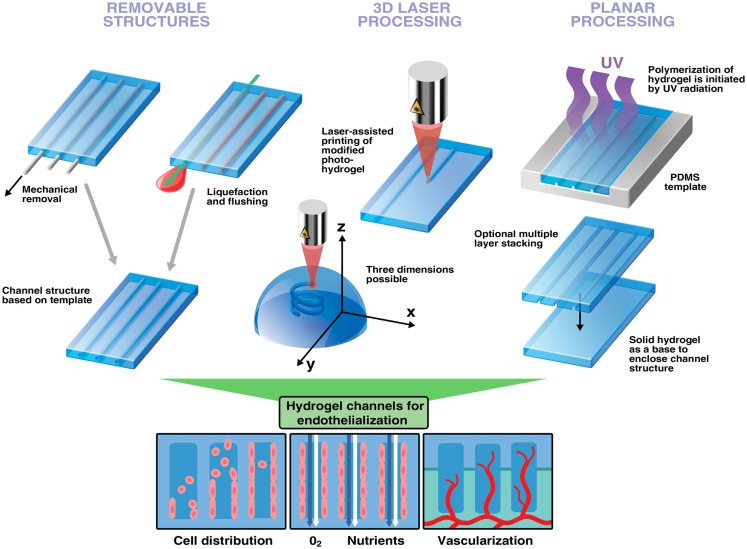
Figure 1
Figure 1
Strategies to engineer channels and interconnected structures in hydrogels to improve vascularization. Removable structures: hydrogels can be cast around non-sacrificial and sacrificial templates. Upon removal, defined channel structures are left behind. 3D laser processing can generate virtually any structures with a remarkable speed and spatial resolution. Depending on the material photo-reactive groups can be cleaved to initiate hydrogel network dissociation or activated for polymerization. Furthermore, photocoupling can be used to functionalize already existing channels with biomolecules enabling cell guidance (not shown). Planar processing utilizes a PDMS stamp to generate layers of channels in hydrogels. This multi-step-procedure is preferably used for establishing perfusion networks in hydrogels. Hollow channels increase control of endothelial cell distribution and improve mass transport. Endothelialized channels promote vessel ingrowth and anastomosis with host vasculature leading to better integration into host tissue upon implantation.

References

    1. Aird W. C. (2012). Endothelial cell heterogeneity. Cold Spring Harb. Perspect. Med. 2, a006429.10.1101/cshperspect.a006429 - DOI - PMC - PubMed
    1. Annabi N., Nichol J. W., Zhong X., Ji C., Koshy S., Khademhosseini A., et al. (2010). Controlling the porosity and microarchitecture of hydrogels for tissue engineering. Tissue Eng. Part B Rev. 16, 371–383.10.1089/ten.TEB.2009.0639 - DOI - PMC - PubMed
    1. Annabi N., Selimovic Š, Acevedo Cox J. P., Ribas J., Afshar Bakooshli M., Heintze D., et al. (2013). Hydrogel-coated microfluidic channels for cardiomyocyte culture. Lab. Chip 13, 3569–3577.10.1039/c3lc50252j - DOI - PMC - PubMed
    1. Arevalo R. C., Urbach J. S., Blair D. L. (2010). Size-dependent rheology of type-I collagen networks. Biophys. J. 99, L65–L67.10.1016/j.bpj.2010.08.008 - DOI - PMC - PubMed
    1. Asakawa N., Shimizu T., Tsuda Y., Sekiya S., Sasagawa T., Yamato M., et al. (2010). Pre-vascularization of in vitro three-dimensional tissues created by cell sheet engineering. Biomaterials 31, 3903–3909.10.1016/j.biomaterials.2010.01.105 - DOI - PubMed
