


Inositol pyrophosphates: why so many phosphates?
- PMID: 25453220
- PMCID: PMC4291286
- DOI: 10.1016/j.jbior.2014.09.015
Inositol pyrophosphates: why so many phosphates?
Abstract
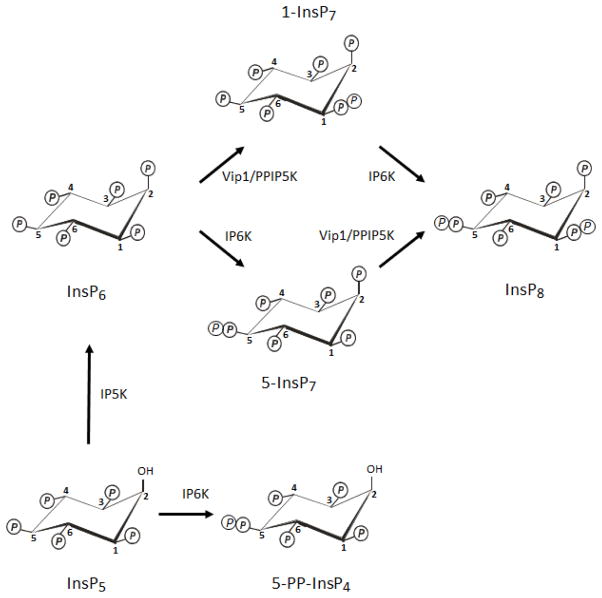
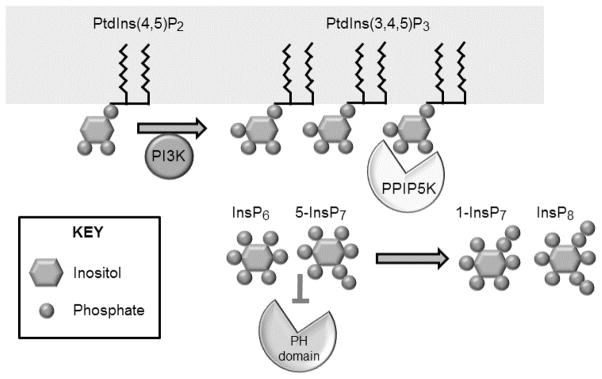
The inositol pyrophosphates (PP-InsPs) are a specialized group of "energetic" signaling molecules found in yeasts, plants and animals. PP-InsPs boast the most crowded three dimensional phosphate arrays found in Nature; multiple phosphates and diphosphates are crammed around the six-carbon, inositol ring. Yet, phosphate esters are also a major energy currency in cells. So the synthesis of PP-InsPs, and the maintenance of their levels in the face of a high rate of ongoing turnover, all requires significant bioenergetic input. What are the particular properties of PP-InsPs that repay this investment of cellular energy? Potential answers to that question are discussed here, against the backdrop of a recent hypothesis that signaling by PP-InsPs is evolutionarily ancient. The latter idea is extended herein, with the proposal that the primordial origins of PP-InsPs is reflected in the apparent lack of isomeric specificity of certain of their actions. Nevertheless, there are other aspects of signaling by these polyphosphates that are more selective for a particular PP-InsP isomer. Consideration of the nature of both specific and non-specific effects of PP-InsPs can help rationalize why such molecules possess so many phosphates.
Keywords: Analogs; Cell-signaling; Diphosphoinositol polyphosphates; Inositol pyrophosphates; Kinase; Phosphorylation; Structure.
Published by Elsevier Ltd.
Figures
References
-
- Adelson JW. Enterosecretory proteins. Nature. 1971;229:321–325. - PubMed
-
- Agranoff BW. Phosphorylated derivatives of myo-inositol. Fed Proc. 1985;45:2629–2633. - PubMed
-
- Agranoff BW, Eisenberg F, Jr, Hauser G, Hawthorn JN, Michell RH. Comment on Abbreviations. In: Bleasdale JE, Eichberg J, Hauser G, editors. Inositol and Phosphoinositides. Metabolism and Regulation. Clifton: Humna Press; 1985. p. xxi.
Publication types
MeSH terms
Substances
Grants and funding
LinkOut - more resources
Full Text Sources
Other Literature Sources
Miscellaneous
