


Are children and adolescents with food allergies at increased risk for psychopathology?
- PMID: 25454290
- PMCID: PMC4307934
- DOI: 10.1016/j.jpsychores.2014.10.005
Are children and adolescents with food allergies at increased risk for psychopathology?
Abstract
Objective: Living with food allergy is a unique and potentially life-threatening stressor that requires constant vigilance to food-related stimuli, but little is known about whether adolescents with food allergies are at increased risk for psychopathology-concurrently and over time.
Methods: Data came from the prospective-longitudinal Great Smoky Mountains Study. Adolescents (N=1420) were recruited from the community, and interviewed up to six times between ages 10 and 16 for the purpose of the present analyses. At each assessment, adolescents and one parent were interviewed using the Child and Adolescent Psychiatric Assessment, resulting in N=5165 pairs of interviews.
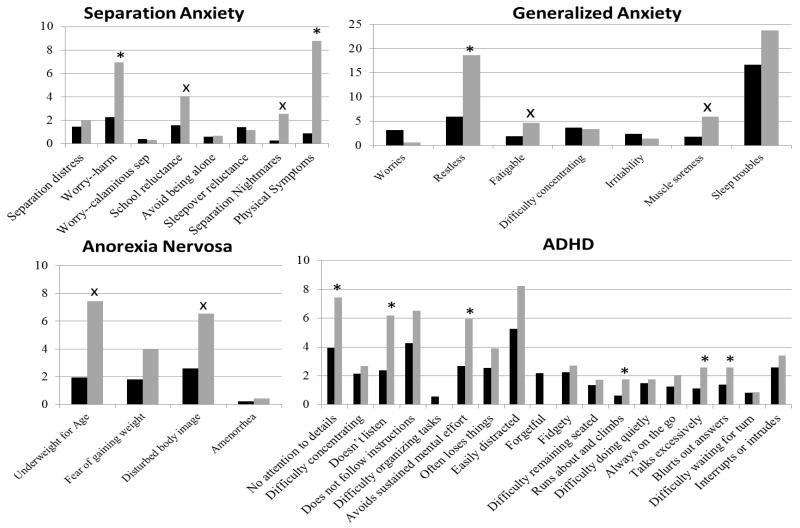
Results: Cross-sectionally, food allergies were associated with more symptoms of separation and generalized anxiety, disorder, attention deficit and hyperactivity disorder, and anorexia nervosa. Longitudinally, adolescents with food allergy experienced increases in symptoms of generalized anxiety disorder and depression from one assessment to the next. Food allergies were not, however, associated with a higher likelihood of meeting diagnostic criteria for a psychiatric disorder.
Conclusion: The unique constellation of adolescents' increased symptoms of psychopathology in the context of food allergy likely reflects an adaptive increase in vigilance rather than cohesive syndromes of psychopathology. Support and guidance from health care providers is needed to help adolescents with food allergies and their caregivers achieve an optimal balance between necessary vigilance and hypervigilance and unnecessary restriction.
Keywords: Adolescence; Anxiety; Depression; Eating disorders; Food allergy; Psychopathology; Stressors.
Copyright © 2014 Elsevier Inc. All rights reserved.
Figures
References
-
- Grundy J, Matthews S, Bateman B, Dean T, Arshad SH. Rising prevalence of allergy to peanut in children: Data from 2 sequential cohorts. Journal of Allergy and Clinical Immunology. 2002;110(5):784–9. - PubMed
-
- Branum AM, Lukacs SL. Food allergy among children in the United States. Pediatrics. 2009;124(6):1549–55. - PubMed
-
- Gupta RS, Springston EE, Warrier MR, Smith B, Kumar R, Pongracic J, et al. The prevalence, severity, and distribution of childhood food allergy in the United States. Pediatrics. 2011;128(1):e9–17. - PubMed
-
- Venter C, Arshad SH. Epidemiology of food allergy. Pediatric Clinics of North America. 2011;58(2):327–49. - PubMed
-
- Kuehn BM. Food allergies becoming more common. JAMA. 2008;300(20):2358. - PubMed
Publication types
MeSH terms
Grants and funding
- R21 MH097959/MH/NIMH NIH HHS/United States
- R01 DA022308/DA/NIDA NIH HHS/United States
- MH63671/MH/NIMH NIH HHS/United States
- R01 MH063970/MH/NIMH NIH HHS/United States
- R01 DA024413/DA/NIDA NIH HHS/United States
- DA/MH11301/DA/NIDA NIH HHS/United States
- MH63970/MH/NIMH NIH HHS/United States
- U01 AA021681/AA/NIAAA NIH HHS/United States
- R03 MH094605/MH/NIMH NIH HHS/United States
- U01 DA024413/DA/NIDA NIH HHS/United States
- R01 HD078346/HD/NICHD NIH HHS/United States
- R33 MH097959/MH/NIMH NIH HHS/United States
- P30 DA023026/DA/NIDA NIH HHS/United States
- R01 DA036523/DA/NIDA NIH HHS/United States
- R01 DA011301/DA/NIDA NIH HHS/United States
- MH094605/MH/NIMH NIH HHS/United States
- R01 MH048085/MH/NIMH NIH HHS/United States
- R01 MH063671/MH/NIMH NIH HHS/United States
LinkOut - more resources
Full Text Sources
Other Literature Sources
Medical
