


Perineural growth in head and neck squamous cell carcinoma: a review
- PMID: 25456006
- PMCID: PMC4268058
- DOI: 10.1016/j.oraloncology.2014.10.004
Perineural growth in head and neck squamous cell carcinoma: a review
Abstract
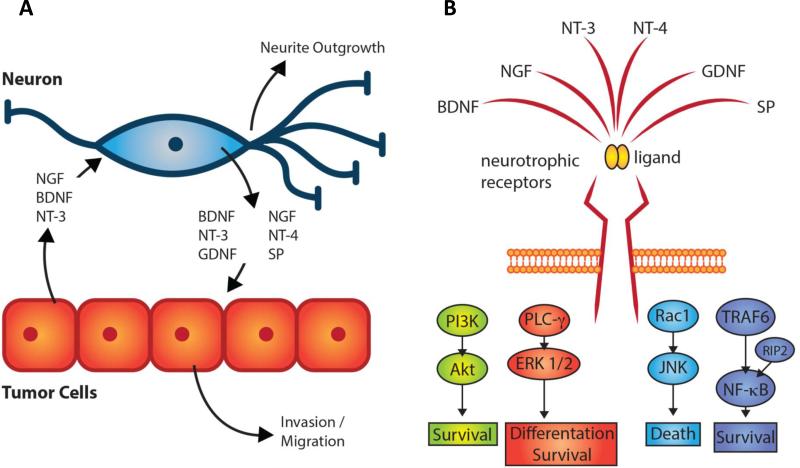
Perineural growth is a unique route of tumor metastasis that is associated with poor prognosis in several solid malignancies. It is diagnosed by the presence of tumor cells inside the neural space seen on histological or imaging evaluations. Little is known about molecular mechanisms involved in the growth and spread of tumor cells in neural spaces. The poor prognosis associated with perineural growth and lack of targeted approaches necessitates the study of molecular factors involved in communication between tumor and neural cells. Perineural growth rates, shown to be as high as 63% in head and neck squamous cell carcinoma (HNSCC), correlate with increased local recurrence and decreased disease-free survival. Here we describe the literature on perineural growth in HNSCC. In addition, we discuss factors implicated in perineural growth of cancer. These factors include brain-derived neurotrophic factor (BDNF), nerve growth factor (NGF), neurotrophin-3 and -4, glial cell-line derived neurotrophic factor (GDNF), the neural cell adhesion molecule (NCAM), substance P (SP), and chemokines. We also explore the literature on membrane receptors, including the Trk family and the low-affinity nerve growth factor receptor. This review highlights areas for further study of the mechanisms of perineural invasion which may facilitate the identification of therapeutic targets in HNSCC.
Keywords: Chemokines; Neurotrophic factors; Neurotrophin; Perineural growth; Perineural invasion; Squamous cell carcinoma.
Copyright © 2014 Elsevier Ltd. All rights reserved.
Figures
References
-
- Skarsgard DP, Groome PA, Mackillop WJ, Zhou S, Rothwell D, Dixon PF, et al. Cancers of the upper aerodigestive tract in Ontario, Canada, and the United States. Cancer. 2000;88:1728–38. - PubMed
-
- Blot WJ, McLaughlin JK, Winn DM, Austin DF, Greenberg RS, Preston-Martin S, et al. Smoking and drinking in relation to oral and pharyngeal cancer. Cancer Res. 1988;48:3282–7. - PubMed
-
- Vineis P, Alavanja M, Buffler P, Fontham E, Franceschi S, Gao YT, et al. Tobacco and cancer: recent epidemiological evidence. J Natl Cancer Inst. 2004;96:99–106. - PubMed
-
- D'Souza G, Kreimer AR, Viscidi R, Pawlita M, Fakhry C, Koch WM, et al. Case-control study of human papillomavirus and oropharyngeal cancer. N Engl J Med. 2007;356:1944–56. - PubMed
-
- Ceyhan GO, Demir IE, Altintas B, Rauch U, Thiel G, Muller MW, et al. Neural invasion in pancreatic cancer: a mutual tropism between neurons and cancer cells. Biochem Biophys Res Commun. 2008;374:442–7. - PubMed
Publication types
MeSH terms
Grants and funding
LinkOut - more resources
Full Text Sources
Other Literature Sources
Medical
Research Materials
Miscellaneous
