


A behavioral intervention for war-affected youth in Sierra Leone: a randomized controlled trial
- PMID: 25457927
- PMCID: PMC5022359
- DOI: 10.1016/j.jaac.2014.09.011
A behavioral intervention for war-affected youth in Sierra Leone: a randomized controlled trial
Abstract
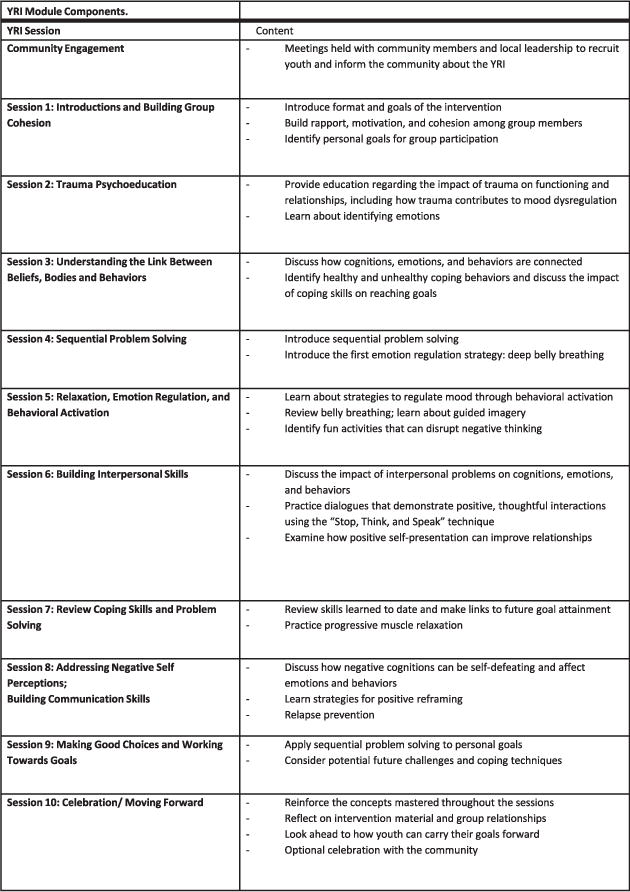
Objective: Youth in war-affected regions are at risk for poor psychological, social, and educational outcomes. Effective interventions are needed to improve mental health, social behavior, and school functioning. This randomized controlled trial tested the effectiveness of a 10-session cognitive-behavioral therapy (CBT)-based group mental health intervention for multisymptomatic war-affected youth (aged 15-24 years) in Sierra Leone.
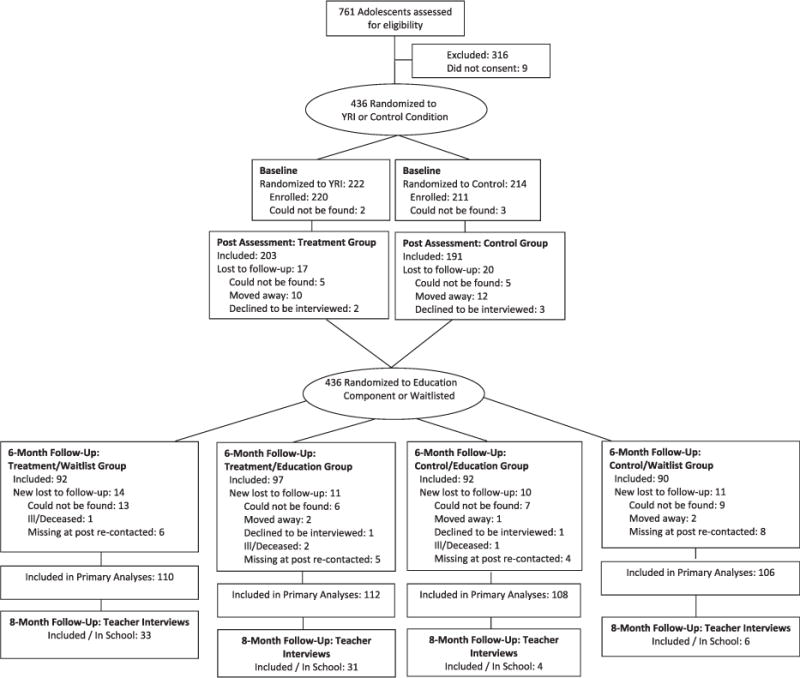
Method: War-affected youth identified by elevated distress and impairment via community screening were randomized (stratified by sex and age) to the Youth Readiness Intervention (YRI) (n = 222) or to a control condition (n = 214). After treatment, youth were again randomized and offered an education subsidy immediately (n = 220) or waitlisted (n = 216). Emotion regulation, psychological distress, prosocial attitudes/behaviors, social support, functional impairment, and posttraumatic stress disorder (PTSD) symptoms were assessed at pre- and postintervention and at 6-month follow-up. For youth in school, enrollment, attendance, and classroom performance were assessed after 8 months. Linear mixed-effects regressions evaluated outcomes.
Results: The YRI showed significant postintervention effects on emotion regulation, prosocial attitudes/behaviors, social support, and reduced functional impairment, and significant follow-up effects on school enrollment, school attendance, and classroom behavior. In contrast, education subsidy was associated with better attendance but had no effect on mental health or functioning, school retention, or classroom behavior. Interactions between education subsidy and YRI were not significant.
Conclusion: YRI produced acute improvements in mental health and functioning as well as longer-term effects on school engagement and behavior, suggesting potential to prepare war-affected youth for educational and other opportunities. Clinical trial registration information-Trial of the Youth Readiness Intervention (YRI); http://clinicaltrials.gov; NCT01684488.
Keywords: intervention; mental health; randomized controlled trial; war-affected; youth.
Copyright © 2014 American Academy of Child and Adolescent Psychiatry. Published by Elsevier Inc. All rights reserved.
Conflict of interest statement
Drs. Betancourt, Newnham, Akinsulure-Smith, Brennan, Weisz, Hansen, and McBain report no biomedical interests or potential conflicts of interest.
Figures
References
-
- Machel G. Impact of Armed Conflict on Children. New York: United Nations; 1996.
-
- Patel V, Flisher AJ, Hetrick S, McGorry P. Mental health of young people: a global public-health challenge. Lancet. 2007;369:1302–1313. - PubMed
-
- Derluyn I, Broekaert E, Schuyten G, De Temmerman E. Post-traumatic stress in former Ugandan child soldiers. Lancet. 2004;363:861–863. - PubMed
-
- Ruf M, Schauer M, Neuner F, Catani C, Schauer E, Elbert T. Narrative exposure therapy for 7- to 16-year-olds: a randomized controlled trial with traumatized refugee children. J Traum Stress. 2010;23:437–445. - PubMed
Publication types
MeSH terms
Associated data
Grants and funding
LinkOut - more resources
Full Text Sources
Other Literature Sources
Medical
