


The cutoff level of free/total prostate specific antigen (f/t PSA) ratios in the diagnosis of prostate cancer: a validation study on a Turkish patient population in different age categories
- PMID: 25458043
- PMCID: PMC11916534
- DOI: 10.1016/j.kjms.2014.03.008
The cutoff level of free/total prostate specific antigen (f/t PSA) ratios in the diagnosis of prostate cancer: a validation study on a Turkish patient population in different age categories
Abstract
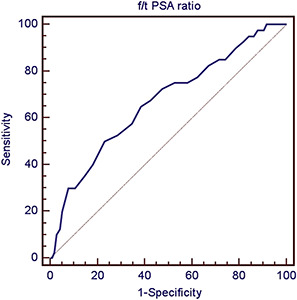
We investigated an optimal cutoff level of free/total PSA ratios (f/t PSA) in predicting prostate cancer in different age groups, focusing on the avoidance of unnecessary prostate biopsies. A total of 4955 men were enrolled into the study. Serum tPSA, fPSA, and f/t PSA ratios were determined for the study population. All males who had suspicious digital rectal examination and tPSA > 4 ng/mL underwent transrectal ultrasonography-guided prostate biopsy. Receiver operating characteristic (ROC) curves for each group were generated by plotting the sensitivity versus 1-specificity for the f/t PSA ratio. The sensitivity, specificity, positive likelihood ratio (PLR), and negative likelihood ratio (NLR) were obtained using various f/t PSA ratio cutoffs for different age groups. There were 657 patients with a PSA level of 4-10 ng/mL. According to sensitivity and specificity f/t% PSA cutoff points were determined to be 10%, 15%, 15%, and 10% in 50-59 years, 60-69 years, >70 years, and all ages categories, respectively, in patients with initial PSA level of 4-10 ng/mL. f/t PSA ratio had an area under the curve (AUC) value of 0.81 (95% confidence level: 0.80-0.82) for all age groups in detecting prostate cancer. f/t PSA ratio has an AUC value of 0.669 (0.632-0.705) in detecting prostate cancer among patients with a PSA level of 4-10 ng/mL. Ten percent of f/t PSA ratio had the highest specificity with PLR and 30% f/t PSA ratio had the highest sensitivity with lower NLR in the all-age categories. The current study shows that the use of f/t PSA ratio in patients with PSA levels of 4-10 ng/mL should enhance the specificity of PSA screening and decrease the number of unnecessary biopsies. The age-related changes warrant further investigation in a large, multicentric, and multinational population to improve the clinical use of f/t PSA cutoffs.
Keywords: Prostate cancer; Sensitivity; Specificity; f/T PSA ratios.
Copyright © 2014. Published by Elsevier Taiwan.
Figures

References
-
- Polascik T.J., Oesterling J.E., Partin A.W.. Prostate specific antigen: a decade of discovery – what we have learned and where we are going. J Urol. 1999; 162: 293–306. - PubMed
-
- Landis S.H., Murray T., Bolden S., Wingo P.A.. Cancer statistics 1999. CA Cancer J Clin. 1999; 49: 8–31. - PubMed
-
- Oesterling J.E., Jacobsen S.J., Chute C.G., Guess H.A., Girman C.J., Panser L.A., et al. Serum prostate‐specific antigen in a community‐based population of healthy men. Establishment of age‐specific reference ranges. JAMA. 1993; 270: 860–864. - PubMed
-
- Thompson I.M., Pauler D.K., Goodman P.J., Tangen C.M., Lucia M.S., Parnes H.L., et al. Prevalence of prostate cancer among men with a prostate‐specific antigen level < or = 4.0 ng per milliliter. N Engl J Med. 2004; 350: 2239–2246. - PubMed
-
- Loeb S., Roehl K.A., Antenor J.A.V., Catalona W.J., Suarez B.K., Nadler R.B.. Baseline PSA compared with median PSA for age group as predictor of pathologic tumor features in men younger than 60 years old. Urology. 2006; 67: 316–320. - PubMed
Publication types
MeSH terms
Substances
LinkOut - more resources
Full Text Sources
Other Literature Sources
Medical
Research Materials
Miscellaneous
