Review
. 2014 Nov 17;24(22):R1099-103.
doi: 10.1016/j.cub.2014.10.011. Epub 2014 Nov 17.

Deciphering the evolutionary history of open and closed mitosis

Affiliations
Review

Deciphering the evolutionary history of open and closed mitosis

Shelley Sazer et al. Curr Biol. .

Abstract

The origin of the nucleus at the prokaryote-to-eukaryote transition represents one of the most important events in the evolution of cellular organization. The nuclear envelope encircles the chromosomes in interphase and is a selectively permeable barrier between the nucleoplasm and cytoplasm and an organizational scaffold for the nucleus. It remains intact in the 'closed' mitosis of some yeasts, but loses its integrity in the 'open' mitosis of mammals. Instances of both types of mitosis within two evolutionary clades indicate multiple evolutionary transitions between open and closed mitosis, although the underlying genetic changes that influenced these transitions remain unknown. A survey of the diversity of mitotic nuclei that fall between these extremes is the starting point from which to determine the physiologically relevant characteristics distinguishing open from closed mitosis and to understand how they evolved and why they are retained in present-day organisms. The field is now poised to begin addressing these issues by defining and documenting patterns of mitotic nuclear variation within and among species and mapping them onto a phylogenic tree. Deciphering the evolutionary history of open and closed mitosis will complement cell biological and genetic approaches aimed at deciphering the fundamental organizational principles of the nucleus.


Figures

Figure 1
Figure 1. The nucleus in interphase
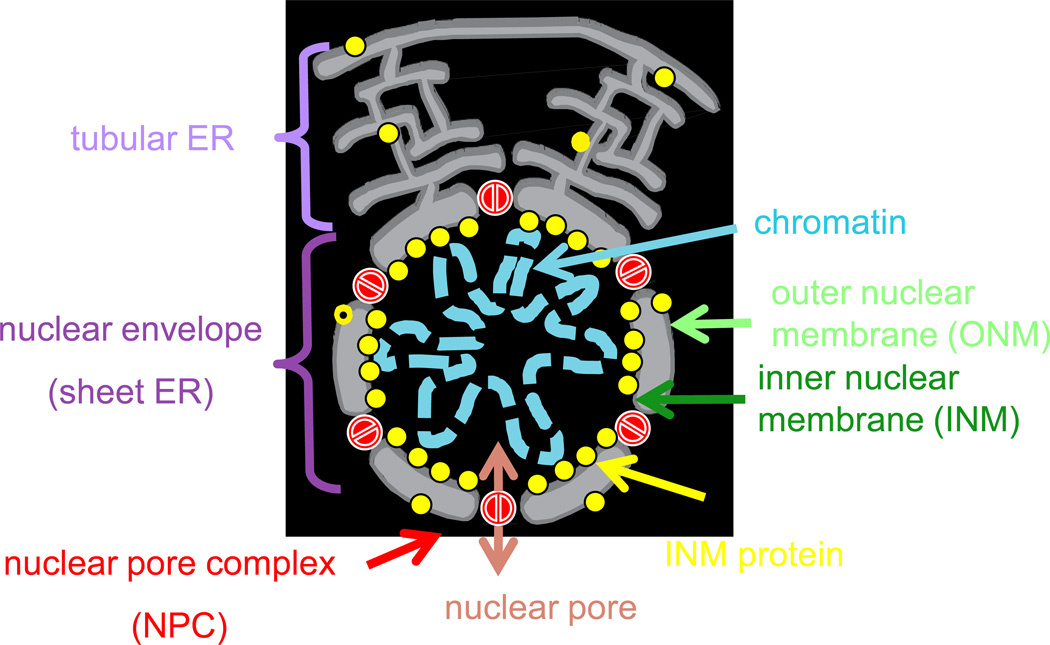
The double phospholipid bilayer-bound nucleus is a specialized region of the endoplasmic reticulum (ER) that harbors the chromosomes of eukaryotic cells in interphase. The membranes of the inner (INM) and outer (ONM) nuclear envelope are continuous with one another and with the ER, but the INM is enriched with a specialized collection of INM proteins [15, 16] that are synthesized in the ER (as shown), transit to the ONM and then to the INM where they are retained by association with chromatin and/or other proteins at the nuclear periphery. The nuclear envelope (NE) is perforated by nuclear pore complexes (NPC), which surround the nuclear pores, aqueous channels that form a selectively-permeable barrier between the nucleoplasm and the cytoplasm. With few exceptions [36, 47], the exchange of material across the intact NE is restricted to the NPCs that allow the free diffusion of some small molecules and proteins and the selective Ran-GTPase dependent exchange of larger cargoes [13]. During interphase of the cell cycle (the time when cells are not in mitosis), the chromosomes are decondensed, the NE is intact, and some proteins of the INM (e.g. the nuclear lamina proteins of mammalian cells or telomere or heterochromatin-binding proteins of yeast), anchor specific chromosome domains, such as non-transcribed heterochromatin and telomeres, to the nuclear periphery.
Figure 2
Figure 2. The nucleus in mitosis
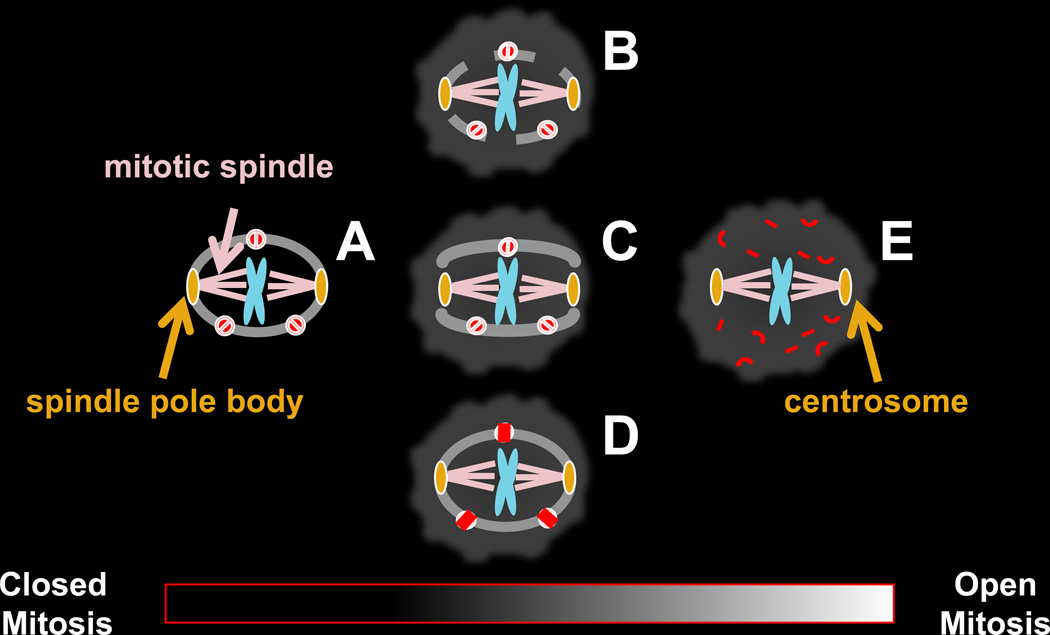
The nucleus changes dramatically from its interphase state (Figure 1) as cells enter mitosis. The chromatin previously tethered to the nuclear periphery is released, the chromosomes condense into their mitotic metaphase configuration, and the microtubule cytoskeleton is typically (but not always [44, 48]) reorganized by the microtubule organizing center, called the centrosome or spindle pole body (SPB), into the mitotic spindle that attaches to and then segregates the duplicated chromosomes to opposite sides of the cell. The two best-characterized examples of mitosis-specific nuclear changes are the closed mitosis of the fission yeast Schizosaccharomyces pombe and the budding yeast Saccharomyces cerevisiae in which the NE remains intact (2-A) and the open mitosis of mammalian cells (2-E) in which it breaks down. There are also examples of mitosis that for a variety of reasons cannot be characterized as strictly open or strictly closed (2-B, 2-C, 2-D). A. In the closed mitosis of some yeast cells, the duplicated SPBs are embedded in the nuclear membrane at mitosis and nucleate mitotic spindle formation within the confines of the nucleus. By definition, the presence of the SPB in the NE is essential for this type of closed mitosis. In some organisms the SPB is embedded in the NE during interphase and mitosis (e.g. S. cerevisiae) whereas in others it lies in the cytoplasm in close proximity to the NE in interphase, and enters the NE at mitosis (e.g. S. pombe)[30]. As the spindle elongates and applies pressure to opposite sides of the nucleus the spherical nucleus divides into two smaller spheres. These properties of closed mitosis are best characterized in S. cerevisiae and S. pombe but are not necessarily typical of other yeast or fungi or other organisms that undergo closed mitosis, some of which do not form a spindle inside of the nucleus [7]. B, C, D. Some types of mitosis are neither open nor closed. There are instances of cells that assemble an intranuclear mitotic spindle from NE embedded SPBs, but later in mitosis holes form in the NE, as in the fission yeast Schizosaccharomyces japonicas [24, 25]. In some cell types, such as multinucleated Drosophila melanogaster embryos [23] (B), nuclei undergo only partial NEBD. In other cell types, such as Chitridiales [7, 26], polar openings form in the NE, through which the cytoplasmic spindle extends (C). Cells with an ultrastructurally intact NE can also have a disrupted permeability barrier, resulting in the mixing of nucleoplasm and cytoplasm due to changes in NPC composition and/or permeability (D) as in the mitotic cycle of the filamentous fungus, Aspergillus nidulans [29], and during meiosis in the fission yeast S. pombe [27, 28]. E. In the open mitosis of mammalian cells, brought about by NEBD, the nuclear lamins (that line the inner NE in interphase) depolymerize, the NPCs disassemble and the NE is reorganized into the mitotic ER [21, 37] to which some of the membrane associated components of the nuclear lamina and NPC also relocalize. Although there are exceptions (e.g. Planarians lack centrosomes [48]) in animal cells the mitotic spindle is typically organized by centrosomes and can gain access to the chromosomes only after NEBD. Unlike the functional equivalent of the centrosomes in yeast (the spindle pole body) the centrosome is not embedded in the NE, even in interphase, although it lies in the cytoplasm in close proximity and tethered to the NE [44, 49]. Following mitosis, membrane associated components of the lamina re-associate with the condensed mitotic chromosomes to nucleate reassembly of the NE [50].

References

    1. Koumandou VL, Wickstead B, Ginger ML, van der Giezen M, Dacks JB, Field MC. Molecular paleontology and complexity in the last eukaryotic common ancestor. Crit. Rev. Biochem. Mol. Biol. 2013;48:373–396. - PMC - PubMed
    1. Devos DP, Graf R, Field MC. Evolution of the nucleus. Curr. Opin. Cell Biol. 2014;28:8–15. - PMC - PubMed
    1. Koonin EV. The origin and early evolution of eukaryotes in the light of phylogenomics. Genome Biol. 2010;11:209. - PMC - PubMed
    1. Cavalier-Smith T. Origin of the cell nucleus, mitosis and sex: roles of intracellular coevolution. Biol. Direct. 2010;5:7. - PMC - PubMed
    1. Allwood AC, Walter MR, Kamber BS, Marshall CP, Burch IW. Stromatolite reef from the Early Archaean era of Australia. Nature. 2006;441:714–718. - PubMed

Publication types

LinkOut - more resources