Review
. 2014 Dec;35(12):664-74.
doi: 10.1016/j.tips.2014.10.007. Epub 2014 Nov 5.

Resistance-resistant antibiotics

Affiliations
Review

Resistance-resistant antibiotics

Eric Oldfield et al. Trends Pharmacol Sci. 2014 Dec.

Abstract

New antibiotics are needed because drug resistance is increasing while the introduction of new antibiotics is decreasing. We discuss here six possible approaches to develop 'resistance-resistant' antibiotics. First, multitarget inhibitors in which a single compound inhibits more than one target may be easier to develop than conventional combination therapies with two new drugs. Second, inhibiting multiple targets in the same metabolic pathway is expected to be an effective strategy owing to synergy. Third, discovering multiple-target inhibitors should be possible by using sequential virtual screening. Fourth, repurposing existing drugs can lead to combinations of multitarget therapeutics. Fifth, targets need not be proteins. Sixth, inhibiting virulence factor formation and boosting innate immunity may also lead to decreased susceptibility to resistance. Although it is not possible to eliminate resistance, the approaches reviewed here offer several possibilities for reducing the effects of mutations and, in some cases, suggest that sensitivity to existing antibiotics may be restored in otherwise drug-resistant organisms.

Keywords: antibiotics; innate immunity; isoprenoids; molecular dynamics; multitargeting; resistance.


Conflict of interest statement

Conflict of Interest

The authors declare they have no conflict of interest.

Figures
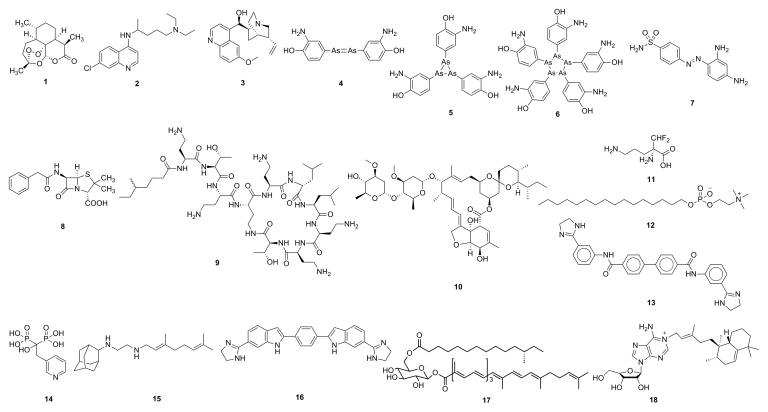
Figure 1
Figure 1
Structures of some drugs, drugs leads and other compounds of interest. 1: artemisinin; 2: chloroquine; 3: quinine; 4: early proposed structure of Salvarsan; 5, 6: actual structures of Salvarsan; 7: Prontosil; 8: penicillin; 9: colistin; 10: ivermectin; 11: eflornithine; 12: miltefosine; 13: bisamidine, BPH-1358; 14: risedronate; 15: SQ109; 16: MBX-1066; 17: staphyloxanthin; 18: tuberculosinyl adenosine.
Figure 2
Figure 2
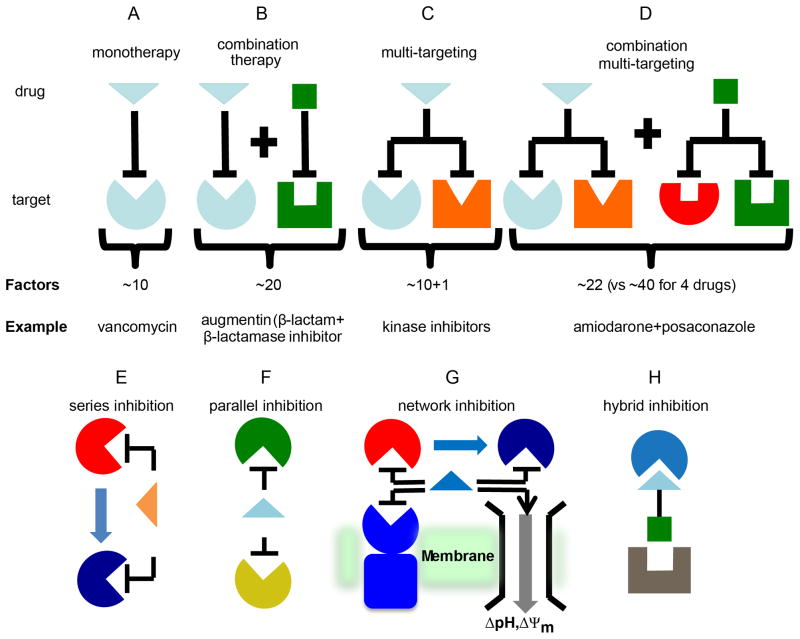
Therapeutic strategies for antibiotic development. A to D, Schematic illustration showing the approximate number of factors or requirements that need to be met for different types of therapies illustrating the advantage of multi-target inhibition. A, For an individual drug acting on a single target, there are at least 10 requirements or factors to be satisfied for success. B, Combination therapies involving two new drugs acting on two new targets double the requirements for success. C, Multi-target inhibitors retain the advantages of combination therapies but require fewer properties to be satisfied for success. D, Combination multi-targeting is expected to be highly active and resistance-resistant. E to G, There are three main classes of multi-target inhibitor: series, parallel and network. E, Series inhibitors work on sequential targets in the same metabolic pathway. F, parallel inhibitors work on unrelated pathways (e.g. DNA and membrane targets). G, Network inhibition is a combination of series and parallel inhibitors. H, Hybrid inhibitors contain overlapping or fused pharmacophores for 2 or more targets. E to G are reprinted with permission from reference [35]. Copyright 2014 American Chemical Society.
Figure 3
Figure 3
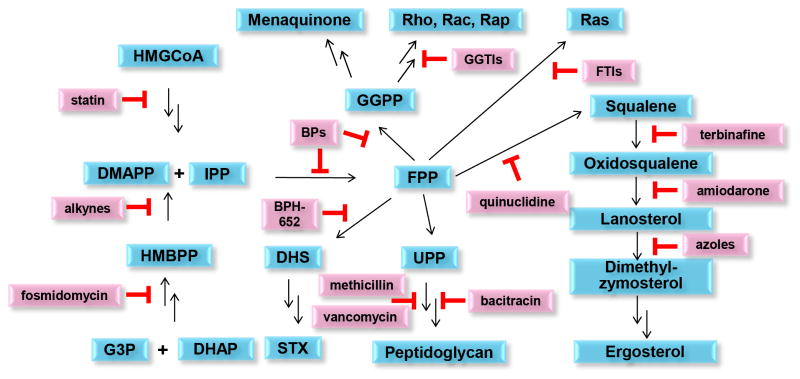
Isoprenoid biosynthesis pathways and inhibitors, showing that there are multiple validated drug targets and corresponding inhibitors in these pathways. Unlike many biosynthetic pathways, isoprenoid biosynthesis produces end-products that are (in most cases) only found in pathogens and are not available from the host, making isoprenoid biosynthesis a good drug target. For clarity, the enzyme targets are omitted but the isoprenoid products are shown in blue, inhibitors in pink. Abbreviations used: G3P, glycerol-3-phosphate; DHAP, dihydroxyacetone phosphate; HMBPP, (E)-hydroxy-2-methyl-but-2-enyl-4-diphosphate; DMAPP, dimethylallyl diphosphate; IPP: isopentenyl diphosphate; HMGCoA: 3-hydroxy-3-methyl-glutaryl-coenzyme A; FPP, farnesyl diphosphate; GGPP, geranylgeranyl diphosphate; UPP, undecaprenyl diphosphate; STX, staphyloxanthin; DHS, dehydrosqualene; GGTI, protein geranylgeranyl transferase inhibitor; FTI, protein farnesyl transferase inhibitor; BPs, bisphosphonates; BPH-652, a biphenyl phosphonosulfonate.
Figure 4
Figure 4
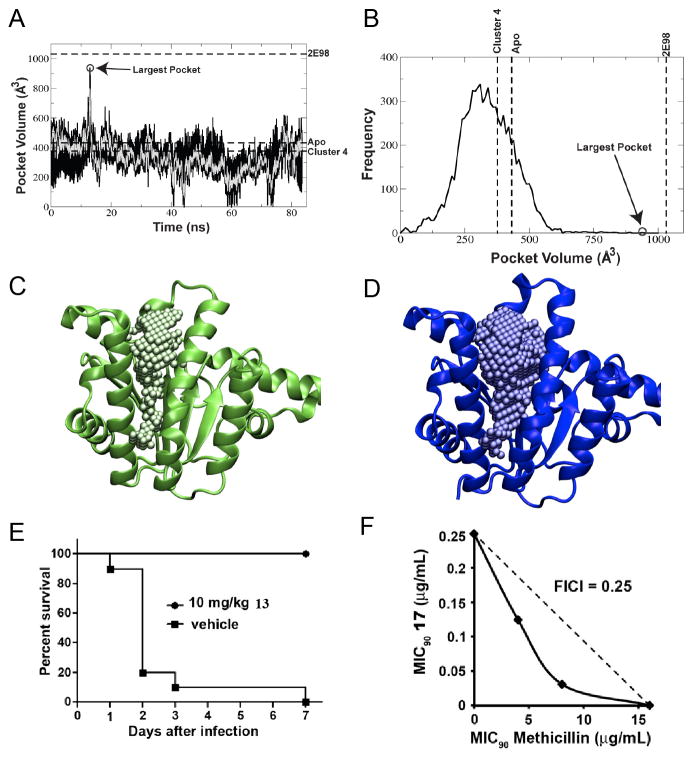
Molecular dynamics as a route to drug lead discovery. A–D, MD results for E. coli UPPS. A, volume of the binding pocket along the MD trajectory of E. coli undecaprenyl diphosphate synthase (UPPS). The black line shows data taken every 10 ps, the over-layed gray line is the average over every 100 ps; B, frequency at which different volumes of the pocket are sampled; C, the apo crystal structure with 1 Å spheres filling the active site pocket; D, a bisphosphonate-bound crystal structure with 1 Å spheres filling the active site pocket. Note the significantly larger pocket size in the bisphosphonate-bound structure when compared to the apo crystal structure. The MD-based structures provide the best correlation between experimental IC50 values and docking scores. E, activity of 13 (bisamidine, BPH-1358) in a mouse model of S. aureus (USA200) infection; F, in vitro synergy showing isobologram for BPH-1358 + methicillin inhibition of S. aureus (USA300) cell growth, FICI = 0.25. A to D are reprinted with permission from reference [40]. E and F are reprinted with permission from reference [34].
Figure 5
Figure 5
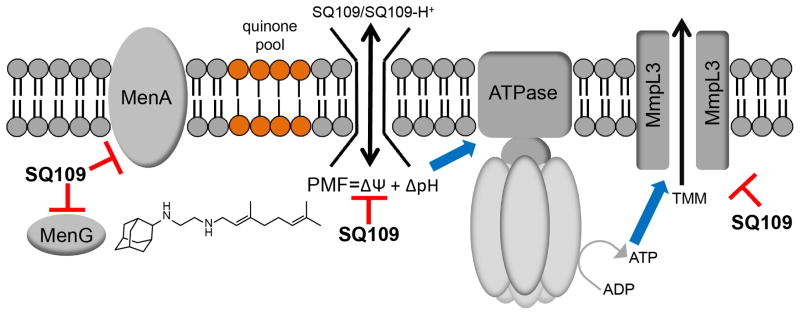
Membrane and protein targeting of SQ109 and its analogues. MenA, MenG targeting can affect respiration/electron transfer; PMF (ΔpH, Δψ) collapse leads to decreased ATP biosynthesis, reduction inPMF/ATP-powered transporters (e.g., MmpL3), increased TMM accumulation, and decreased cell wall biosynthesis. Reprinted with permission from reference [35]. Copyright 2014 American Chemical Society.
Figure 6
Figure 6
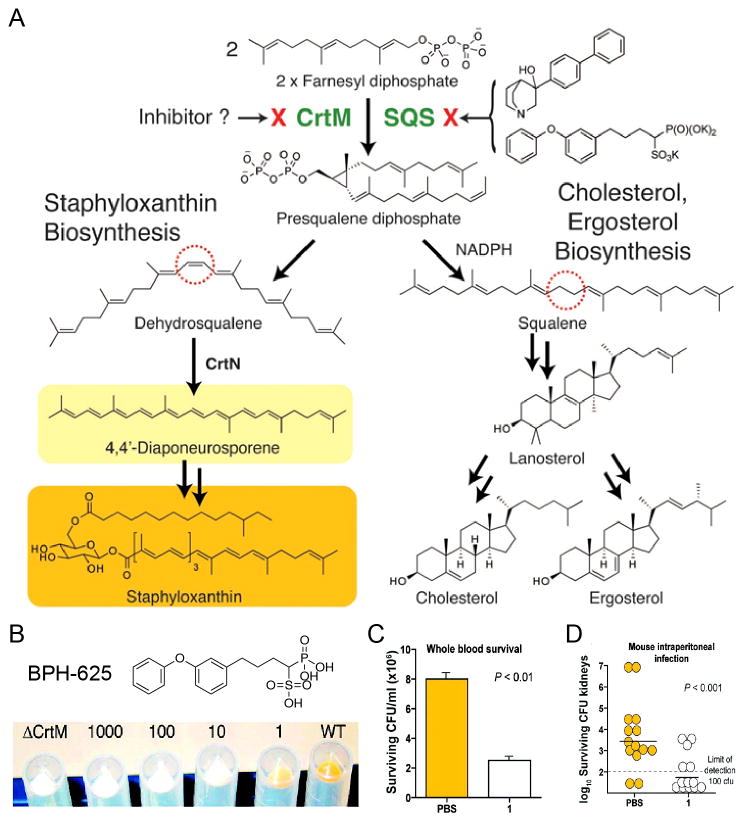
Targeting virulence factor formation in S. aureus. A, Initial step in the metabolic pathways to the virulence factor staphyloxanthin and cholesterol/ergosterol are the same. B, The cholesterol-lowing drug lead BPH-652 inhibits CrtM and inhibits formation of the orange carotenoid virulence factor. C, Bacteria treated with BPH-652 are killed by whole blood (ROS from neutrophils, macrophages). D. Mice treated with BPH-652 control a S. aureus infection (bacteria CFUs reduced by 98%). Reprinted with permission from reference [76].

References

    1. Threat Report 2013: Antibiotic/Antimicrobial Resistance. Centers for Disease Control and Prevention; http://www.cdc.gov/drugresistance/threat-report-2013/
    1. Antimicrobial resistance: global report on surveillance 2014. World Health Organization; http://www.who.int/drugresistance/documents/surveillancereport/en/
    1. http://www.longitudeprize.org/.

    1. Executive Order -- Combating Antibiotic-Resistant Bacteria. The White House; http://www.whitehouse.gov/the-press-office/2014/09/18/executive-order-co....
    1. Tu Y. The discovery of artemisinin (qinghaosu) and gifts from Chinese medicine. Nat Med. 2011;17:1217–1220. - PubMed

Publication types

Substances