


Case Reports
doi: 10.1016/j.hrthm.2014.10.035.
Epub 2014 Oct 31.
CALM3 mutation associated with long QT syndrome
Affiliations
- PMID: 25460178
- PMCID: PMC4907373
- DOI: 10.1016/j.hrthm.2014.10.035
Item in Clipboard
Case Reports
CALM3 mutation associated with long QT syndrome
Heart Rhythm.
2015 Feb.
No abstract available
Keywords: Arrhythmia; CALM3; Calcium channel inactivation; Calmodulin; Genetics; Long QT syndrome.
Conflict of interest statement
Michael J. Ackerman is a consultant for Boston Scientific, Gilead Sciences, Medtronic, and St. Jude Medical and receives sales based royalties from Transgenomic for their FAMILION-LQTS and FAMILION-CPVT genetic tests. The other authors have no conflicts of interest relevant to this article to disclose.
Figures
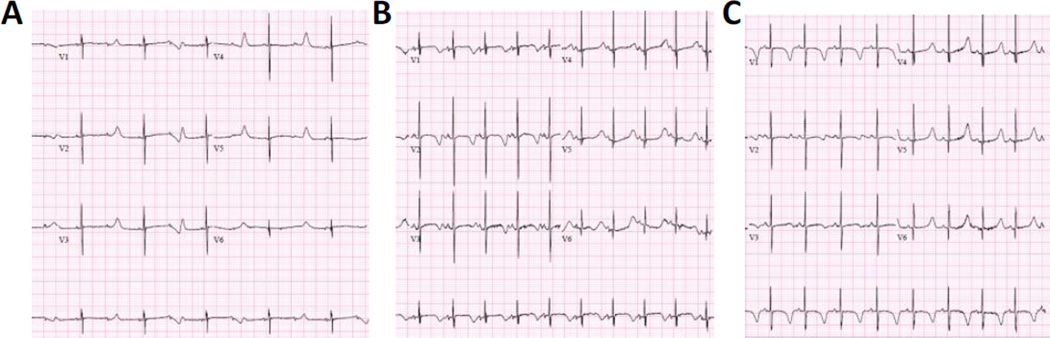
(A) ECG taken at 1 day of age showing extreme QT prolongation (QTc = 690 ms), 2:1 atrioventricular block, bradycardia (59 bpm), and T wave alternans. (B) ECG at 5 weeks of age showing QT prolongation (QTc = 586 ms) at a normal heart rate (111 bpm) and resolution of the 2:1 AV block. (C) ECG at 6 months of age showing marked QT prolongation (QTc = 556 ms).
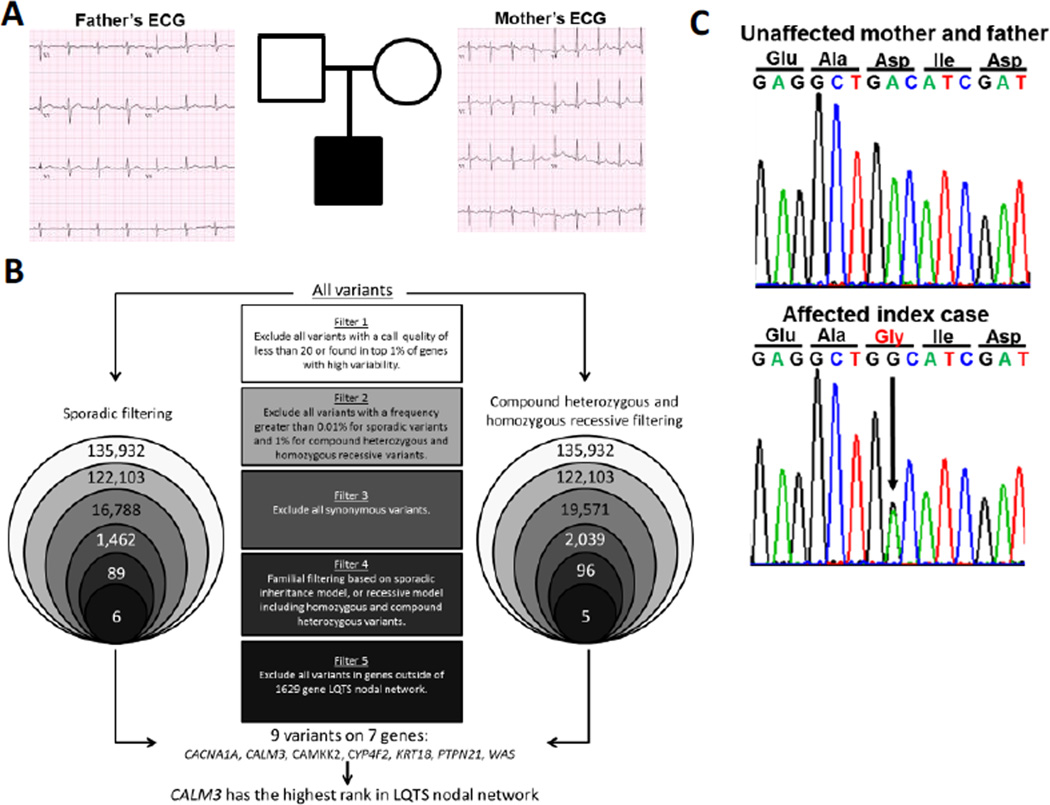
(A) Pedigree of family utilized for WES, including ECGs for the mother and father of the proband, showing normal corrected QT intervals. (B) Filtering strategy utilized for WES, separated by inheritance pattern, to include filtering for sporadic inheritance (left) and recessive inheritance (right). Some variants were identified in both sequencing strategies; please see Table 1 for more information regarding the identified variants. (C) DNA Sanger sequencing confirmation of the p.D130G mutation in the proband (lower) and the p.D130G mutation’s absence in the parents (upper), supporting a sporadic inheritance pattern.
Comment in
-
Calmodulinopathy: a genetic trilogy.Heart Rhythm. 2015 Feb;12(2):423-4. doi: 10.1016/j.hrthm.2014.11.017. Epub 2014 Nov 18. Heart Rhythm. 2015. PMID: 25460856 No abstract available.
References
-
- Go AS, Mozaffarian D, Roger VL, et al. Executive summary: heart disease and stroke statistics-2014 update: a report from the American Heart Association. Circulation. 2014 Jan 21;129:399–410. - PubMed
-
- Schwartz PJ, Ackerman MJ. The long QT syndrome: a transatlantic clinical approach to diagnosis and therapy. Eur Heart J. 2013 - PubMed
-
- Boczek NJ, Best JM, Tester DJ, Giudicessi JR, Middha S, Evans JM, Kamp TJ, Ackerman MJ. Exome sequencing and systems biology converge to identify novel mutations in the L-type calcium channel, CACNA1C, linked to autosomal dominant long QT syndrome. Circ Cardiovasc Genet. 2013;6:279–289. - PMC - PubMed
-
- Szperl AM, Ricano-Ponce I, Li JK, et al. Exome sequencing in a family segregating for celiac disease. Clin Genet. 2011;80:138–147. - PubMed
Publication types
MeSH terms
Substances
Grants and funding
LinkOut - more resources
Full Text Sources
Other Literature Sources
Molecular Biology Databases
