


The keys to healthy family child care homes intervention: study design and rationale
- PMID: 25460337
- PMCID: PMC4345353
- DOI: 10.1016/j.cct.2014.11.003
The keys to healthy family child care homes intervention: study design and rationale
Abstract
Background: Obesity is a major public health problem for which early preventive interventions are needed. Large numbers of young children are enrolled in some form of child care program, making these facilities influential environments in children's development. Family child care homes (FCCH) are a specific type of child care in which children are cared for within the provider's own residence. FCCHs serve approximately 1.5 million children in the U.S.; however, research to date has overlooked FCCH providers and their potential to positively influence children's health-related behaviors.
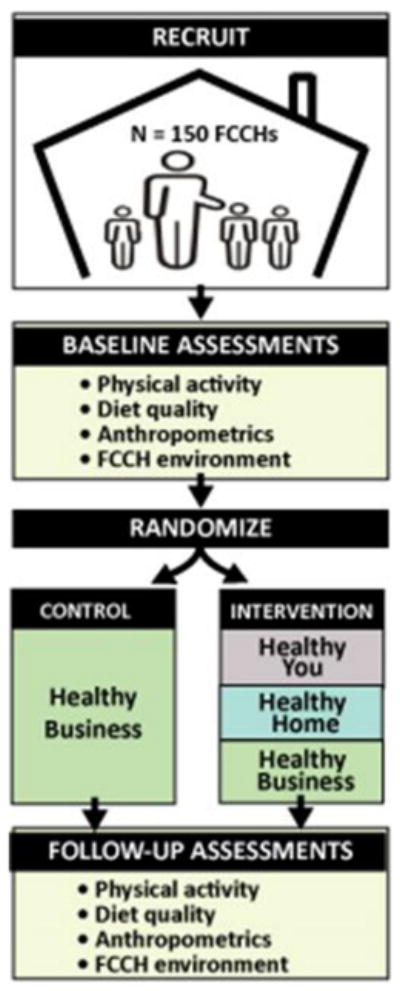
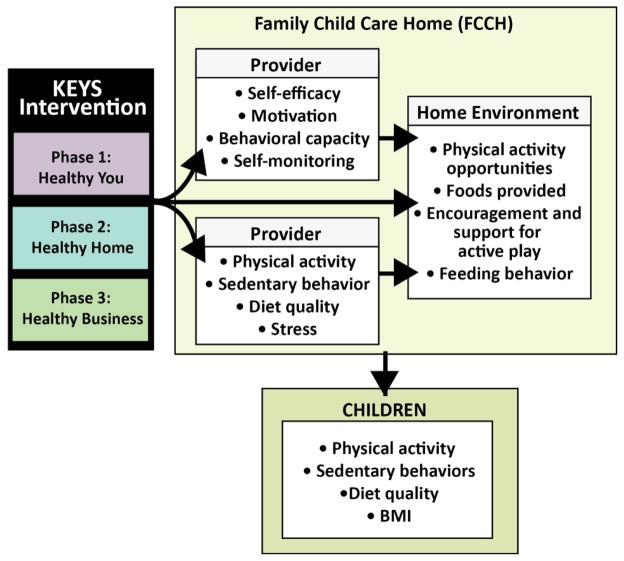
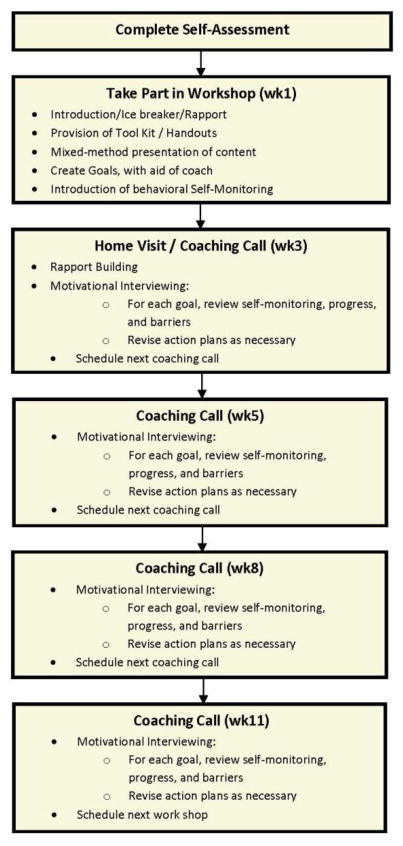
Methods: Keys to Healthy Family Child Care Homes (Keys) is a cluster-randomized controlled trial testing the efficacy of an intervention designed to help providers become healthy role models, provide quality food- and physical activity-supportive FCCH environments, and implement effective business practices. The intervention is delivered through workshops, home visits, tailored coaching calls, and educational toolkits. Primary outcomes are child physical activity measured via accelerometry data and dietary intake data collected using direct observation at the FCCH. Secondary outcomes include child body mass index, provider weight-related behaviors, and observed obesogenic environmental characteristics.
Conclusion: Keys is an innovative approach to promoting healthy eating and physical activity in young children. The intervention operates in a novel setting, targets children during a key developmental period, and addresses both provider and child behaviors to synergistically promote health.
Keywords: Children; Family child care homes; Obesity; Overweight; Randomized controlled trial.
Copyright © 2014. Published by Elsevier Inc.
Figures
References
-
- Freedman DS, Dietz WH, Srinivasan SR, Berenson GS. The relation of overweight to cardiovascular risk factors among children and adolescents: the Bogalusa Heart Study. Pediatrics. 1999;103(6 Pt 1):1175–1182. - PubMed
-
- Roberts EA. Pediatric nonalcoholic fatty liver disease (NAFLD): a “growing” problem? Journal of hepatology. 2007 Jun;46(6):1133–1142. - PubMed
-
- Rodriguez MA, Winkleby MA, Ahn D, Sundquist J, Kraemer HC. Identification of population subgroups of children and adolescents with high asthma prevalence: findings from the Third National Health and Nutrition Examination Survey. Archives of pediatrics & adolescent medicine. 2002 Mar;156(3):269–275. - PubMed
Publication types
MeSH terms
Grants and funding
LinkOut - more resources
Full Text Sources
Other Literature Sources
Medical
