


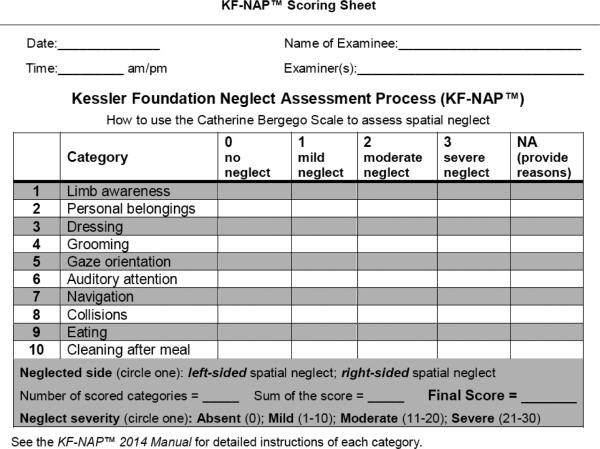
Kessler Foundation Neglect Assessment Process uniquely measures spatial neglect during activities of daily living
- PMID: 25461827
- PMCID: PMC4410062
- DOI: 10.1016/j.apmr.2014.10.023
Kessler Foundation Neglect Assessment Process uniquely measures spatial neglect during activities of daily living
Abstract
Objectives: To explore the factor structure of the Kessler Foundation Neglect Assessment Process (KF-NAP), and evaluate the prevalence and clinical significance of spatial neglect among stroke survivors.
Design: Inception cohort.
Setting: Inpatient rehabilitation facility (IRF).
Participants: Participants (N=121) with unilateral brain damage from their first stroke were assessed within 72 hours of admission to an IRF, and 108 were assessed again within 72 hours before IRF discharge.
Interventions: Usual and standard IRF care.
Main outcome measures: During each assessment session, occupational therapists measured patients' functions with the KF-NAP, FIM, and Barthel Index (BI).
Results: The KF-NAP showed excellent internal consistency with a single-factor structure. The exploratory factor analysis revealed the KF-NAP to be unique from both the FIM and BI even though all 3 scales were correlated. Symptoms of spatial neglect (KF-NAP>0) were present in 67.8% of the participants at admission and 47.2% at discharge. Participants showing the disorder at IRF admission were hospitalized longer than those showing no symptoms. Among those presenting with symptoms, the regression analysis showed that the KF-NAP scores at admission negatively predicted FIM scores at discharge, after controlling for age, FIM at admission, and length of stay.
Conclusions: The KF-NAP uniquely quantifies symptoms of spatial neglect by measuring functional difficulties that are not captured by the FIM or BI. Using the KF-NAP to measure spatial neglect, we found the disorder persistent after inpatient rehabilitation, and replicated previous findings showing that spatial neglect adversely affects rehabilitation outcome even after prolonged IRF care.
Keywords: Hemispatial neglect; Outcome assessment; Rehabilitation; Symptom assessment.
Copyright © 2015 American Congress of Rehabilitation Medicine. Published by Elsevier Inc. All rights reserved.
Figures
References
-
- Denes G, Semenza C, Stoppa E, Lis A. Unilateral spatial neglect and recovery from hemiplegia: a follow-up study. Brain. 1982;105(Pt 3):543–52. doi: 10.1093/brain/105.3.543. PubMed PMID: MEDLINE:7104665. - PubMed
-
- Fullerton KJ, McSherry D, Stout RW. Albert test: A neglected test of perceptual neglect. Lancet. 1986;1(8478):430–2. PubMed PMID: ISI:A1986A147100013. - PubMed
-
- Stone SP, Halligan PW, Greenwood RJ. The incidence of neglect phenomena and related disorders in patients with an acute right or left-hemisphere stroke. Age Ageing. 1993;22(1):46–52. doi: 10.1093/ageing/22.1.46. PubMed PMID: WOS:A1993KJ97600010. - PubMed
-
- McGlone J, Losier BJ, Black SE. Are there sex differences in hemispatial visual neglect after unilateral stroke? Neuropsychiatry Neuropsychol Behav Neurol. 1997;10(2):125–34. PubMed PMID: ISI:A1997WY13900008. - PubMed
Publication types
MeSH terms
Grants and funding
LinkOut - more resources
Full Text Sources
Other Literature Sources
Medical
Research Materials
