


Pathways between acculturation and health behaviors among residents of low-income housing: the mediating role of social and contextual factors
- PMID: 25462602
- PMCID: PMC4425350
- DOI: 10.1016/j.socscimed.2014.10.034
Pathways between acculturation and health behaviors among residents of low-income housing: the mediating role of social and contextual factors
Abstract
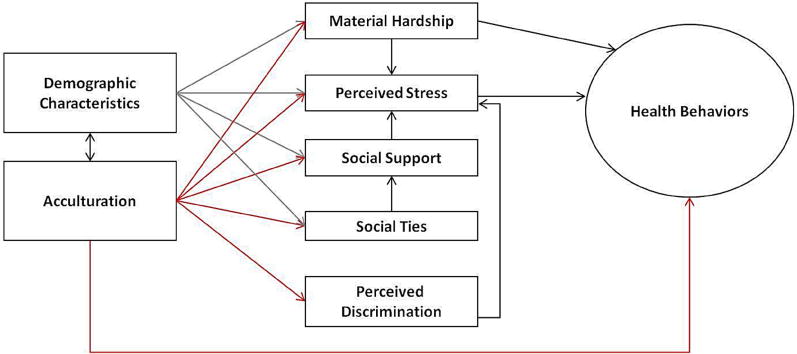
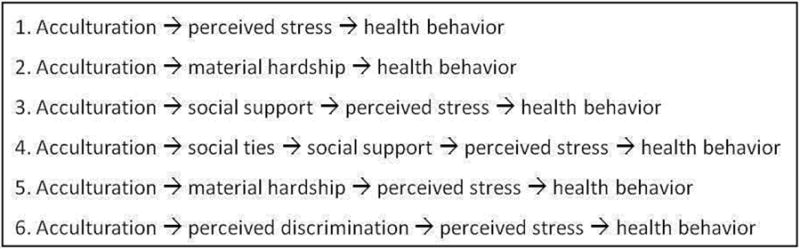
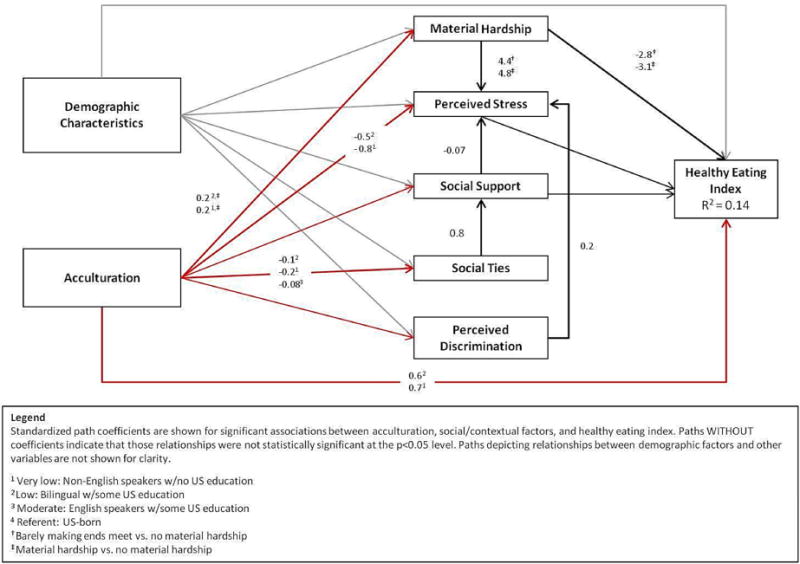
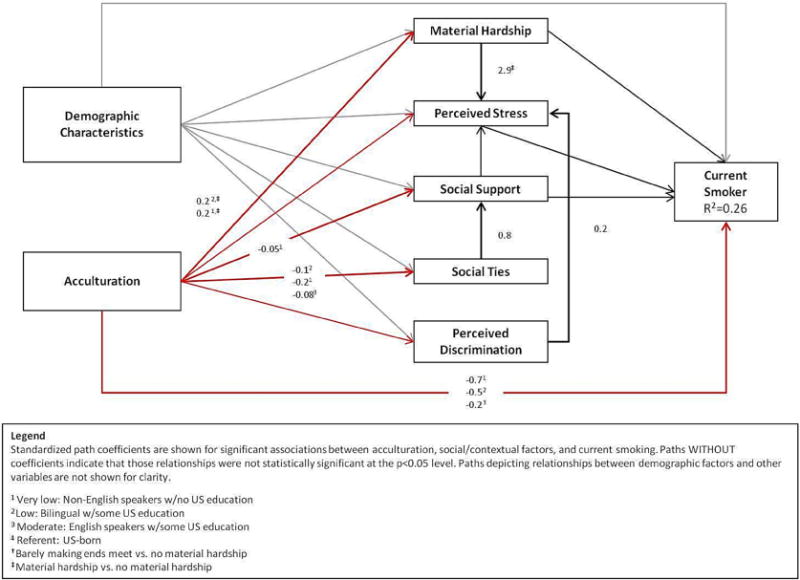
Acculturation may influence health behaviors, yet mechanisms underlying its effect are not well understood. In this study, we describe relationships between acculturation and health behaviors among low-income housing residents, and examine whether these relationships are mediated by social and contextual factors. Residents of 20 low-income housing sites in the Boston metropolitan area completed surveys that assessed acculturative characteristics, social/contextual factors, and health behaviors. A composite acculturation scale was developed using latent class analysis, resulting in four distinct acculturative groups. Path analysis was used to examine interrelationships between acculturation, health behaviors, and social/contextual factors, specifically self-reported social ties, social support, stress, material hardship, and discrimination. Of the 828 respondents, 69% were born outside of the U.S. Less acculturated groups exhibited healthier dietary practices and were less likely to smoke than more acculturated groups. Acculturation had a direct effect on diet and smoking, but not physical activity. Acculturation also showed an indirect effect on diet through its relationship with material hardship. Our finding that material hardship mediated the relationship between acculturation and diet suggests the need to explicate the significant role of financial resources in interventions seeking to promote healthy diets among low-income immigrant groups. Future research should examine these social and contextual mediators using larger, population-based samples, preferably with longitudinal data.
Keywords: Acculturation; Health behavior; Immigrant; Public housing; Social context; United States.
Copyright © 2014 The Authors. Published by Elsevier Ltd.. All rights reserved.
Figures
References
-
- Acevedo-Garcia D, Bates LM. Latino Health Paradoxes: Empirical Evidence, Explanations, Future Research, and Implications. In: Rodríguez H, Sáenz R, Menjívar C, editors. Latinas/os in the United States: Changing the Face of América. Springer US; 2008. pp. 101–113.
-
- Acevedo-Garcia D, Sanchez-Vaznaugh EV, Viruell-Fuentes EA, Almeida J. Integrating social epidemiology into immigrant health research: a cross-national framework. Soc Sci Med. 2012;75:2060–2068. - PubMed
Publication types
MeSH terms
Grants and funding
- K05 CA108663- 05/CA/NCI NIH HHS/United States
- U48DP001946/DP/NCCDPHP CDC HHS/United States
- K01 CA169041/CA/NCI NIH HHS/United States
- R25 CA057711/CA/NCI NIH HHS/United States
- K01 CA169041-01/CA/NCI NIH HHS/United States
- U48 DP001946/DP/NCCDPHP CDC HHS/United States
- T32 CA163184/CA/NCI NIH HHS/United States
- R01 CA111310/CA/NCI NIH HHS/United States
- R25 DA057713/DA/NIDA NIH HHS/United States
- R25 CA163184/CA/NCI NIH HHS/United States
- K05 CA108663/CA/NCI NIH HHS/United States
- R25 CA057713/CA/NCI NIH HHS/United States
- K05 CA108663-05/CA/NCI NIH HHS/United States
- R01 CA111310-01A1/CA/NCI NIH HHS/United States
LinkOut - more resources
Full Text Sources
Other Literature Sources
