. 2014 Dec;237(2):609-17.
doi: 10.1016/j.atherosclerosis.2014.09.036. Epub 2014 Oct 17.

Genetic demonstration of intestinal NPC1L1 as a major determinant of hepatic cholesterol and blood atherogenic lipoprotein levels

Affiliations

Genetic demonstration of intestinal NPC1L1 as a major determinant of hepatic cholesterol and blood atherogenic lipoprotein levels

Ping Xie et al. Atherosclerosis. 2014 Dec.

Abstract

Objective: The correlation between intestinal cholesterol absorption values and plasma low-density lipoprotein-cholesterol (LDL-C) levels remains controversial. Niemann-Pick-C1-Like 1 (NPC1L1) is essential for intestinal cholesterol absorption, and is the target of ezetimibe, a cholesterol absorption inhibitor. However, studies with NPC1L1 knockout mice or ezetimibe cannot definitively clarify this correlation because NPC1L1 expression is not restricted to intestine in humans and mice. In this study we sought to genetically address this issue.

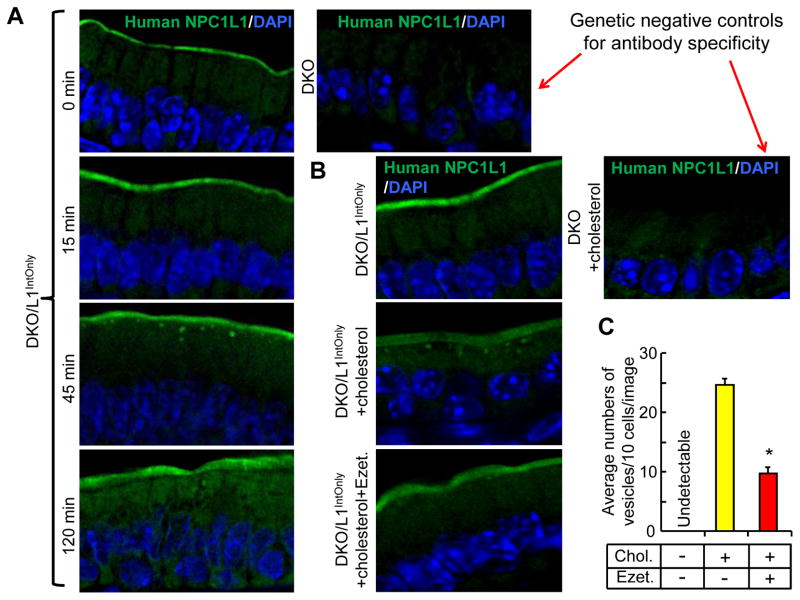
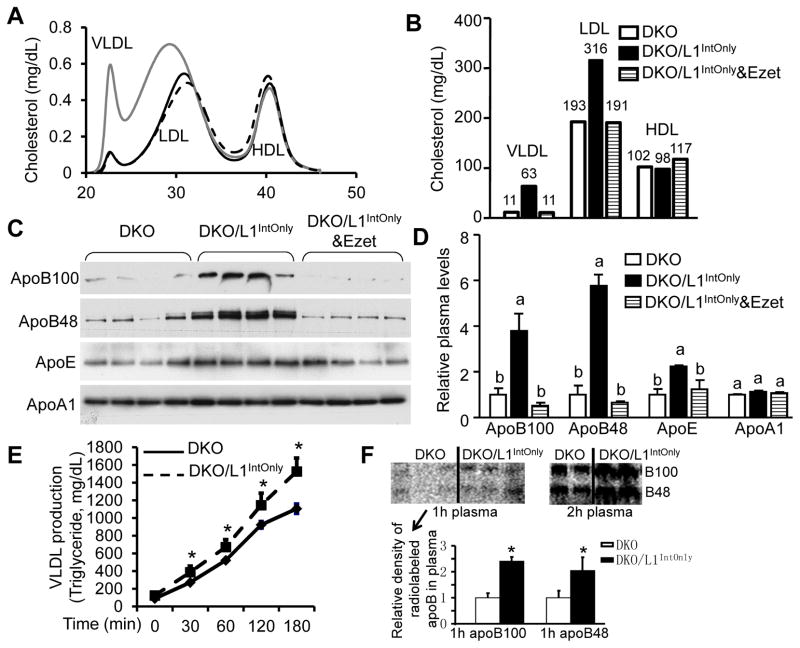
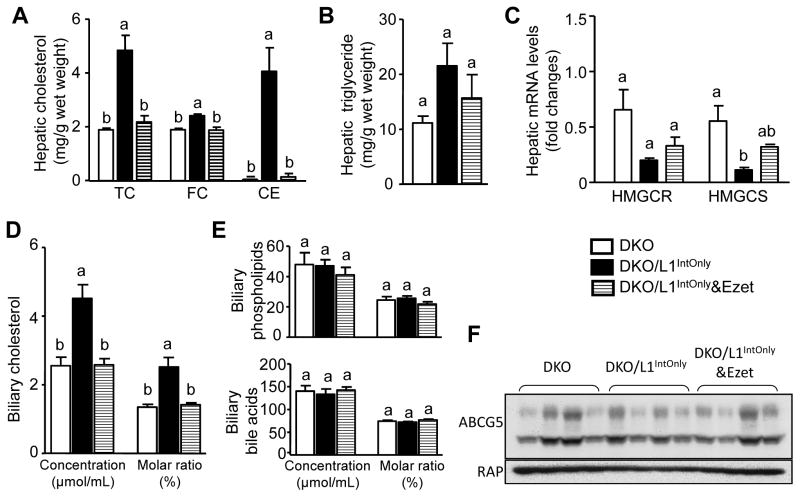
Methods and results: We developed a mouse model that lacks endogenous (NPC1L1) and LDL receptor (LDLR) (DKO), but transgenically expresses human NPC1L1 in gastrointestinal tract only (DKO/L1(IntOnly) mice). Our novel model eliminated potential effects of non-intestinal NPC1L1 on cholesterol homeostasis. We found that human NPC1L1 was localized at the intestinal brush border membrane of DKO/L1(IntOnly) mice. Cholesterol feeding induced formation of NPC1L1-positive vesicles beneath this membrane in an ezetimibe-sensitive manner. Compared to DKO mice, DKO/L1(IntOnly) mice showed significant increases in cholesterol absorption and blood/hepatic/biliary cholesterol. Increased blood cholesterol was restricted to very low-density lipoprotein (VLDL) and LDL fractions, which was associated with increased secretion and plasma levels of apolipoproteins B100 and B48. Additionally, DKO/L1(IntOnly) mice displayed decreased fecal cholesterol excretion and hepatic/intestinal expression of cholesterologenic genes. Ezetimibe treatment virtually reversed all of the transgene-related phenotypes in DKO/L1(IntOnly) mice.

Conclusion: Our findings from DKO/L1(IntOnly) mice clearly demonstrate that NPC1L1-mediated cholesterol absorption is a major determinant of blood levels of apolipoprotein B-containing atherogenic lipoproteins, at least in mice.

Keywords: Apolipoprotein B; Cholesterol absorption; Chylomicron remnant; Fecal neutral sterol excretion; Low-density lipoprotein receptor; Niemann-Pick-C1-Like 1.


Figures

Fig. 1
Fig. 1
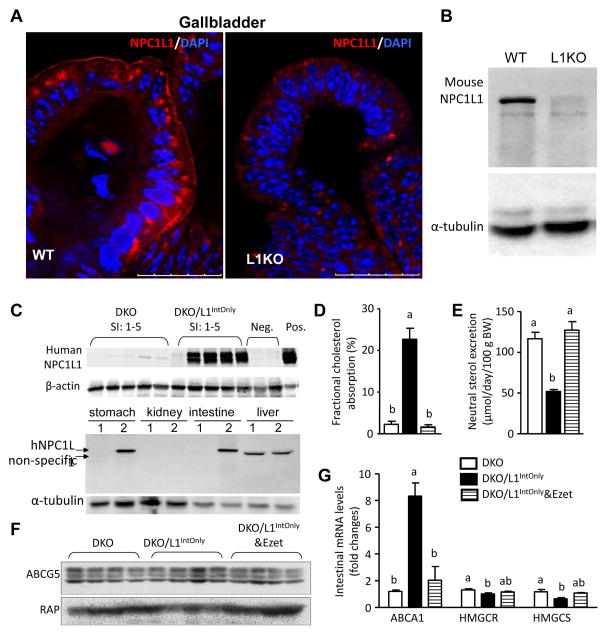
A) Immunofluorescence staining of mouse NPC1L1 in the gallbladder of wild-type (WT) and L1KO mice on regular chow diet using a rabbit Anti-NPC1L1 Antibody (aa1000–1100) IHC-plus LS-B88 (LifeSpan BioSciences, Inc., Seattle, WA). White arrows denote the luminal surface of gallbladder epithelium. B) Immunoblots of mouse NPC1L1 in the 100μg of gallbladder homogenates of WT and L1KO mice using the above antibody. C) Immunoblots of human NPC1L1 in the homogenates (30μg protein each) of the 5 equal segments of small intestine (SI: 1–5). Two L1-KO mouse livers as negative controls (Neg., 20μg). The L1KO liver transgenically overexpressing human NPC1L1 as a positive control (Pos., 20μg). In the bottom panel, 50μg homogenate proteins were used for stomach, kidney and liver, and 20μg for intestine (jejunum). 1, DKO; 2, DKO/IntOnly. D) Intestinal cholesterol absorption (n = 8). E) Fecal neutral sterol excretion (n = 8–12). F) Immunoblots of ABCG5 and receptor-associated protein (RAP) (as a loading control) in the jejunal membrane preparations. G) Relative mRNA levels of cholesterol-sensitive genes in the jejuna (n = 5). Groups not sharing a common superscript letter are significantly different (P < 0.05). Ezet, ezetimibe; HMGCR, HMG-CoA reductase; HMGCS, HMG-CoA synthase.
Fig. 2
Fig. 2
Ezetimibe blocks cholesterol-induced vesicular trafficking of human NPC1L1 in DKO/L1IntOnly mice. A) Cholesterol feeding induces vesicular trafficking of intestinal NPC1L1. Two-month-old male mice were fasted overnight, and then fed with a synthetic diet containing 0.2% (w/w) cholesterol. The mice were sacrificed at 15, 45 and 120 min, and the jejuna taken for immunofluorescence studies. B) Ezetimibe (Ezet.) inhibits cholesterol-induced NPC1L1 trafficking. Two-month-old male mice were pretreated with or without ezetimibe (10 mg/kg/day) by gavage for 3 days. On day 4, the overnight-fasted mice were treated with ezetimibe or vehicle. After 30 min, the mice were administered by gavage with 150 μl medium-chain triglycerides (MCT) oil or MCT oil containing 40mg/ml cholesterol. The mice were sacrificed 30 min post MCT gavage, and the jejuna taken for immunofluorescence staining. C) Average numbers of NPC1L1-positive vesicles beneath the brush border membrane of the jejunum. Multiple images (n = 10–12) from (B) were taken and counted. Chol., cholesterol. *P = 3.85E-10 (Student-t-test).
Fig. 3
Fig. 3
Ezetimibe blocks intestinal NPC1L1-mediated increases in plasma atherogenic lipoproteins in DKO/L1IntOnly mice. A) Plasma lipoprotein-cholesterol profile of pooled plasma samples (n = 5). B) Calculated cholesterol mass in each lipoprotein subclass based on the lipoprotein profile and total plasma cholesterol concentrations. C) Immunoblots of plasma apolipoproteins. Mice were fasted for 4 h prior to blood collection. Plasma samples were diluted by 1:200 with saline. A total of 14μl of diluted plasma sample from each mouse was separated on a 4–15% gradient SDS-polyacrylamide gel for immunoblotting. The same membrane was used for all the apolipoproteins selected. D) Densitometry quantification of (C). Groups not sharing a common superscript letter are significantly different (P < 0.05). E) VLDL production (plasma triglyceride concentrations at different time points) after retro-orbital injections of Triton WR-1339 at 500mg/kg body weight in overnight-fasted male mice (n = 4). * P < 0.05. F) ApoB secretion in 4h-fasted mice. Densitometry was done using ImageJ software for the radiolabeled apoB bands in plasma samples collected 1h post Triton WR-1339 and [35S]methionine injection. * P < 0.05.
Fig. 4
Fig. 4
Ezetimibe blocks intestinal NPC1L1-mediated increases in hepatic and biliary cholesterol. A) Total cholesterol (TC), free cholesterol (FC) and cholesterol ester (CE). The amount of cholesterol ester was calculated by subtracting free cholesterol from total cholesterol and multiplying by 1.67 to convert to cholesterol ester mass. B) Triglycerides (n = 8–12). C) Relative hepatic mRNA levels of cholesterol-regulated genes (n = 5). HMGCR, HMG-CoA reductase; HMGCS, HMG-CoA synthase. D), E) Biliary concentrations and molar ratios of cholesterol, phospholipids and bile acids (n = 8–12). F) Immunoblots of ABCG5 and receptor-associated protein (RAP) (as an internal control) in the liver membrane preparations. Groups not sharing a common superscript letter are significantly different (P < 0.05).

References

    1. Wilson PW, Garrison RJ, Castelli WP, Feinleib M, McNamara PM, Kannel WB. Prevalence of coronary heart disease in the Framingham Offspring Study: role of lipoprotein cholesterols. The American journal of cardiology. 1980;46(4):649–54. - PubMed
    1. Dietschy JM, Turley SD, Spady DK. Role of liver in the maintenance of cholesterol and low density lipoprotein homeostasis in different animal species, including humans. Journal of lipid research. 1993;34(10):1637–59. - PubMed
    1. Van Heek M, France CF, Compton DS, McLeod RL, Yumibe NP, Alton KB, Sybertz EJ, Davis HR., Jr In vivo metabolism-based discovery of a potent cholesterol absorption inhibitor, SCH58235, in the rat and rhesus monkey through the identification of the active metabolites of SCH48461. J Pharmacol Exp Ther. 1997;283(1):157–63. - PubMed
    1. Brown MS, Faust JR, Goldstein JL. Induction of 3-hydroxy-3-methylglutaryl coenzyme A reductase activity in human fibroblasts incubated with compactin (ML-236B), a competitive inhibitor of the reductase. The Journal of biological chemistry. 1978;253(4):1121–8. - PubMed
    1. Bays HE, Moore PB, Drehobl MA, Rosenblatt S, Toth PD, Dujovne CA, Knopp RH, Lipka LJ, Lebeaut AP, Yang B, et al. Effectiveness and tolerability of ezetimibe in patients with primary hypercholesterolemia: pooled analysis of two phase II studies. Clin Ther. 2001;23(8):1209–30. - PubMed

Publication types

MeSH terms