


Genetic demonstration of intestinal NPC1L1 as a major determinant of hepatic cholesterol and blood atherogenic lipoprotein levels
- PMID: 25463095
- PMCID: PMC4262594
- DOI: 10.1016/j.atherosclerosis.2014.09.036
Genetic demonstration of intestinal NPC1L1 as a major determinant of hepatic cholesterol and blood atherogenic lipoprotein levels
Abstract
Objective: The correlation between intestinal cholesterol absorption values and plasma low-density lipoprotein-cholesterol (LDL-C) levels remains controversial. Niemann-Pick-C1-Like 1 (NPC1L1) is essential for intestinal cholesterol absorption, and is the target of ezetimibe, a cholesterol absorption inhibitor. However, studies with NPC1L1 knockout mice or ezetimibe cannot definitively clarify this correlation because NPC1L1 expression is not restricted to intestine in humans and mice. In this study we sought to genetically address this issue.
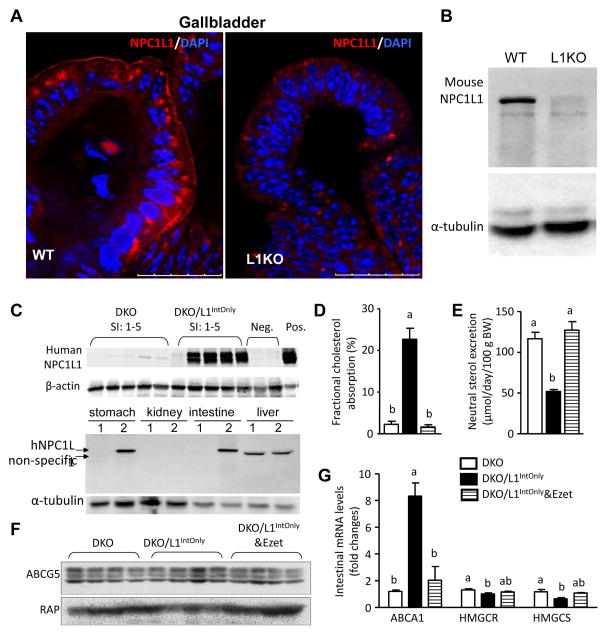
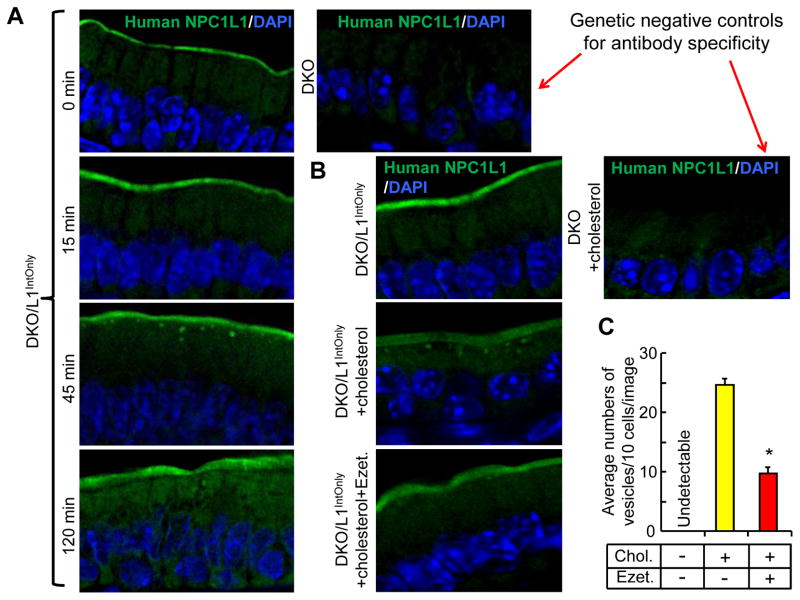
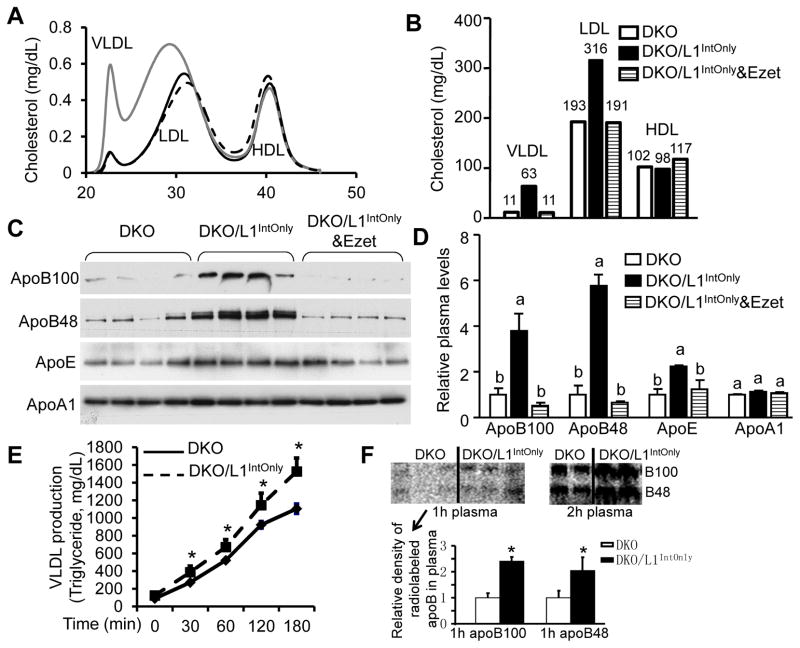
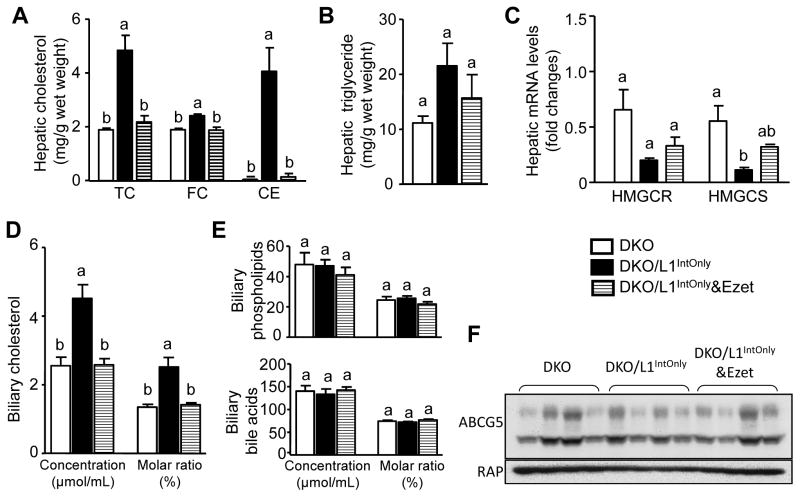
Methods and results: We developed a mouse model that lacks endogenous (NPC1L1) and LDL receptor (LDLR) (DKO), but transgenically expresses human NPC1L1 in gastrointestinal tract only (DKO/L1(IntOnly) mice). Our novel model eliminated potential effects of non-intestinal NPC1L1 on cholesterol homeostasis. We found that human NPC1L1 was localized at the intestinal brush border membrane of DKO/L1(IntOnly) mice. Cholesterol feeding induced formation of NPC1L1-positive vesicles beneath this membrane in an ezetimibe-sensitive manner. Compared to DKO mice, DKO/L1(IntOnly) mice showed significant increases in cholesterol absorption and blood/hepatic/biliary cholesterol. Increased blood cholesterol was restricted to very low-density lipoprotein (VLDL) and LDL fractions, which was associated with increased secretion and plasma levels of apolipoproteins B100 and B48. Additionally, DKO/L1(IntOnly) mice displayed decreased fecal cholesterol excretion and hepatic/intestinal expression of cholesterologenic genes. Ezetimibe treatment virtually reversed all of the transgene-related phenotypes in DKO/L1(IntOnly) mice.
Conclusion: Our findings from DKO/L1(IntOnly) mice clearly demonstrate that NPC1L1-mediated cholesterol absorption is a major determinant of blood levels of apolipoprotein B-containing atherogenic lipoproteins, at least in mice.
Keywords: Apolipoprotein B; Cholesterol absorption; Chylomicron remnant; Fecal neutral sterol excretion; Low-density lipoprotein receptor; Niemann-Pick-C1-Like 1.
Copyright © 2014 Elsevier Ireland Ltd. All rights reserved.
Figures
References
-
- Wilson PW, Garrison RJ, Castelli WP, Feinleib M, McNamara PM, Kannel WB. Prevalence of coronary heart disease in the Framingham Offspring Study: role of lipoprotein cholesterols. The American journal of cardiology. 1980;46(4):649–54. - PubMed
-
- Dietschy JM, Turley SD, Spady DK. Role of liver in the maintenance of cholesterol and low density lipoprotein homeostasis in different animal species, including humans. Journal of lipid research. 1993;34(10):1637–59. - PubMed
-
- Van Heek M, France CF, Compton DS, McLeod RL, Yumibe NP, Alton KB, Sybertz EJ, Davis HR., Jr In vivo metabolism-based discovery of a potent cholesterol absorption inhibitor, SCH58235, in the rat and rhesus monkey through the identification of the active metabolites of SCH48461. J Pharmacol Exp Ther. 1997;283(1):157–63. - PubMed
-
- Brown MS, Faust JR, Goldstein JL. Induction of 3-hydroxy-3-methylglutaryl coenzyme A reductase activity in human fibroblasts incubated with compactin (ML-236B), a competitive inhibitor of the reductase. The Journal of biological chemistry. 1978;253(4):1121–8. - PubMed
-
- Bays HE, Moore PB, Drehobl MA, Rosenblatt S, Toth PD, Dujovne CA, Knopp RH, Lipka LJ, Lebeaut AP, Yang B, et al. Effectiveness and tolerability of ezetimibe in patients with primary hypercholesterolemia: pooled analysis of two phase II studies. Clin Ther. 2001;23(8):1209–30. - PubMed
Publication types
MeSH terms
Substances
Grants and funding
LinkOut - more resources
Full Text Sources
Other Literature Sources
Medical
Molecular Biology Databases
