Review
. 2015 Aug 27:302:59-73.
doi: 10.1016/j.neuroscience.2014.11.018. Epub 2014 Nov 25.

M1 and M2 immune activation in Parkinson's Disease: Foe and ally?

Affiliations
Review

M1 and M2 immune activation in Parkinson's Disease: Foe and ally?

M S Moehle et al. Neuroscience. .

Abstract

Parkinson's Disease (PD) is a chronic and progressive neurodegenerative disorder of unknown etiology. Autopsy findings, genetics, retrospective studies, and molecular imaging all suggest a role for inflammation in the neurodegenerative process. However, relatively little is understood about the causes and implications of neuroinflammation in PD. Understanding how inflammation arises in PD, in particular the activation state of cells of the innate immune system, may provide an exciting opportunity for novel neuroprotective therapeutics. We analyze the evidence of immune system involvement in PD susceptibility, specifically in the context of M1 and M2 activation states. Tracking and modulating these activation states may provide new insights into both PD etiology and therapeutic strategies.

Keywords: animal models; genetics; macrophage; microglia; monocyte; neurodegeneration.


Figures

Figure 1
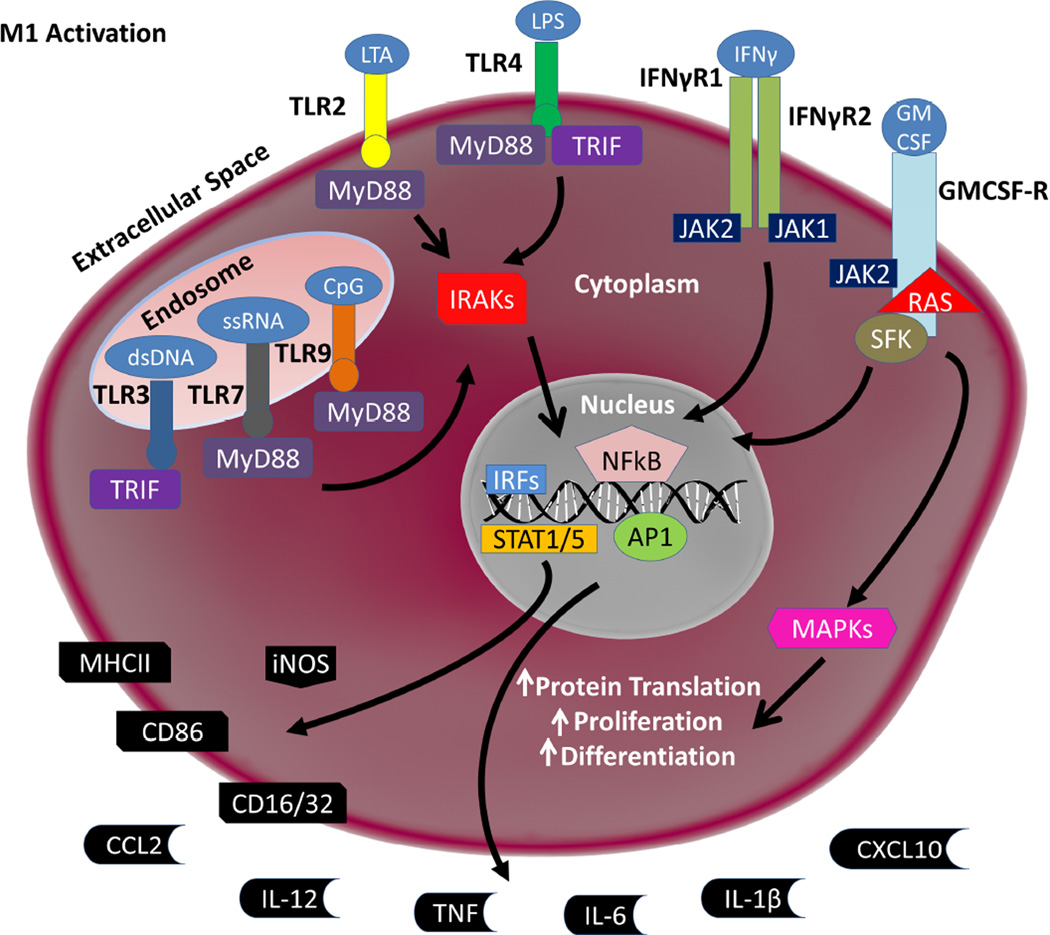
Figure 1. Schematic of M1 Signaling
A broad array of stimuli can induce an M1 pro-inflammatory response. TLR3 binds double stranded DNA (dsDNA). TLR7 binds single stranded RNA (ssRNA). TLR9 binds unmethylated CpG islands in stretches of DNA. Broadly, TLR3, 7, and 9 defend against viral infection. TLR2 binds lipoteichoich acid (LTA) and some other microbial products. TLR4, along with co-receptors MD2 and CD14 (not shown), binds lipopolysaccharide (LPS). TLRs signal through MyD88 and/or TRIF to activate the IRAK family of kinases. IRAKs then cause the translocation of several transcription factors to the nucleus, namely NFkβ, AP1, STAT5, and IRFs. Interferon-gamma (IFNγ) binds and activates a heterodimer of the IFNγ Receptor 1 and 2 (IFNγR1/2). Activation then leads to JAK1/2 activation which leads to STAT5 translocation to the nucleus. Granulocyte modifying- colony stimulating factor (GM-CSF) binds a dodecamer of subunits that forms the GM-CSF Receptor (GMCSF-R), which in turn activates JAK2, RAS and SFK. In addition to causing STAT5 translocation to the nucleus, GM-CSF alters the RAS pathway to increase protein translation, proliferation, and differentiation in innate immune cells. NFkβ, AP1, STAT1/5, and IRFs translocation to the nucleus leads to up-regulation of iNOS as well as the cell surface markers MHCII, CD86, and CD16/32. The production and release of cytokines TNF, IL-6, IL-1β, and IL-12 and chemokines CCL2 and CXCL10 are also up-regulated.
Figure 2
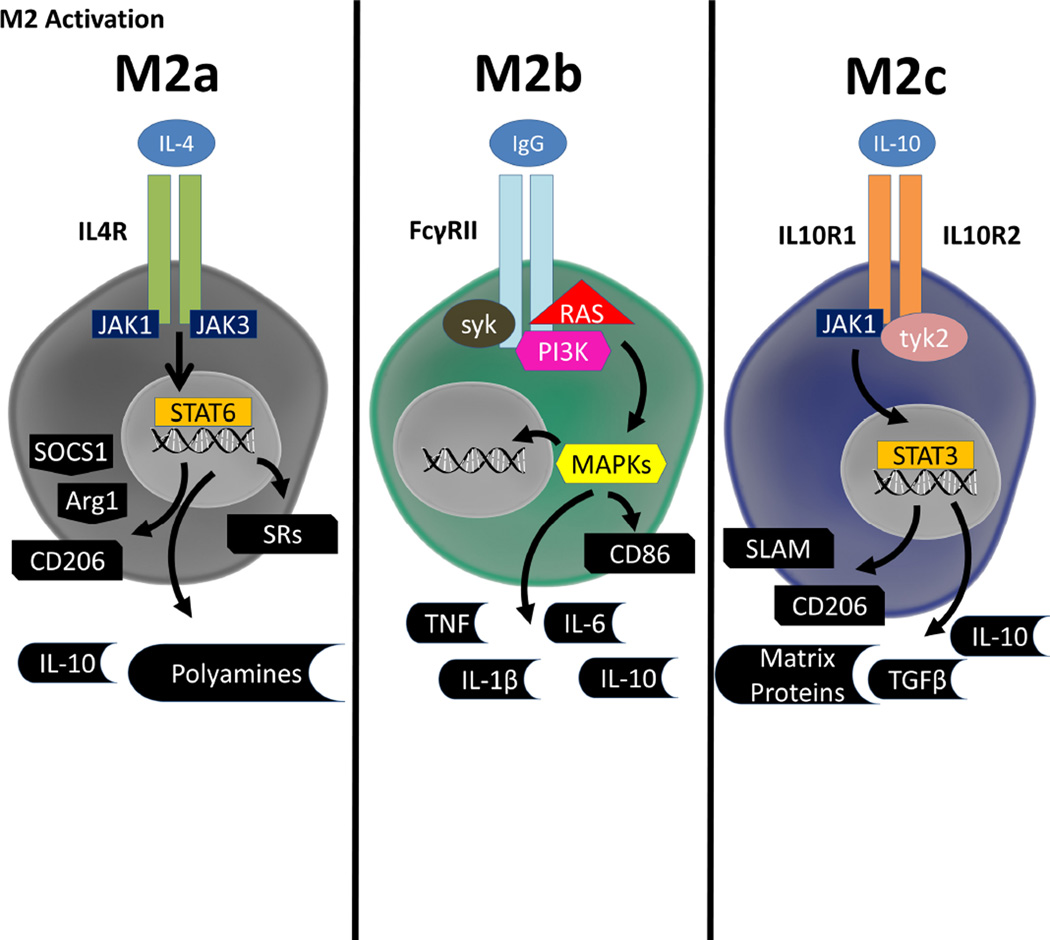
Figure 2. Schematic of M2 Signaling
The M2 activation state is further broken down into three subclasses, dubbed the M2a, M2b, and M2c state, that have few overlapping characteristics. The M2a state is caused by IL-4 binding to one of three receptor pairs, which causes activation of JAK1/3. This in turn causes STAT6 translocation to the nucleus and upregulation of SOCS1, Arg1, CD206, scavenger receptors (SRs) and releases of IL-10 and polyamines. The M2b state has some characteristics of an M1 response. TLR activation is necessary to fuse the subunits of the Fcγ Receptor, which then binds IgG. Through a RAS, PI3K, and syk signaling cascade, there is increased release of typically pro-inflammatory cytokines such as TNF, IL-6 and IL-1β as well as typical M2 cytokine IL-10. Similarly to the M1 state, CD86 is up-regulated on the cell surface. The M2c state s caused by IL-10 binding to a heterodimer of IL10 Receptor subunits 1 and 2 which in turn causes activation of JAK1 and tyk. JAK1 and tyk then cause STAT3 translocation to nucleus and up-regulation of SLAM and CD206 as well as increased release of IL-10, TGFβ, and extracellular matrix proteins.
Figure 3
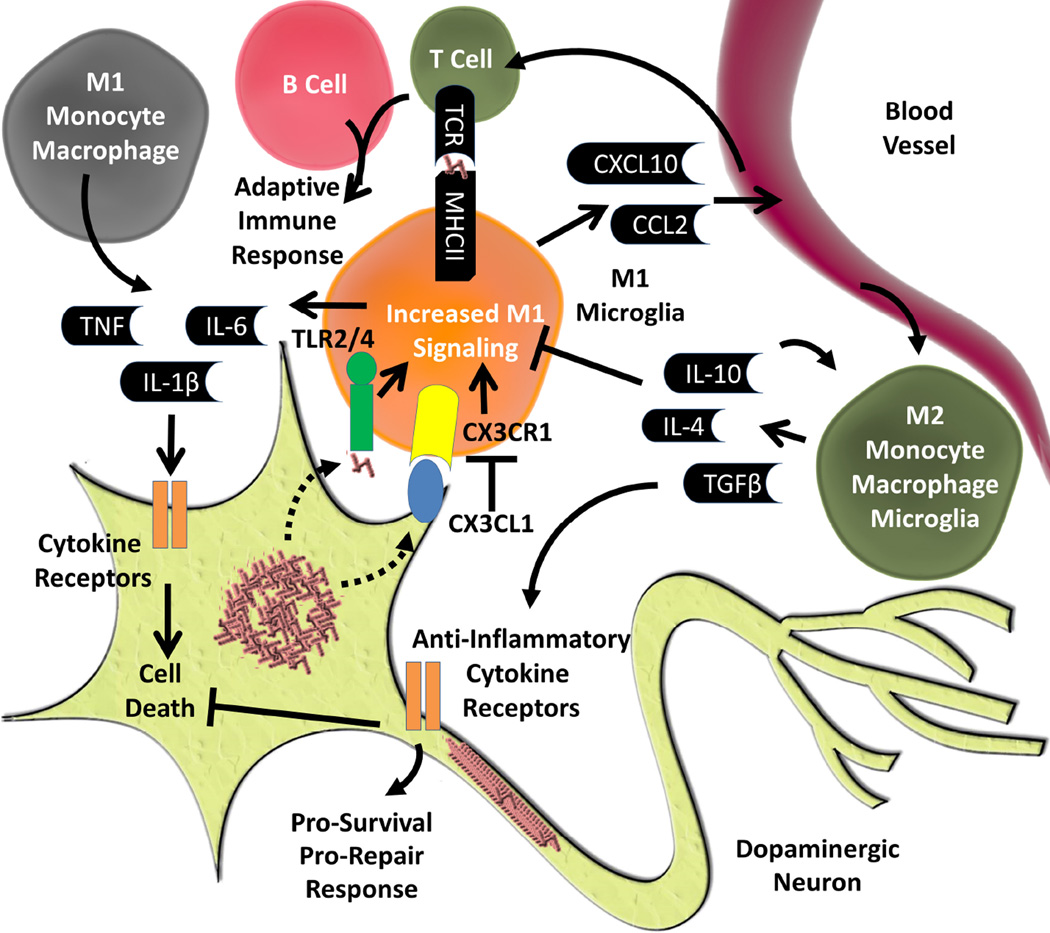
Figure 3. Overview of Inflammatory Mechanisms in PD
Inflammation is a common pathological hallmark in PD. One possible mechanism of how this arises is through direct activation of TLR2/4 by aggregated forms of α-synuclein. Another is through mechanisms by which neuronal health or dysfunction directly activates microglia. One mechanism is through CX3CR1, which is expressed on microglia, binding CX3CL1, which is expressed by neurons. Through injury, changes in health of neurons, or through α-synuclein CX3CL1 becomes down regulated which activates M1 signaling through CX3CR1 in microglia. With increased M1 signaling, microglia will release pro-inflammatory cytokines and chemokines. Chemokines will draw in innate immune cells from the peripheral immune system. These peripheral immune cells could lead to an adaptive immune response through T and B cells, or could lead to an increased M1 response through the recruitment of monocytes/macrophages and release of more pro-inflammatory cytokines and chemokines. These pro-inflammatory cytokines can act on a variety of cytokine receptors on dopaminergic neurons which could lead to cell death. Concurrently, or as a result of therapeutic intervention, M2 immune cells could release anti-inflammatory cytokines and chemokines that could decrease M1 activation and bind to anti-inflammatory cytokine receptors on neurons and promote survival and repair.

References

    1. ADAPT. Results of a follow-up study to the randomized Alzheimer’s Disease Anti-inflammatory Prevention Trial (ADAPT) Alzheimer’s & dementia : the journal of the Alzheimer’s Association. 2013;9:714–723. - PMC - PubMed
    1. Ahmed I, Tamouza R, Delord M, Krishnamoorthy R, Tzourio C, Mulot C, Nacfer M, Lambert JC, Beaune P, Laurent-Puig P, Loriot MA, Charron D, Elbaz A. Association between Parkinson’s disease and the HLA-DRB1 locus. Movement disorders : official journal of the Movement Disorder Society. 2012;27:1104–1110. - PubMed
    1. Ajami B, Bennett JL, Krieger C, McNagny KM, Rossi FM. Infiltrating monocytes trigger EAE progression, but do not contribute to the resident microglia pool. Nature neuroscience. 2011;14:1142–1149. - PubMed
    1. Anderson CF, Mosser DM. A novel phenotype for an activated macrophage: the type 2 activated macrophage. Journal of leukocyte biology. 2002;72:101–106. - PubMed
    1. Barkholt P, Sanchez-Guajardo V, Kirik D, Romero-Ramos M. Long-term polarization of microglia upon alpha-synuclein overexpression in nonhuman primates. Neuroscience. 2012;208:85–96. - PubMed

Publication types