


Stuttering, induced fluency, and natural fluency: a hierarchical series of activation likelihood estimation meta-analyses
- PMID: 25463820
- PMCID: PMC4405378
- DOI: 10.1016/j.bandl.2014.10.002
Stuttering, induced fluency, and natural fluency: a hierarchical series of activation likelihood estimation meta-analyses
Abstract
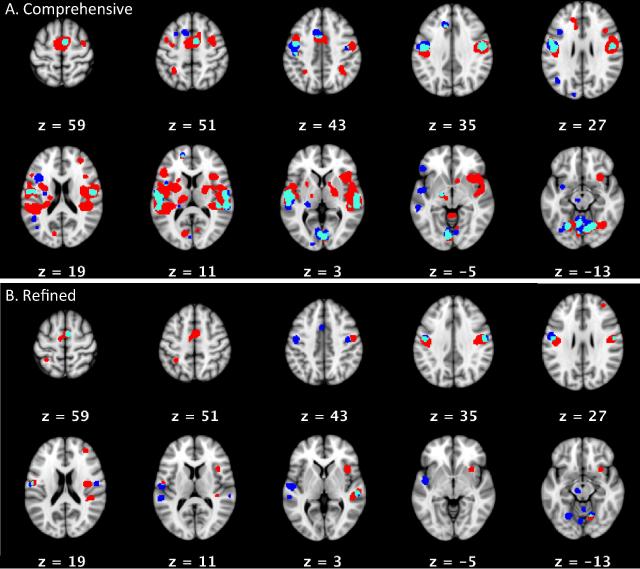
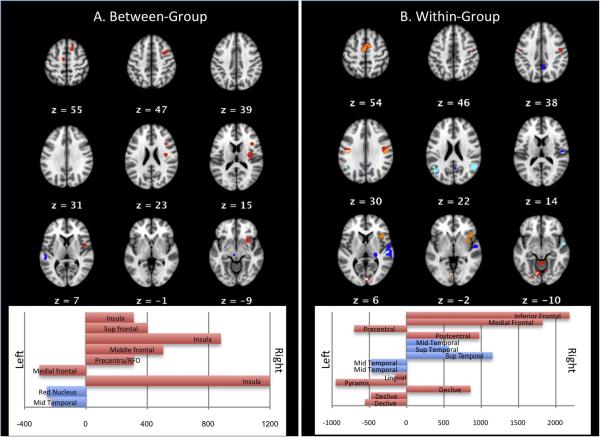
Developmental stuttering is a speech disorder most likely due to a heritable form of developmental dysmyelination impairing the function of the speech-motor system. Speech-induced brain-activation patterns in persons who stutter (PWS) are anomalous in various ways; the consistency of these aberrant patterns is a matter of ongoing debate. Here, we present a hierarchical series of coordinate-based meta-analyses addressing this issue. Two tiers of meta-analyses were performed on a 17-paper dataset (202 PWS; 167 fluent controls). Four large-scale (top-tier) meta-analyses were performed, two for each subject group (PWS and controls). These analyses robustly confirmed the regional effects previously postulated as "neural signatures of stuttering" (Brown, Ingham, Ingham, Laird, & Fox, 2005) and extended this designation to additional regions. Two smaller-scale (lower-tier) meta-analyses refined the interpretation of the large-scale analyses: (1) a between-group contrast targeting differences between PWS and controls (stuttering trait); and (2) a within-group contrast (PWS only) of stuttering with induced fluency (stuttering state).
Keywords: ALE; Activation likelihood estimation; Functional neuroimaging; Meta-analysis; Persistent developmental stuttering.
Copyright © 2014 Elsevier Inc. All rights reserved.
Figures
References
-
- Alm PA. Stuttering and the basal ganglia circuits: a critical review of possible relations. Journal of Communication Disorders. 2004;37(4):325–369. doi:10.1016/j.jcomdis.2004.03.001. - PubMed
-
- Barron DS, Fox PT, Pardoe H, Lancaster J, Price LR, Blackmon K, et al. UNCORRECTED PROOF. Ynicl. 2014:1–8. doi:10.1016/j.nicl.2014.08.002.
-
- Bloodstein O. A Handbook on Stuttering. Singular Group; San Diego: 1995.
-
- Braun A. Altered patterns of cerebral activity during speech and language production in developmental stuttering. 1997:1–24. - PubMed
Publication types
MeSH terms
Grants and funding
LinkOut - more resources
Full Text Sources
Other Literature Sources
Medical
Molecular Biology Databases
