Efficacy of nitric oxide, with or without continuing antihypertensive treatment, for management of high blood pressure in acute stroke (ENOS): a partial-factorial randomised controlled trial
- PMID: 25465108
- PMCID: PMC4343308
- DOI: 10.1016/S0140-6736(14)61121-1
Efficacy of nitric oxide, with or without continuing antihypertensive treatment, for management of high blood pressure in acute stroke (ENOS): a partial-factorial randomised controlled trial
Erratum in
- Lancet. 2015 Feb 14;385(9968):606
Abstract
Background: High blood pressure is associated with poor outcome after stroke. Whether blood pressure should be lowered early after stroke, and whether to continue or temporarily withdraw existing antihypertensive drugs, is not known. We assessed outcomes after stroke in patients given drugs to lower their blood pressure.
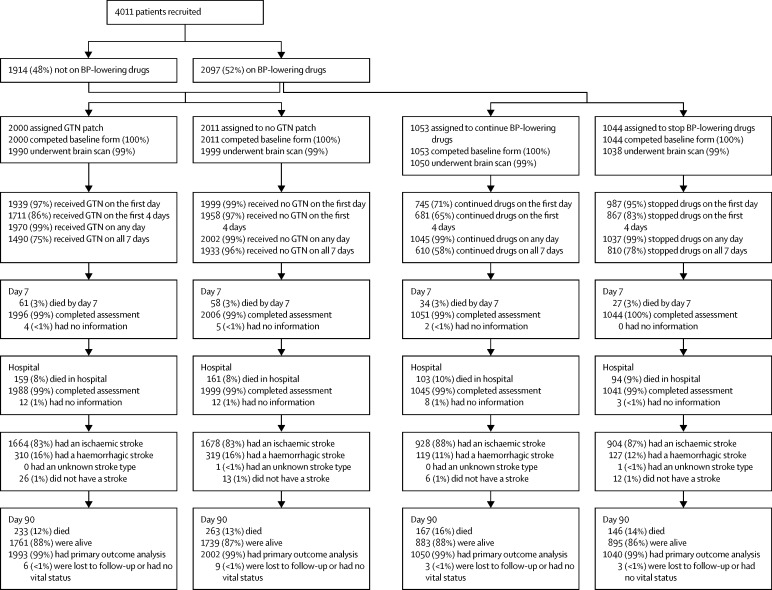
Methods: In our multicentre, partial-factorial trial, we randomly assigned patients admitted to hospital with an acute ischaemic or haemorrhagic stroke and raised systolic blood pressure (systolic 140-220 mm Hg) to 7 days of transdermal glyceryl trinitrate (5 mg per day), started within 48 h of stroke onset, or to no glyceryl trinitrate (control group). A subset of patients who were taking antihypertensive drugs before their stroke were also randomly assigned to continue or stop taking these drugs. The primary outcome was function, assessed with the modified Rankin Scale at 90 days by observers masked to treatment assignment. This study is registered, number ISRCTN99414122.
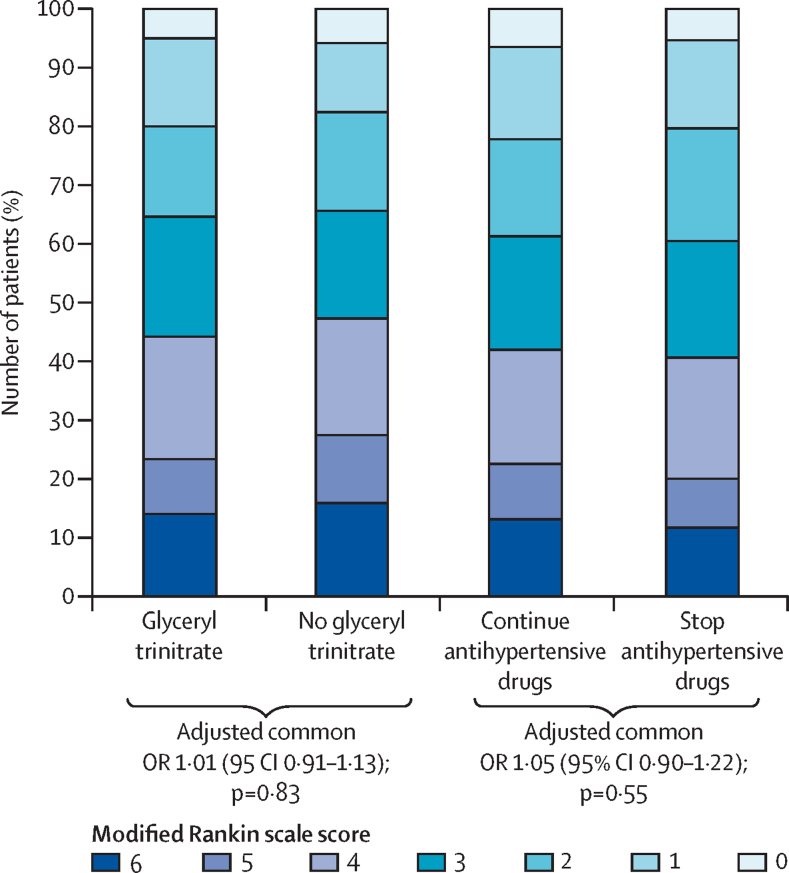
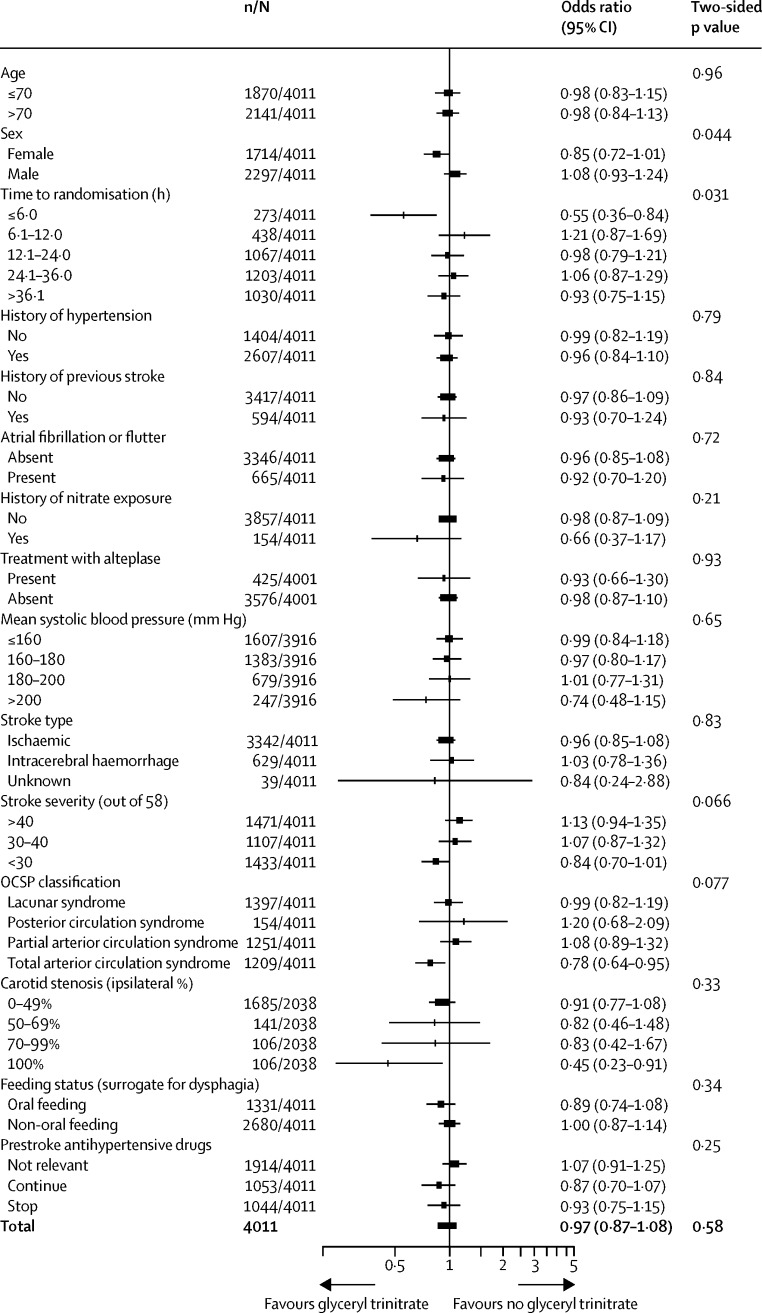
Findings: Between July 20, 2001, and Oct 14, 2013, we enrolled 4011 patients. Mean blood pressure was 167 (SD 19) mm Hg/90 (13) mm Hg at baseline (median 26 h [16-37] after stroke onset), and was significantly reduced on day 1 in 2000 patients allocated to glyceryl trinitrate compared with 2011 controls (difference -7·0 [95% CI -8·5 to -5·6] mm Hg/-3·5 [-4·4 to -2·6] mm Hg; both p<0·0001), and on day 7 in 1053 patients allocated to continue antihypertensive drugs compared with 1044 patients randomised to stop them (difference -9·5 [95% CI -11·8 to -7·2] mm Hg/-5·0 [-6·4 to -3·7] mm Hg; both p<0·0001). Functional outcome at day 90 did not differ in either treatment comparison-the adjusted common odds ratio (OR) for worse outcome with glyceryl trinitrate versus no glyceryl trinitrate was 1·01 (95% CI 0·91-1·13; p=0·83), and with continue versus stop antihypertensive drugs OR was 1·05 (0·90-1·22; p=0·55).
Interpretation: In patients with acute stroke and high blood pressure, transdermal glyceryl trinitrate lowered blood pressure and had acceptable safety but did not improve functional outcome. We show no evidence to support continuing prestroke antihypertensive drugs in patients in the first few days after acute stroke.
Funding: UK Medical Research Council.
Copyright © 2015 Bath et al. Open Access article distributed under the terms of CC BY. Published by Elsevier Ltd. All rights reserved.
Figures
Comment in
-
Blood pressure in acute stroke: which questions remain?Lancet. 2015 Feb 14;385(9968):582-585. doi: 10.1016/S0140-6736(14)61898-5. Epub 2014 Oct 21. Lancet. 2015. PMID: 25465109 No abstract available.
-
ACP Journal Club: glyceryl trinitrate did not improve functional outcome in patients with acute stroke and high BP.Ann Intern Med. 2015 Apr 21;162(8):JC12. doi: 10.7326/ACPJC-2015-162-8-012. Ann Intern Med. 2015. PMID: 25894045 No abstract available.
References
-
- Leonardi-Bee J, Bath PMW, Phillips SJ, Sandercock PAG, for the IST Collaborative Group Blood pressure and clinical outcomes in the International Stroke Trial. Stroke. 2002;33:1315–1320. - PubMed
-
- Willmot M, Leonardi-Bee J, Bath PM. High blood pressure in acute stroke and subsequent outcome: a systematic review. Hypertension. 2004;43:18–24. - PubMed
-
- Sprigg N, Gray LJ, Bath PM. Relationship between outcome and baseline blood pressure and other haemodynamic measures in acute ischaemic stroke: data from the TAIST trial. J Hypertens. 2006;24:1413–1417. - PubMed
-
- Geeganage C, Tracy M, England T. Relationship between baseline blood pressure parameters (including mean pressure, pulse pressure, and variability) and early outcome after stroke: data From the Tinzaparin in Acute Ischaemic Stroke Trial (TAIST) Stroke. 2011;42:491–493. - PubMed
-
- Sandset EC, Bath PM, Boysen G. The angiotensin-receptor blocker candesartan for treatment of acute stroke (SCAST): a randomised, placebo-controlled, double-blind trial. Lancet. 2011;377:741–750. - PubMed
Publication types
MeSH terms
Substances
Associated data
Grants and funding
LinkOut - more resources
Full Text Sources
Medical